
At 2:14 AM, a prospective patient throws out their lower back and grabs their phone. They search for a clinic, hit call, and land on your office voicemail. They hang up and call the next practice down the road.
That single missed call costs your practice a $150 consultation and potentially an $1,800 care plan. Multiply that by four after-hours calls a week; that is 208 opportunities annually. At a 50% conversion rate to care plans, you're leaving $187,200 on the table, plus another $31,200 in consultation fees. That's $218,400 in annual revenue walking out the door to a silent Voicemail Drain.
Answering services with live human agents used to be the default fix. They take generic messages, misspell clinical details, and charge $800 a month for poor execution. Smarter clinics handle this differently.
Deploying a modern ai answering service changes the math entirely. It captures critical details and books qualified consultations directly into your calendar while your team sleeps.
This article covers the math of off-hours demand, why legacy call overflow fails, and three operational rules for securing late-night clinic revenue.
Silence at 2:00 AM is a policy choice.
Key Takeaways
- Revenue Loss Quantified: Missed after-hours calls cost chiropractic practices $218,400 annually—$187,200 in lost care plans plus $31,200 in consultation fees from 208 yearly opportunities at 50% conversion rates.
- AI Response Speed: AI front desks respond in under 15 seconds versus 4.4-minute average wait times for traditional healthcare call centers, booking appointments directly while human answering services only take messages with 40–60% callback drop-off rates.
- Compliance Penalties Escalate: HIPAA civil monetary penalties reach $73,011 per single violation in 2026, while healthcare data breaches average $7.42 million in costs, making non-deterministic generic AI tools like ChatGPT dangerous for patient communications without strict guardrails.
- Cost Comparison Favors Automation: Traditional answering services charge $1.25–$2.25 per minute ($1,000–$3,000 monthly for multi-provider coverage) and book 30% of inquiries, while AI systems cost $400 monthly fixed and convert 60–70% of after-hours leads.
- No-Show Economics Matter: Missed appointments cost U.S. healthcare $150 billion annually at $200 per missed slot, while patients who miss one primary care visit are 70% more likely to not return within 18 months, making immediate booking during high-motivation moments critical.
How Does an AI Front Desk Work After Hours?
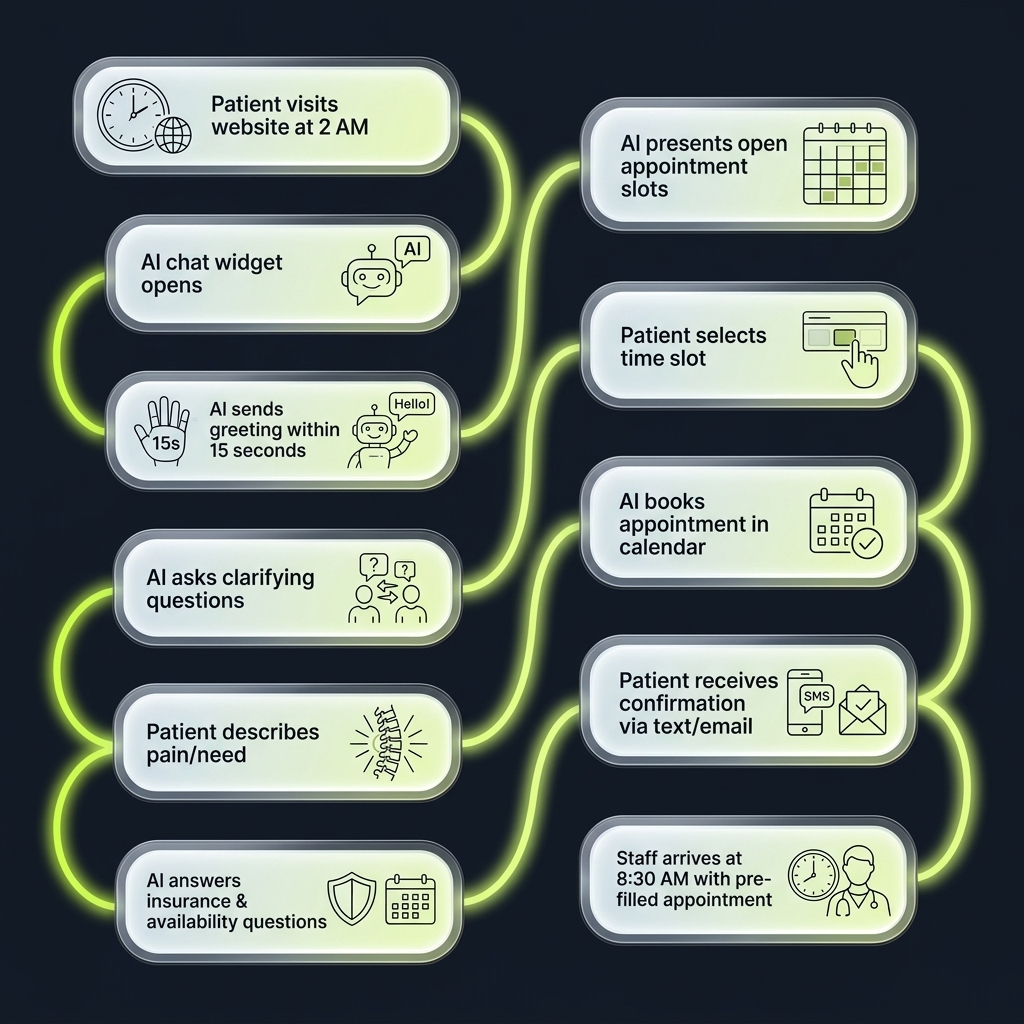
An AI front desk operates after hours by engaging website visitors through conversational chat in real time. When patients arrive at 2 AM, the system responds within seconds, asks clarifying questions about their needs, answers inquiries about insurance and availability, and books appointments directly into the practice calendar, ensuring leads don't go to competitors overnight.
What is an AI Front Desk, and How Does It Operate at 2 AM?
An AI front desk is an automated patient communication system that interacts with prospective patients in real time, answering practice questions and scheduling appointments during non-business hours.
The mechanism is simple. A prospective patient lands on your website at 1:30 AM. They click the chat widget or fill a contact form. Within 15 seconds, a conversational AI engine responds with a structured greeting and begins gathering information.
This is not a static auto-responder. Those systems send a confirmation email that says "We'll call you back tomorrow" and nothing else. The prospective patient closes the browser and keeps searching. By 9:00 AM when your staff arrives, that person has already booked with a competitor.
A real conversational AI conducts a two-way exchange. It asks clarifying questions. It answers common objections about location, insurance, and availability. It presents open time slots and locks them into your calendar immediately.
Here is the scenario: A prospective patient wakes at midnight with severe lower back tightness. They cannot sleep. They search "chiropractor near me open now" and land on your site. The chat widget opens automatically and says: "I see you're looking for help with back pain. I can get you scheduled for an evaluation as early as tomorrow morning. What area of your back is bothering you most?"
The patient types "lower back, left side." The system responds: "Got it. Have you seen a chiropractor before, or is this your first visit?" The conversation continues. Within three minutes, the patient has selected a 9:00 AM slot, entered their contact details, and received a calendar invitation via text and email.
Your front desk staff arrives at 8:30 AM. The appointment is already on the books. The intake form is pre-filled. The patient shows up on time because they committed while the pain was acute and the motivation was highest.
That is how an AI front desk operates at 2 AM. It converts intent into action before the window closes.
What Does an AI Front Desk Say to Patients Late at Night?
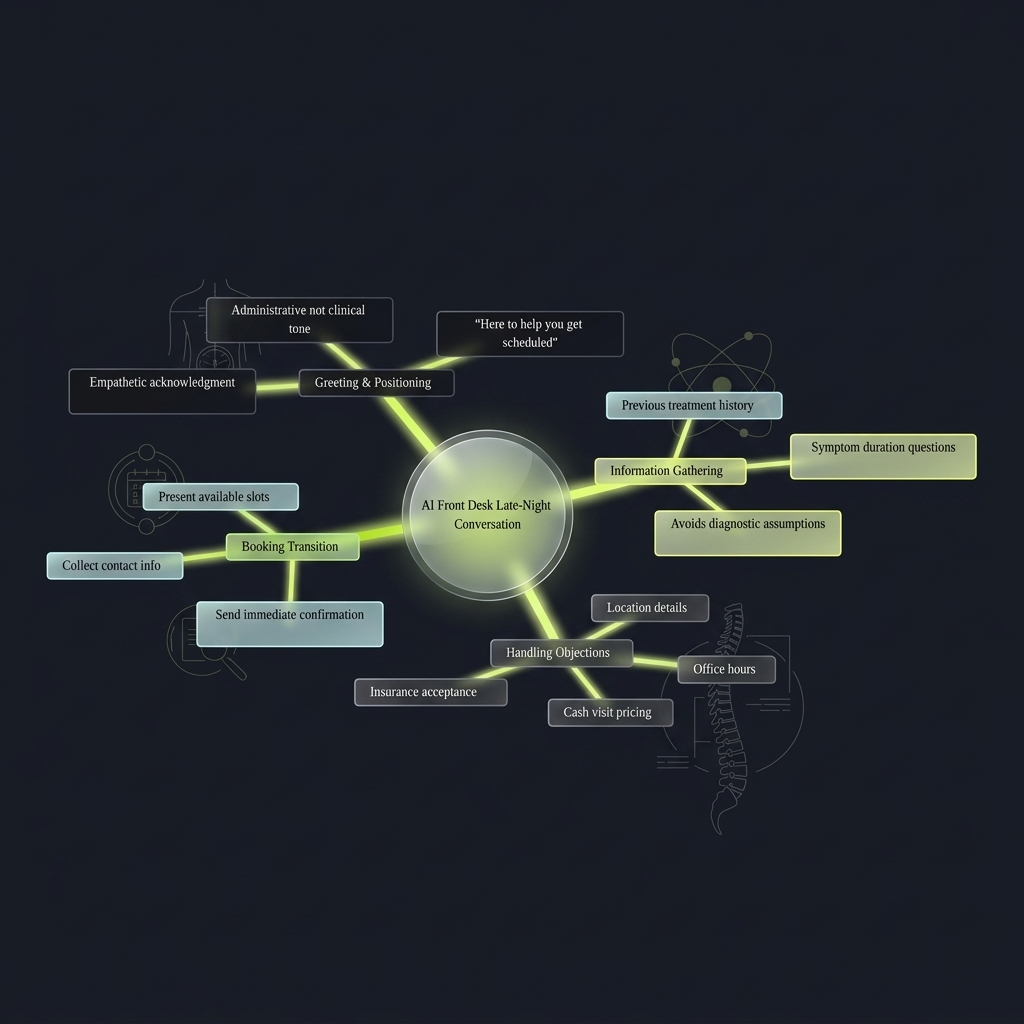
An AI front desk greets late-night patients empathetically, asks targeted questions about symptoms and treatment history, answers common queries about location, insurance, costs, and hours, then offers available appointment times. The system maintains a supportive, administrative tone, avoids clinical assumptions or promises, and guides patients from inquiry to confirmed booking within three to five minutes.
What Does an AI Front Desk Actually Say to a Prospective Patient in the Middle of the Night?
An AI front desk greets prospective patients empathetically, asks targeted questions about their condition, answers basic clinic policy queries, and offers direct links to book an available evaluation.
The communication flow follows a predictable structure. First, the system acknowledges the patient's situation without making clinical assumptions. "I'm here to help you get scheduled for an evaluation" is safe. "I can diagnose your problem right now" is not.
Second, it gathers information through triage questions. These focus on symptoms, duration, and previous care. "How long has this been bothering you?" and "Have you tried any treatment for this yet?" are both appropriate. The system never asks diagnostic questions like "Do you think you have a herniated disc?" because that crosses into clinical territory.
Third, it handles common objections instantly. Prospective patients at 2 AM are comparison shopping. They want to know: Where are you located? Do you take my insurance? How much does a visit cost without insurance? What are your hours?
A well-configured system answers all of these without delay. "We're located at 450 Main Street, about two miles from downtown. We accept Blue Cross, Aetna, and UnitedHealthcare. If you're paying cash, a first visit is $85. We're open Monday through Friday, 8 AM to 6 PM, and Saturday mornings from 9 to 1."
Fourth, it transitions to the booking action. "I have openings tomorrow at 9:00 AM, 11:30 AM, and 2:00 PM. Which works best for you?" The patient clicks a time. The system collects their name, phone, and email. It sends a confirmation immediately.
The entire exchange takes three to five minutes. The tone stays supportive and administrative. It never promises outcomes. It never uses clinical language the patient did not introduce first. It moves the conversation from "I'm in pain and searching" to "I have an appointment and I'm done searching."
That shift is the entire point. Prospective patients at 2 AM are in high-intent mode. They will book with whoever makes it easiest. Your system either captures that intent or watches it flow to a competitor.
How Does an AI Front Desk Safely Handle Severe Pain?
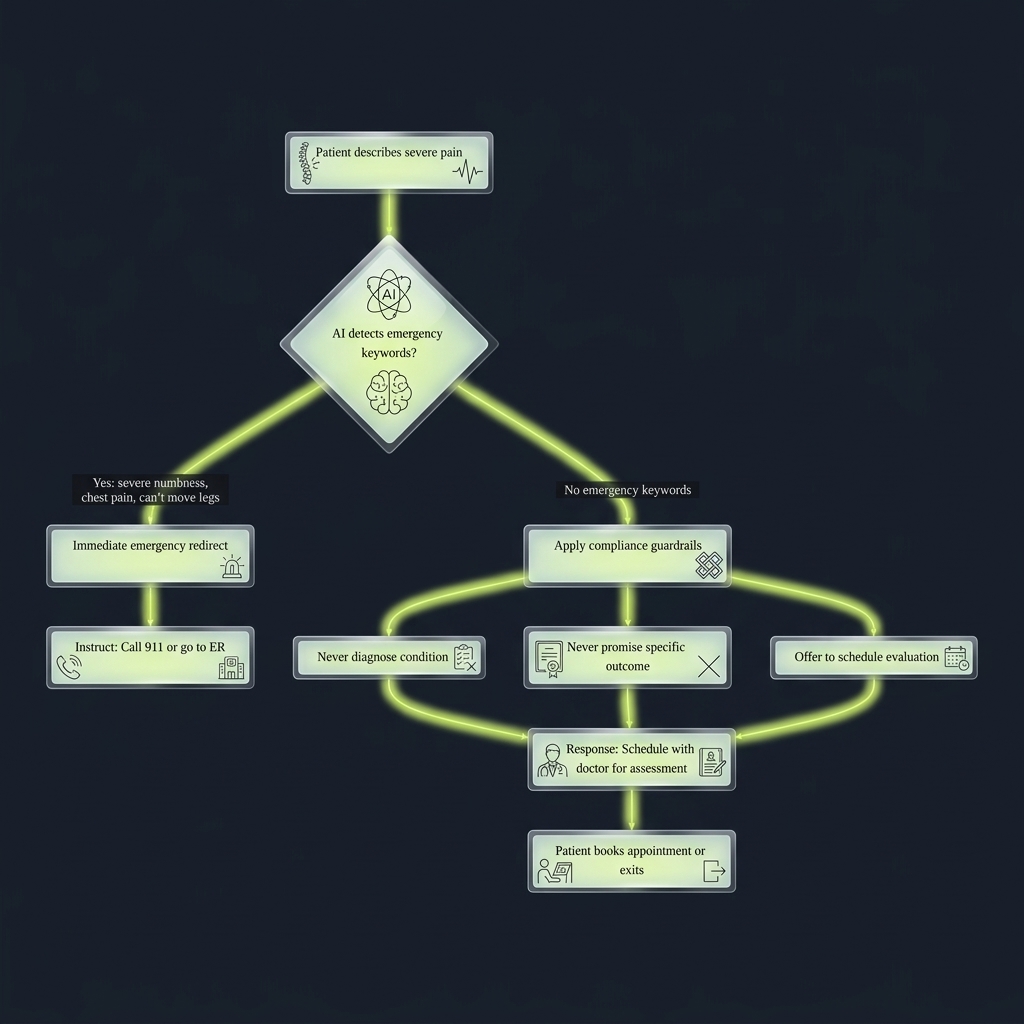
An AI front desk handles severe pain inquiries by deploying emergency redirection protocols that detect keywords like "severe numbness" or "can't move my legs" and immediately instructs patients to call 911 or visit an emergency room. The system never diagnoses conditions or promises outcomes, instead offering to schedule evaluations while maintaining strict compliance guardrails.
How Does an AI Front Desk Respond to Severe Pain Inquiries Without Making Illegal Medical Claims?
An AI front desk uses strict guardrails to offer supportive, administrative assistance while redirection protocols ensure the system never diagnoses conditions, promises guaranteed cures, or provides formal medical advice.
Healthcare advertising compliance is not optional. The Federal Trade Commission (FTC) regulates health-related advertising claims. State chiropractic boards have their own rules about what constitutes an impermissible guarantee or diagnosis. Violating these rules exposes your practice to fines, board complaints, and reputational damage.
In 2025, the average cost of a healthcare data breach reached $7.42 million. Civil monetary penalties under HIPAA can reach up to $73,011 per single violation in 2026, adjusted annually for inflation. These numbers make clear that compliance is not a soft suggestion.
A properly designed system operates within three boundaries. First, it never diagnoses. If a patient says "I think I have sciatica," the system does not confirm or deny. It responds with: "I can help you schedule an evaluation so the doctor can assess what's going on. Would you like to see available times?"
Second, it never promises specific outcomes. "We will fix your back pain in three visits" is a prohibited claim in most jurisdictions. The system instead says: "Dr. Smith will perform a full evaluation and discuss a care plan with you at your first visit."
Third, it includes emergency redirection protocols. If a patient types keywords like "severe numbness," "chest pain," "traumatic accident," or "can't move my legs," the system immediately responds: "What you're describing sounds serious. Please call 911 or go to the nearest emergency room right away. This is not something we can handle through a scheduled appointment."
These guardrails are not suggestions. They are hard-coded rules that the system cannot override. A conversational AI built for healthcare must be deterministic in its compliance logic. It cannot improvise. It cannot guess. It follows the script or it shuts down the conversation.
Generic tools like ChatGPT are non-deterministic. They generate responses based on probability, not rules. That makes them dangerous in a regulated environment. A single bad response, "Yes, that sounds like a herniated disc, you should come in", can trigger a board complaint or an FTC inquiry.
Your system must be built to say no. It must recognize the edge of its authority and stop there. That discipline is what separates a compliant tool from a liability.
How Does Automated Booking Turn Late Night Leads Into Appointments?
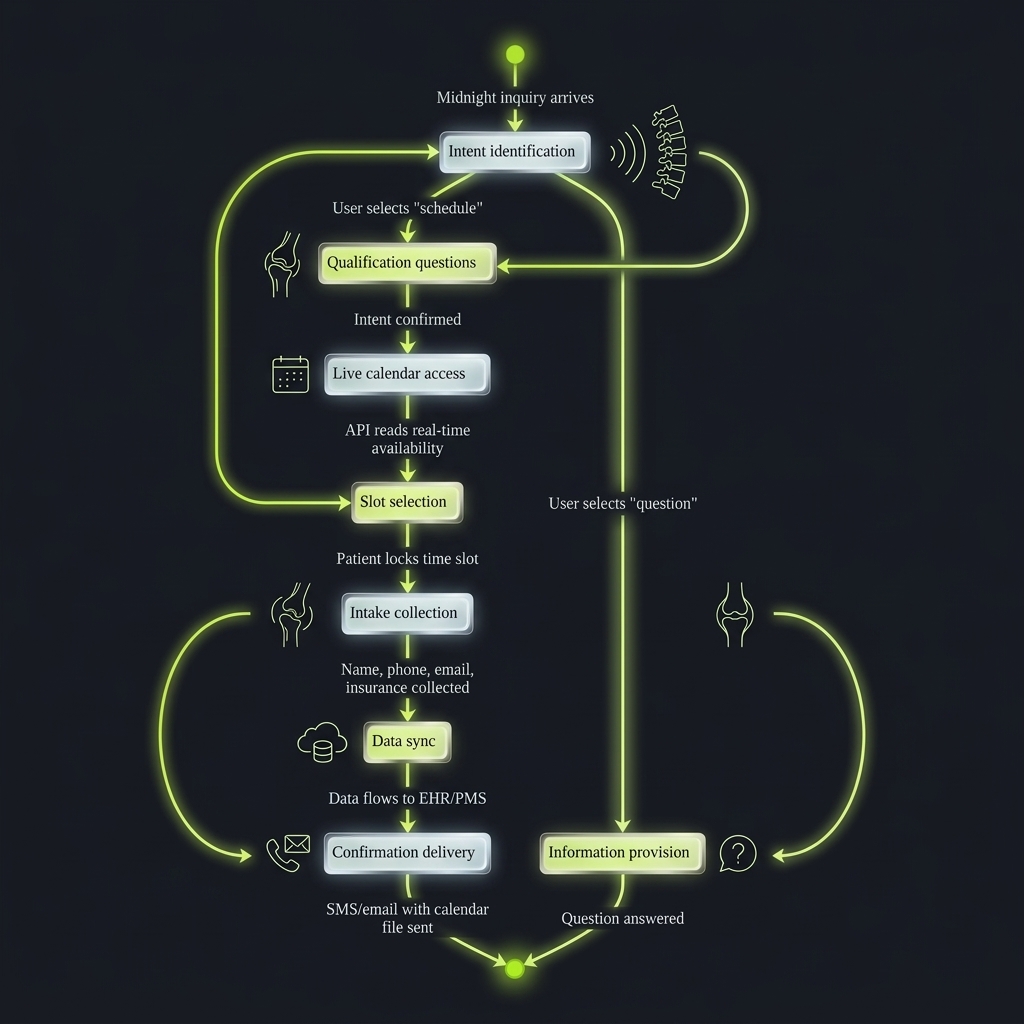
Automated booking systems convert late-night leads by immediately guiding prospects through qualification questions, displaying real-time calendar availability via API integration with practice management software, and allowing instant appointment locking. The system collects patient information, syncs data directly to EHR systems, and sends SMS and email confirmations with calendar files, maintaining conversion momentum while prospects are actively engaged.
How Does an Automated Front Desk Convert a Midnight Inquiry Into a Booked Schedule Slot?
The system converts inquiries by guiding prospective patients through real-time qualification questions and instantly presenting live calendar availability so they can lock in an appointment before closing the browser.
The conversion sequence has four steps. Step one is intent identification. The system asks: "Are you looking to schedule an appointment, or do you have a question about our services?" If the answer is "schedule," the system moves immediately to qualification.
Step two is real-time calendar access. The system reads your practice management software through a secure Application Programming Interface (API) connection. It knows which providers are working, which time slots are open, and which are already booked. It presents only genuinely available windows.
This eliminates the "We'll call you back to confirm" friction. The patient is not waiting. They are booking. The slot they select is locked immediately, just as if your front desk staff had written it into the schedule manually.
Step three is intake collection. The system asks for name, phone, email, and any insurance information you require. It can also collect the reason for visit and basic history if you configure it that way. All of this data flows directly into your Electronic Health Record (EHR) or practice management system.
Step four is confirmation delivery. The patient receives an SMS and an email with the appointment details, your clinic address, and instructions for their first visit. The confirmation includes a calendar file they can add to their phone. This reduces no-shows because the appointment is now in their personal calendar, not just yours.
The psychological mechanism here is momentum. Missed appointments cost the U.S. healthcare system an estimated $150 billion annually. Individual no-shows cost practices an average of $200 per missed slot. Patients who miss a single primary care visit are 70% more likely to not return within 18 months.
Booking at the moment of highest motivation, when the pain is acute, when the search is active, secures commitment. Asking the patient to wait until morning and call back introduces delay. Delay creates drop-off. Drop-off costs you $1,800 care plans.
The math is simple. Four after-hours inquiries per week, 52 weeks per year, equals 208 missed opportunities annually. At a $150 consultation rate and a 50% conversion to a $1,800 care plan, you're leaving $187,200 in care plan revenue on the table, plus another $31,200 in consultation fees—$218,400 total. An automated system that converts even half of those inquiries recovers $109,200 in revenue.
That is the economic argument for frictionless booking. Speed wins. Delay loses.
Should I Replace My Front Desk Staff With AI?
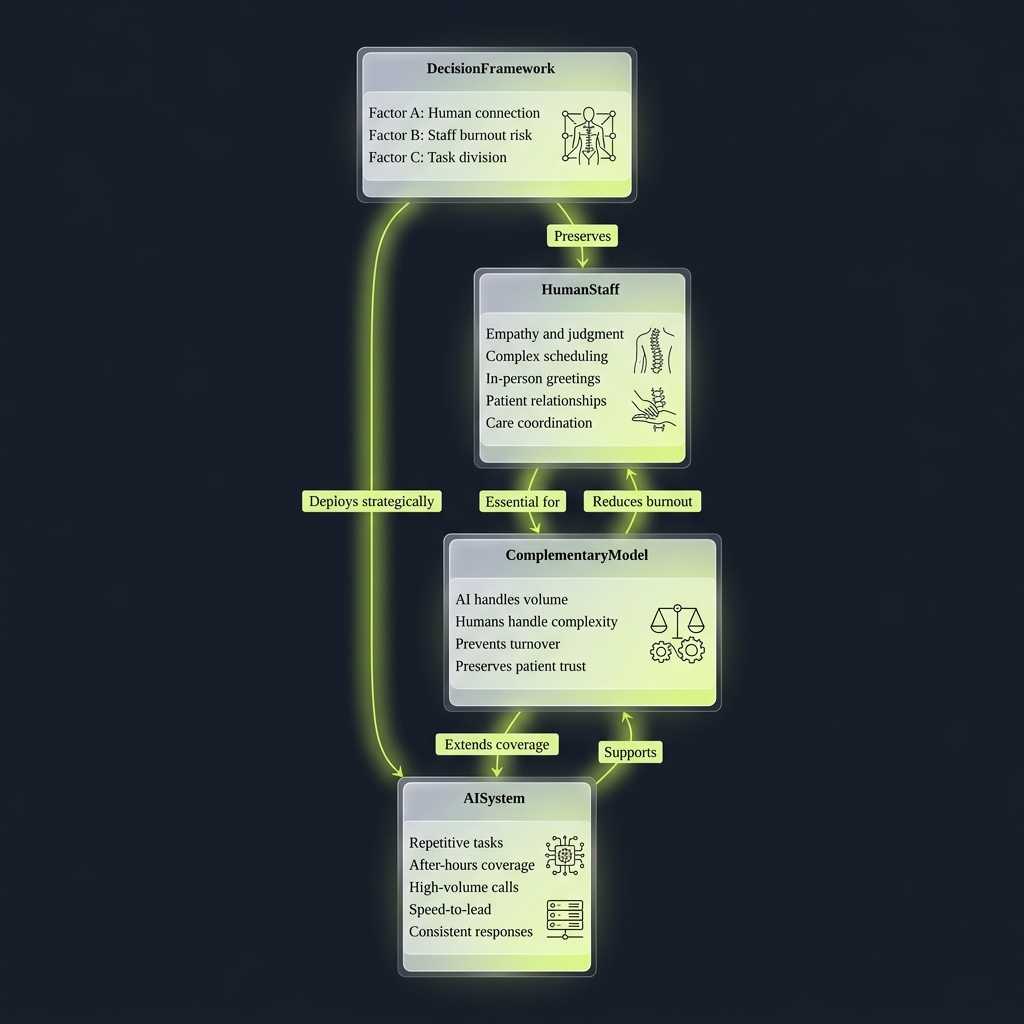
No, healthcare practices should not replace front desk staff with AI. Human staff excel at empathy, complex scheduling, patient relationships, and in-person care coordination that AI cannot replicate. Instead, AI should complement human teams by handling repetitive tasks, after-hours inquiries, and high-volume calls, preventing staff burnout while preserving essential human connection during clinic hours.
Should I Replace My Human Front Desk Staff With an AI Front Desk System?
No, practice owners should not replace staff. Decision factors include front-desk call volume, after-hours lead loss, staff burnout, and the need for high-touch, in-person patient care during regular hours.
Human staff handle tasks that require judgment, empathy, and relationship continuity. They greet patients warmly when they walk through the door. They manage complex scheduling changes. They handle upset patients who need more than a scripted response. They coordinate care between providers and insurance companies.
An AI system cannot do those things well. It can handle repetitive, high-volume tasks with perfect consistency. It can answer the same question 200 times without fatigue. It can operate at 2 AM when no human wants to be awake.
The decision framework has three factors. Factor A is human connection in the clinic. In-person check-ins, patient retention, and warm greetings require dedicated human staff. If you strip that layer out to save $40,000 a year in salary, you will lose far more than $40,000 in patient attrition and poor reviews.
Factor B is the exhaustion of after-hours coverage. Expecting human staff to manage calls or texts at 2 AM leads to rapid turnover. 33% of U.S. medical practices report an inability to fill front-desk and administrative roles. Replacing a single administrative staff member can cost up to 200% of their annual salary when factoring in recruiting, onboarding, and lost productivity.
Burning out your existing team by demanding round-the-clock availability is not a sustainable growth strategy. It is a retention crisis waiting to happen.
Factor C is task division. AI manages repetitive tasks, initial speed-to-lead, and late-night triage. Human staff handle complex care coordination and patient relationships. The two systems complement each other. They do not compete.
The trigger event for deployment is simple. If your practice regularly misses off-hours leads but you want to protect existing staff from after-hours work obligations, an automated system is the right move. If your front desk is already overwhelmed during business hours and you need to offload routine scheduling, an automated system is the right move.
If you are trying to eliminate human staff entirely to cut costs, you are solving the wrong problem. The value of automation is augmentation, not replacement.
Is ChatGPT Safe for Medical Practice Late-night Responses?
ChatGPT and generic AI tools pose significant safety risks for medical practice late-night responses due to non-deterministic outputs that can violate advertising regulations, diagnose without examination, and promise specific outcomes. These violations can trigger state board complaints and HIPAA penalties up to $73,011 per violation, while requiring substantial management overhead and lacking proper healthcare system integrations.

Should I Use Generic AI Tools Like ChatGPT to Build My Practice's Late-night Response Workflow?
Decision factors include regulatory compliance risks, technical maintenance bandwidth, prompt hallucination management, and integration stability with health practice management software.
Generic AI tools are powerful for general tasks. They are not purpose-built for healthcare. That difference matters in three ways.
First, regulatory and advertising compliance. Generic models are non-deterministic. They generate responses based on statistical patterns, not hard rules. That means they can easily produce a response like: "It sounds like you have a pinched nerve. You should definitely come in for an adjustment, and we can probably get you feeling better in just a few visits."
That response violates multiple advertising rules. It diagnoses without an examination. It promises a specific outcome. It uses clinical language that implies certainty. A single response like that, captured in a screenshot by a disgruntled prospective patient or a competitor, can trigger a state board complaint.
In 2026, HIPAA civil monetary penalties can reach up to $73,011 per single violation. The FTC has fined healthcare companies millions of dollars for deceptive advertising. You cannot afford to operate a system that might say the wrong thing.
Second, time and management overhead. Setting up a generic AI tool to handle patient inquiries requires building custom prompts, connecting third-party webhooks, configuring Zapier bridges, and testing edge cases manually. That consumes dozens of owner-hours every month.
Then the tool breaks. APIs change. Integrations fail. The calendar stops syncing. You spend a Tuesday afternoon troubleshooting why appointments are not appearing in your practice management system. That is not automation. That is a second job.
Third, software ecosystem integration. Generic tools lack native, robust integrations with specialized practice management systems. They do not read your calendar in real time. They do not write appointments with the correct metadata. They do not sync patient intake forms to your EHR without manual intervention.
The result is booking errors, duplicate records, and morning cleanup work for your staff. The system that was supposed to save time creates more work.
The decision trigger is clear. If you have the technical bandwidth to build, maintain, and monitor a custom AI workflow, and you are willing to accept the compliance risk of a non-deterministic system, a generic tool might work. If you are a busy practice owner who wants consistent, safe growth without adding a technical management job to your plate, you need a specialized, managed architecture.
The difference is not capability. It is reliability and safety. Generic tools can do impressive things. They just cannot guarantee they will do the right thing every single time.
How Does AI Compare to Traditional Answering Services?
AI front desks respond in under 15 seconds versus 4.4-minute average wait times for traditional services, book appointments directly instead of taking messages, maintain consistent brand voice rather than generic scripts, and operate at fixed costs compared to $1.25-$2.25 per-minute charges. Traditional services experience 40-60% patient drop-off rates due to delayed callbacks.
How Does an AI Front Desk Compare to Traditional After-hours Answering Services?
AI front desks deliver instant, real-time booking and precise practice messaging at a fixed cost, whereas traditional answering services rely on expensive per-minute human operators who rarely book directly.
The comparison breaks down across four dimensions. First, speed to lead. The average wait time in U.S. healthcare call centers is 4.4 minutes. That exceeds the Healthcare Financial Management Association's target benchmark of 50 seconds. An AI system responds in 15 seconds or less.
A prospective patient in pain at 2 AM is not patient. They will not wait on hold. They will hang up and call the next clinic. Speed is not a luxury. It is the baseline requirement for conversion.
Second, capability. Traditional answering services take messages. They write down the patient's name, phone number, and reason for calling. They promise someone will call back in the morning. That is not booking. That is delayed follow-up, and delayed follow-up has a 40% to 60% drop-off rate by the time your staff makes the return call.
An AI system books directly. It presents available time slots, locks the appointment into your calendar, and sends confirmation immediately. The patient is committed before they hang up.
Third, brand voice consistency. Answering services use third-party operators who read from generic scripts. They do not know your practice values, your tone, or your specific policies. They say "Doctor's office, how can I help you?" in a flat, transactional voice.
An AI system delivers strictly structured messaging aligned with your practice. It uses your language, your policies, and your tone. Every interaction sounds like it came from your front desk, because it is configured to represent your brand exactly.
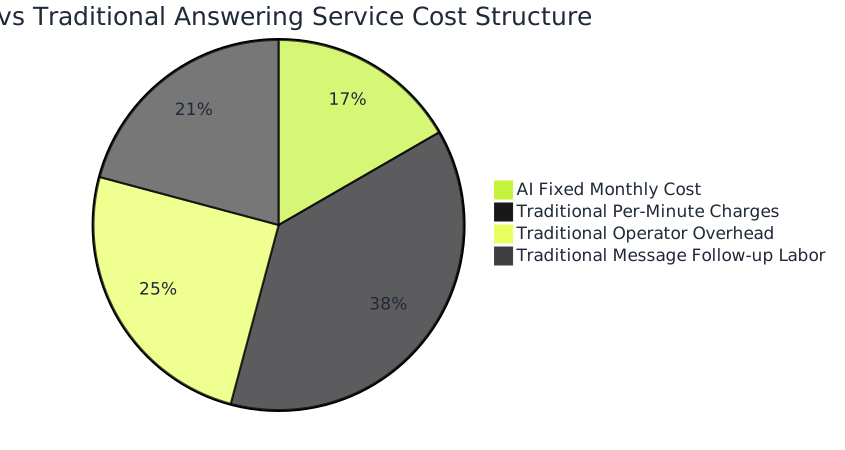
Fourth, cost predictability. Traditional pay-per-minute medical answering services cost between $1.25 and $2.25 per minute of receptionist time in 2026. For a growing clinic, 24/7 multi-provider coverage can push costs to $1,000 to $3,000 or more per month depending on call volume.
An AI system operates on a fixed software subscription model. You pay the same amount whether you get 10 inquiries or 100. That makes budgeting predictable and eliminates the anxiety of watching your answering service bill spike during busy months.
The math favors automation. A traditional service at $1,500 per month costs $18,000 per year and books maybe 30% of after-hours inquiries. An AI system at $400 per month costs $4,800 per year and books 60% to 70% of inquiries. You save $13,200 annually and capture more revenue.
Traditional services made sense in 2005. They do not make sense in 2026.
What Mistakes Should Practices Avoid With After-hours Automation?
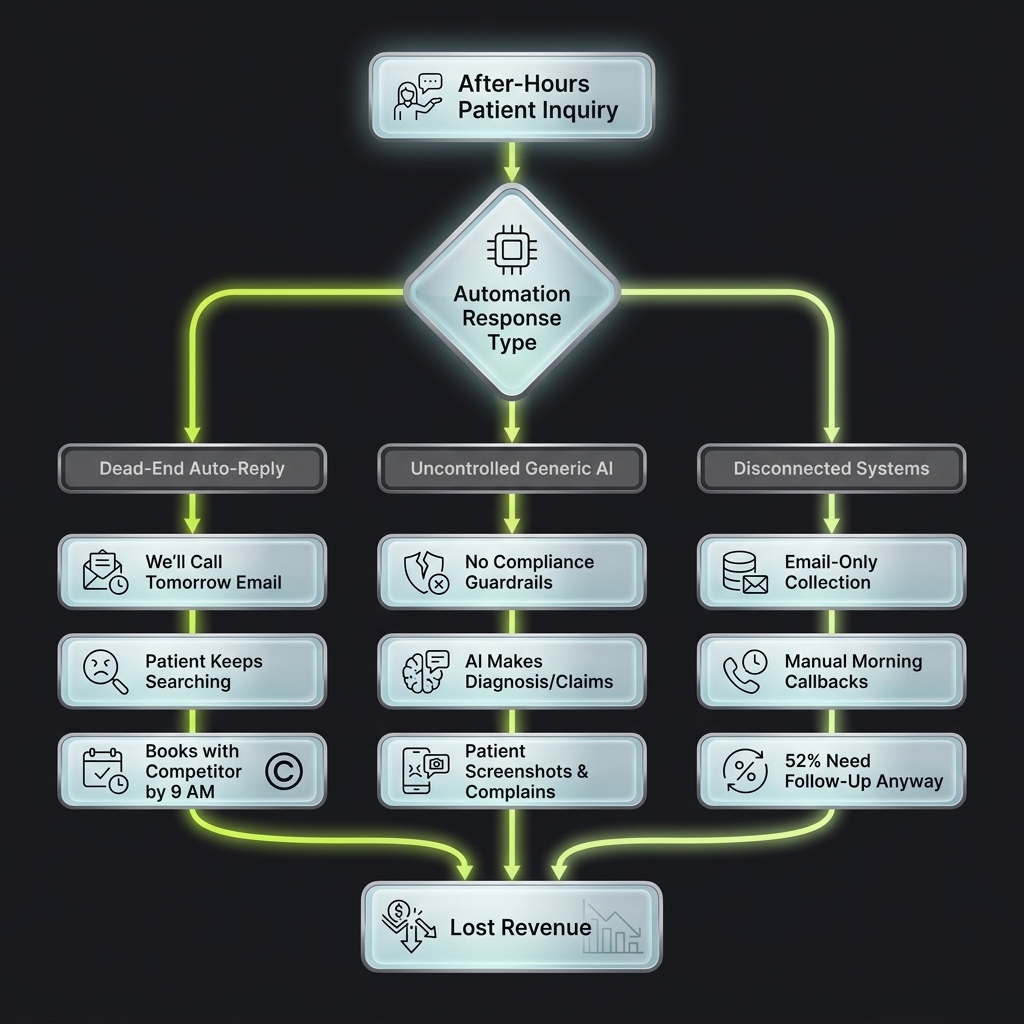
Practices should avoid sending dead-end auto-responses that delay scheduling, using unvetted generic AI prompts without compliance guardrails that risk making diagnoses or claims, and operating disconnected systems where inquiries aren't linked to live calendar inventory. These mistakes cause prospective patients to book with competitors who offer immediate scheduling and create regulatory vulnerabilities through uncontrolled automated communications.
What Are the Biggest Mistakes Practice Owners Make With After-hours Automation?
The biggest mistakes include sending dead-end email auto-responses, failing to link live calendar inventory, using unvetted generic prompts, and failing to notify internal teams of morning follow-up tasks.
Pitfall one is the "We Will Call You Tomorrow" trap. A prospective patient submits a contact form at 11 PM. They receive an auto-reply email that says: "Thank you for contacting us. Someone will reach out to you during business hours." That patient keeps searching. By 9 AM, they have already booked with a competitor who offered immediate scheduling.
Only 52% of patient inquiries to healthcare call centers are resolved on the first call. That means nearly half of all patient contacts require a callback or further manual follow-up from staff the next morning. Every callback is a chance for the patient to say "I already found someone else."
Telling a late-night lead in pain to wait 10 hours guarantees they keep searching. You have not solved their problem. You have asked them to wait while their motivation decays.
Pitfall two is uncontrolled generic prompts. A practice owner sets up a ChatGPT integration and writes a loose prompt like: "You are a friendly receptionist for a chiropractic clinic. Answer patient questions and help them schedule appointments." That prompt has no guardrails. The model might say: "Based on your symptoms, it sounds like you have a lumbar strain. We can definitely help with that."
That is a diagnosis. That is a claim. That is a compliance violation. The practice owner does not discover the problem until a patient screenshots the conversation and files a complaint.
Pitfall three is disconnected systems. A practice installs a chat widget on their website. The widget collects inquiries and sends them to the owner's email. The owner manually checks email each morning and calls patients back. Meanwhile, the practice calendar sits in a separate system with no connection to the chat widget.
The result is double-booking errors, missed appointments, and manual data entry. The system that was supposed to save time creates more work.
Pitfall four is over-automation. A practice routes every single inquiry through the AI system, including complex cases that need human judgment. A patient calls with a billing dispute. The AI tries to handle it with a scripted response. The patient gets frustrated and leaves a one-star review.
Automation works for repetitive, high-volume tasks. It fails for edge cases that require empathy, negotiation, or judgment. The mistake is treating automation as a universal solution instead of a tool for specific use cases.
The fix for all four pitfalls is the same: design the system with clear boundaries, integrate it with your calendar, and route edge cases back to human staff. Automation is not set-it-and-forget-it. It is a managed system that requires initial configuration and periodic review.
How Does AI Integration Prevent Appointment Double-booking?
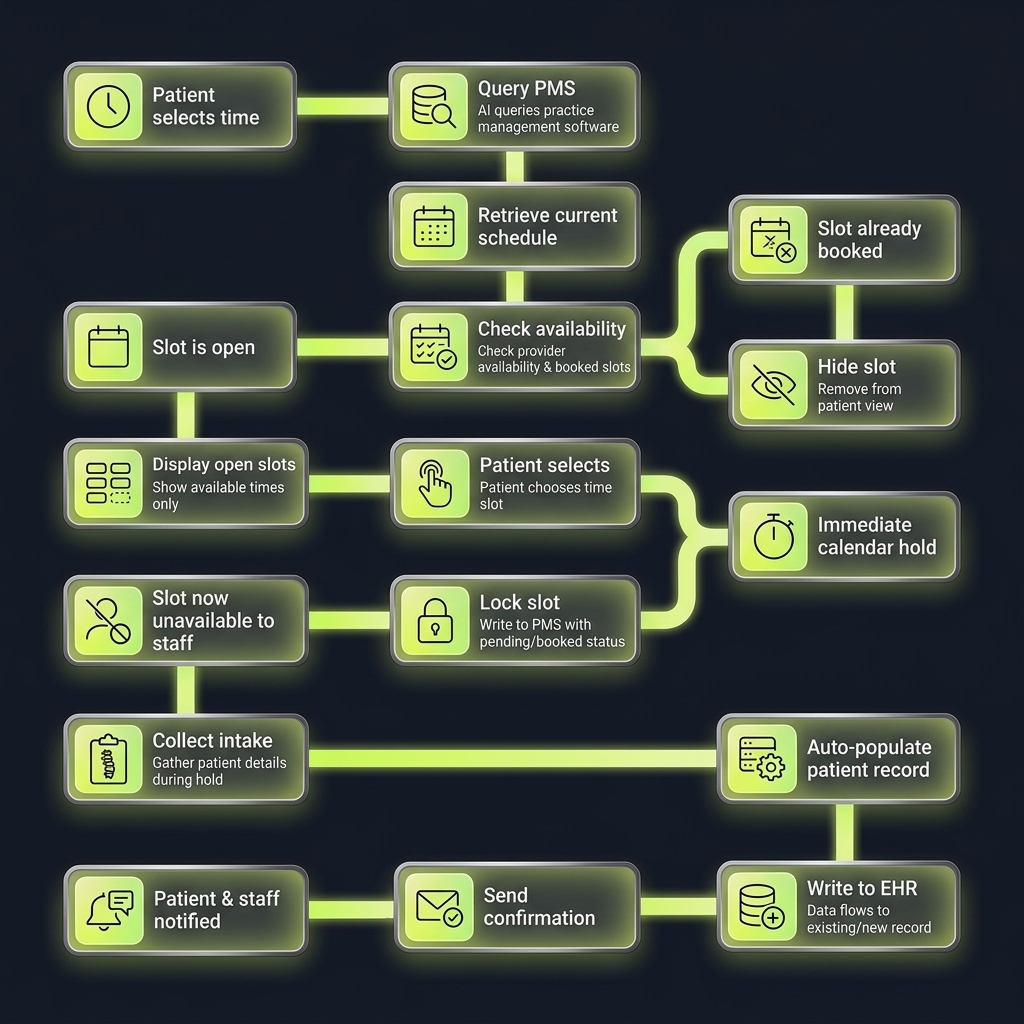
AI integration prevents double-booking by querying practice management software in real-time to retrieve current availability, displaying only genuinely open slots to patients. When a patient selects a time, the system immediately locks that slot by writing it into the calendar with pending or booked status, making it unavailable to staff or other patients simultaneously.
How Does an AI Front Desk Integrate With Existing Practice Management Software to Prevent Double-booking?
An AI front desk reads real-time schedule availability through secure practice management integrations, locking selected time slots instantly to ensure internal staff and online patients never overlap.
The technical mechanism operates through a read-write API connection. Step one: the system queries your practice management software to retrieve current schedule availability. It asks: "Which providers are working today? Which time slots are open? Which are already booked?"
Step two: the system presents only genuinely available windows to the prospective patient. If Dr. Smith's 9 AM slot is already booked, the system does not show it as an option. If the 11 AM slot is open, it appears in the list.
Step three: when the patient selects a time, the system immediately executes a calendar hold. It writes the appointment into your practice management system with a "pending" or "booked" status, depending on your configuration. That slot is now locked. Your front desk staff cannot book another patient into the same window.
Step four: the system collects intake information while the hold is active. Name, phone, email, insurance details, reason for visit. All of this data flows directly into your EHR as a new patient record or appends to an existing record if the patient has been to your clinic before.
Step five: the system sends confirmation to the patient and a notification to your staff. Your team arrives in the morning and sees the appointment already on the books, fully populated with intake details.
The integration eliminates the manual transcription step. Your staff is not copying information from a message pad into the computer. The data flows automatically from the chat conversation into the patient record.
This is not theoretical. Approximately 60% of patient appointment booking attempts occur outside of standard business hours. Without real-time integration, those inquiries turn into morning cleanup work. With real-time integration, they turn into booked appointments that require no additional staff time.
The difference is operational efficiency. A system that creates work for your staff is not automation. A system that eliminates work is.
How Fast Can a Chiropractor Setup AI Front Desk Software?
Chiropractors can deploy AI front desk software within three to seven days using managed implementations. The process includes knowledge base alignment, system connections, automated testing, and live activation. Pre-built clinic frameworks and integrations with major practice management platforms eliminate custom development work, enabling practices to capture leads around the clock in under a week.

How Quickly Can a Chiropractic Practice Deploy an AI Front Desk System to Capture Missing Leads?
Managed implementations deploy within days because pre-built clinic frameworks and standard communication guardrails eliminate the need for practice owners to build custom workflows or software connections from scratch.
The implementation has four phases. Phase one is knowledge base alignment. The system needs to know your practice rules, location details, hours, insurance parameters, and tone preferences. A managed provider collects this information through a structured intake form and configures the system accordingly.
This phase takes one to two days. You are not writing code. You are answering questions about how your practice operates.
Phase two is system connections. The provider wires your practice management software, calendar streams, lead channels, and notification routing. This is the technical work that would take weeks if you were building it yourself. A managed provider has pre-built integrations with the major practice management platforms, so the connection happens in hours, not weeks.
Phase three is automated testing and verification. The provider simulates off-hours inquiries to confirm messaging safety and schedule writing. They test edge cases: What happens if a patient asks for a diagnosis? What happens if someone types emergency keywords? What happens if the calendar is fully booked?
The system must handle all of these scenarios correctly before it goes live. Testing takes one to two days.
Phase four is live activation. The provider turns on 24/7 capture across search, social, and web channels. Your practice is now responding to inquiries instantly, around the clock.
Total elapsed time from contract signature to live operation: three to seven days, depending on the complexity of your practice management system and the number of providers you want to include.
Compare that to a DIY build. If you are configuring ChatGPT, setting up Zapier workflows, and building custom API connections yourself, you are looking at 40 to 60 hours of work. That is a full work week. Most practice owners do not have a full work week to spend on technical projects.
The value of a managed system is not just the software. It is the elimination of the build-and-maintain burden. You get the result without the work.
What is a Quick Summary of AI Front Desks?
AI front desks are automated conversational systems that handle patient inquiries 24/7, providing empathetic greetings, answering practice questions, and enabling direct appointment booking outside business hours. They use strict guardrails to avoid medical claims, integrate with practice management software to prevent scheduling conflicts, and augment human staff by managing off-hours lead capture while preserving in-person care quality.

Quick-Reference Summary
| Question | Short Answer | Where to Learn More |
|---|---|---|
| What does an AI front desk say at 2 AM? | It greets prospective patients empathetically, answers basic practice queries, and provides direct booking links for available appointments. | Section: What does an AI front desk actually say to a prospective patient in the middle of the night? |
| Can AI safely talk to patients without making clinical claims? | Yes, strict boundary guardrails prevent medical diagnosis while triaging emergency keywords safely to formal health services. | Section: How does an AI front desk respond to severe pain inquiries without making illegal medical claims? |
| Should I replace human staff with an AI assistant? | No, AI should augment staff by handling off-hours speed-to-lead, leaving high-touch in-person care to human office teams. | Section: Should I replace my human front desk staff with an AI front desk system? |
| Why not use basic ChatGPT for late-night inquiries? | Generic AI risks non-deterministic messaging, health ad non-compliance, and requires heavy manual setup and maintenance drag. | Section: Should I use generic AI tools like ChatGPT to build my practice's late-night response workflow? |
| How does an AI front desk avoid scheduling errors? | Direct integration reads live practice inventory and locks selected time slots instantly across connected calendar systems. | Section: How does an AI front desk integrate with existing practice management software to prevent double-booking? |
Conclusion
Unattended 2 AM inquiries represent a quantifiable source of lost revenue for growing practices. Four missed calls per week, at $150 per consultation and a 50% conversion to an $1,800 care plan, equals $218,400 in annual opportunity cost when you include both consultation fees and care plan revenue.
Operating an automated, compliant response system guarantees immediate prospective patient capture while human teams rest. The system books appointments, collects intake data, and delivers confirmations without staff intervention.
Still have questions about capturing late-night inquiries without taking on a second job managing tech? Platforms that operate this whole loop end-to-end, consistent content presence, fast response, review momentum, steady patient communication, exist for busy local practice owners; Omniply delivers fully aligned patient communication, content publishing, and AI response engines designed specifically for that operational reality.
I have spent 16 years running marketing for health professionals and local practices. The system inside Omniply is the playbook elite practice coaches teach their clients to execute by hand: the one that works every time it is actually executed, and fails every time life gets in the way of executing it. So I learned to code and built the version that cannot get tired, cannot get busy, and cannot skip a week.
Silence at 2:00 AM is a policy choice. Choose differently.