
At 7:15 PM on Tuesday, a new patient called your office with acute lower back pain. Your front desk was closed. The call went to voicemail. By 7:18 PM, that patient booked an intake with the clinic down the street.
That single missed call cost your practice $1,200 in revenue. It happens four to six times every week in a busy two-location practice. You cannot keep your staff on the clock twenty-four hours a day.
This week, an AI front desk plugged that exact leak for a multi-location clinic. It answered on the second ring, screened the issue, verified schedule availability, and booked the appointment directly into the electronic health record.
No voicemail left behind. No phone tag on Wednesday morning.
This breakdown details the exact technical mechanics behind that booking. You will see the conversation logic, the software setup, and the guardrails that protect your schedule.
Here is how the machine took the call.
Key Takeaways
- Revenue Leakage Scale: Chiropractic practices miss 25% to 40% of inbound calls during after-hours and peak periods, costing a two-location practice up to $312,000 annually in lost new-patient revenue at $1,200 average lifetime value per patient.
- After-Hours Conversion Window: 43% of all patient appointments are scheduled outside standard business hours, yet most practices rely on voicemail systems that delay response until the next morning when prospects have already booked with faster competitors.
- Speed-to-Lead Dominance: AI front desk systems achieve 47-second median response times and are 11 times more likely to qualify a lead than practices waiting over five minutes, with 78% of buyers choosing the first responder in local healthcare markets.
- Generic AI Compliance Risk: Consumer-grade large language models like ChatGPT lack built-in HIPAA compliance, produce non-deterministic outputs that may invent practice policies, and require ongoing prompt engineering that costs practice owners $2,000+ monthly in opportunity cost.
- Operational Workflow Transformation: Automated patient intake systems eliminate morning voicemail backlogs, shift front desk focus from reactive phone triage to proactive in-person service, and deliver pre-registered patients with completed intake forms before their first visit.
Where Are Chiropractic Practices Losing Revenue?
Chiropractic practices lose revenue primarily through after-hours communication gaps and delayed response times. Missed calls accumulate overnight, web form inquiries sit unattended for hours, and prospects book with faster-responding competitors before morning callbacks occur. With over 100 daily phone interactions competing for limited front desk capacity during peak hours, high-intent patients slip through operational bottlenecks.
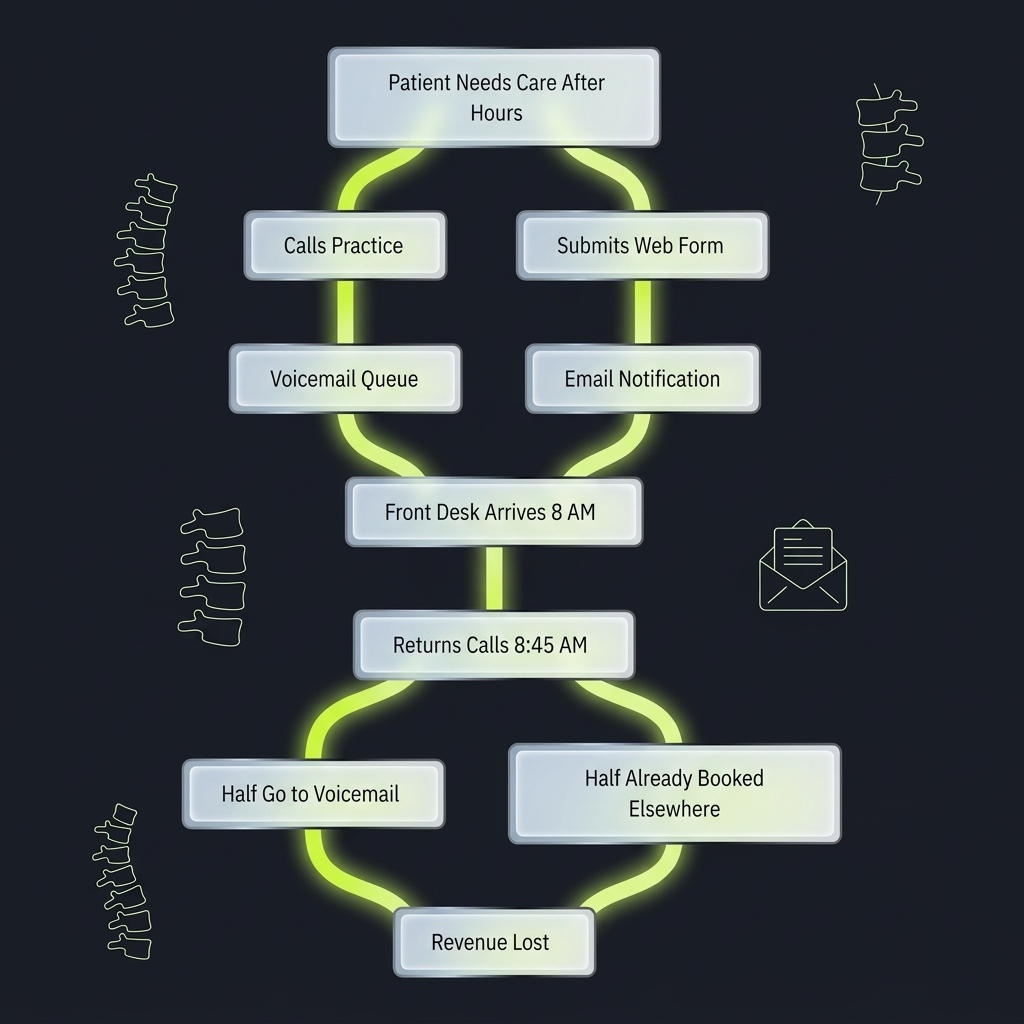
The Situation: Where the Revenue Leak Happens
Picture a three-room practice running two locations. Six adjusting tables total. Peak volume hits between 3 PM and 6 PM when workers leave their desks and finally address the neck tension they ignored all day.
Your front desk runs two people. One manages check-ins and insurance verification at the physical counter. The other fields phone calls, reschedules cancellations, and handles the payment terminal when the line backs up.
According to Medical Group Management Association benchmarks, primary care practices receive an average of 53 inbound calls per physician per day. Scale that across two chiropractors and you are looking at over 100 daily phone interactions competing for the same two sets of hands that are also running your lobby.
The objective is straightforward: capture high-intent local prospects searching for care outside your operating hours. Get them onto your calendar before they contact the clinic with evening availability or the practice that answers texts immediately.
You have tried the standard solutions.
Standard voicemail leaves after-hours callers in a queue until tomorrow morning. Your front desk arrives at 8 AM to seventeen missed calls. They start returning them at 8:45 after handling the early check-ins. Half go to voicemail themselves. The other half have already booked elsewhere.
Web contact forms trigger an email notification that sits in an inbox until someone has bandwidth to review it. That typically happens mid-morning. The form came in at 9 PM the night before. The prospect has been shopping for eleven hours.
Third-party call centers provide live humans, but those humans do not know your practice. They cannot see your calendar in real time. They take messages and promise a callback, which circles back to the same morning phone-tag problem. The monthly cost runs $400 to $900 depending on volume, and you still lose the speed advantage.
Here is the math on what that costs you. Assume your average new-patient lifetime value is $1,200 across initial intake, treatment plan, and maintenance visits. If you receive twenty new-patient inquiries per week and miss five of them, you are leaving $6,000 on the table every week. That is $312,000 annually.
The constraint is not marketing budget. The constraint is operational capacity at the exact moment intent peaks.
Your staff cannot work nights and weekends. The phone rings anyway.
Why Do Medical Practices Lose Prospective Patients After Hours?
Medical practices lose prospective patients after hours because 43% of appointment scheduling occurs outside business hours when offices are closed. Patients searching for care at night or on weekends encounter voicemail instead of instant booking options, creating friction that drives them to competitors offering immediate digital scheduling capabilities that match modern consumer expectations.
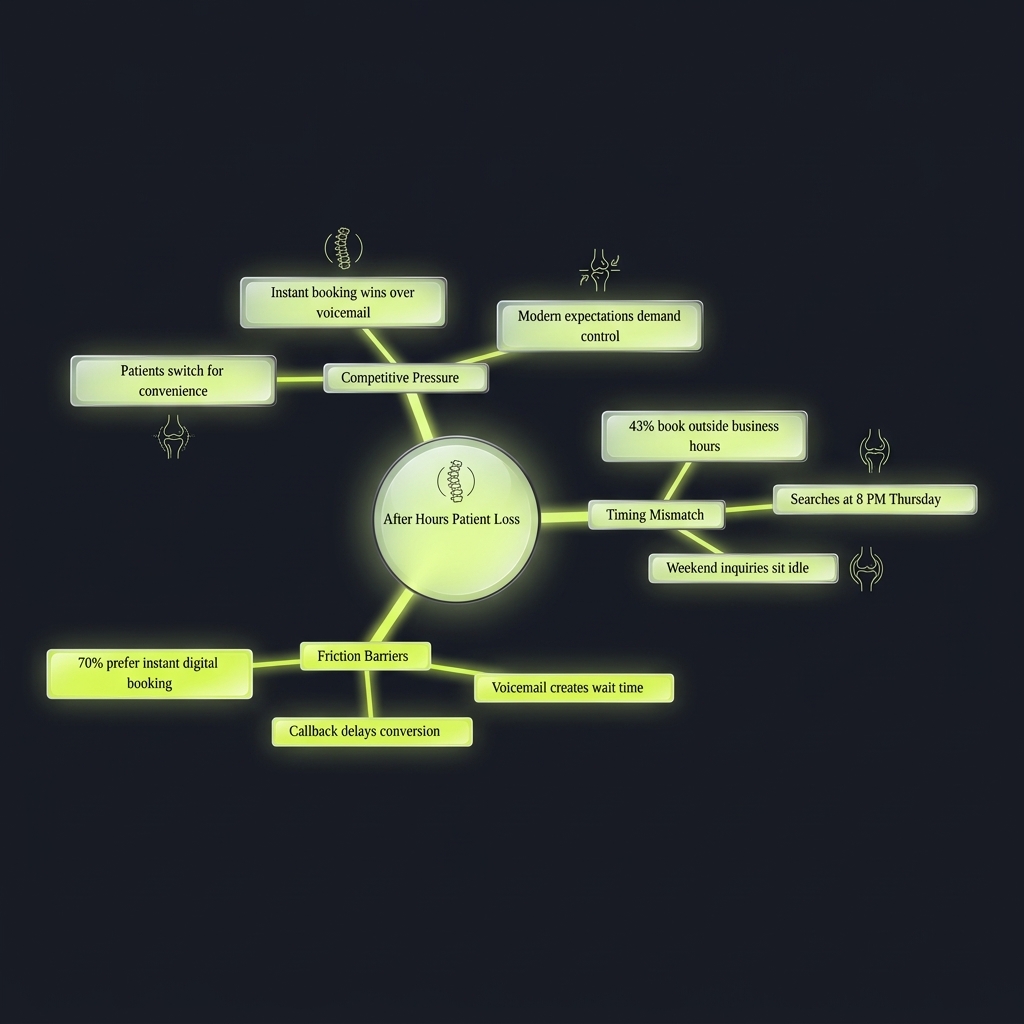
The Diagnosis: Why the Breakdown Happens When It Does
The failure point is not traffic. Your website gets visitors. Your Google Business Profile shows up in local pack results. The ads are running.
The breakdown happens in the gap between inquiry and intake. That gap widens dramatically outside business hours.
Here is what the data shows: according to medical booking marketplace data aggregated from platforms like Zocdoc, 43% of all patient appointments are scheduled outside of standard operating hours. Nearly half of all appointment decisions happen when your office is dark.
People search for chiropractic care when they are home from work, sitting on the couch, feeling the day's tension settle into their lower back. They search at 8 PM on Thursday. They search at 11 AM on Saturday. They search during lunch breaks when they cannot call because they are in an open office.
The inquiry arrives. Your system logs it. Nothing happens until Monday morning.
The second diagnostic insight: friction kills conversion. Requiring a prospect to wait for a callback creates an unnecessary barrier that modern service expectations will not tolerate.
Multiple healthcare consumer trend reports from recent years consistently find that roughly 70% of patients prefer and are more likely to select providers offering digital scheduling options. The expectation has shifted. Patients want control over their schedule on their timeline.
Patient access journey surveys show that convenience, specifically time, location, and availability, is cited by over 60% of patients as the primary barrier to care. Nearly half of modern healthcare consumers report a willingness to switch practices entirely for digital convenience.
Your voicemail is not competing against other voicemails. It is competing against practices that let patients book instantly from their phones.
The third insight addresses the risk of improvised solutions. Some practices attempt to solve this by deploying generic artificial intelligence tools or building custom prompts in consumer chatbot platforms.
Those tools carry three structural problems.
First, they are non-deterministic. A large language model will generate different responses to the same question depending on context, phrasing, and probabilistic token selection. It might invent a clinic policy. It might state your hours incorrectly. It might promise a service you do not offer.
Second, they require ongoing human oversight. Someone on your team has to write the prompts, test the outputs, refine the logic, and monitor conversations for compliance drift. That someone is you, and you are already working fifty-hour weeks adjusting patients.
Third, general-purpose large language models are not inherently HIPAA-compliant out-of-the-box, nor are they natively programmed to adhere to FTC advertising guidelines for healthcare. They require specific configurations and guardrails. They will confidently write claims your practice is not allowed to make. They will offer diagnostic language. They will create liability.
The problem is not technology availability. The problem is healthcare automation that operates safely without consuming your time.
How Does the New System Actually Work?
The system operates through four integrated layers: it initiates conversational engagement within seconds across text, web chat, and voicemail; accesses a verified knowledge base containing practice details and regulatory guardrails; synchronizes directly with scheduling software to display real-time availability; and allows prospects to book appointments that write automatically into the EHR system without manual intervention.
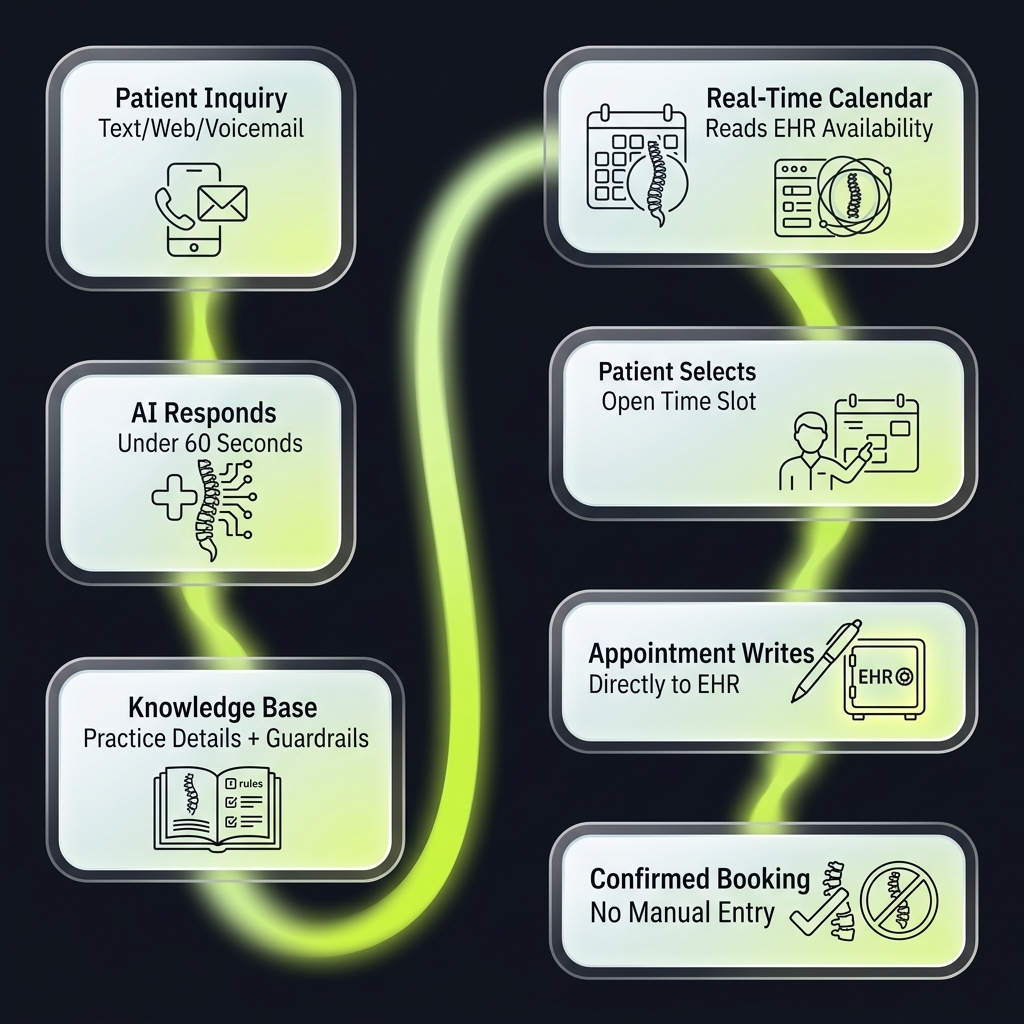
The Approach: What Got Deployed
The solution deployed this week operates in four connected layers.
Step One: Immediate Conversational Engagement
The system initiates contact within seconds of an inquiry, regardless of time or day. A prospect texts the office number at 10 PM. The AI responds in under a minute.
Sales and lead response research, including widely cited studies from Harvard Business Review, confirms that the odds of qualifying a lead drop by roughly 80% if the response time stretches beyond the first five minutes. Speed is not a convenience feature. It is the primary conversion lever.
The engagement layer works across text, web chat, and voicemail transcription. All channels funnel into the same conversational interface. The prospect experiences a single continuous interaction, not a fragmented multi-platform scavenger hunt.
Step Two: Practice-Tuned Knowledge Integration
The AI operates from a verified knowledge base containing your actual practice details. Accepted insurance carriers. Office locations and parking instructions. Initial visit expectations. Common treatment categories like sports injury rehabilitation, postural correction, and wellness maintenance.
The knowledge base also contains explicit regulatory guardrails. The system will not offer medical diagnoses. It will not make claims about treatment outcomes. It will not promise pain relief or functional restoration. It will not use promotional language that violates health advertising standards.
These are hard rules, not probabilistic guidelines. The AI cannot improvise outside its defined operational boundaries.
Step Three: Direct Calendar Synchronization
The system connects directly to your scheduling software. It reads real-time availability. It shows the prospect open slots. The prospect selects a time. The appointment writes directly into your EHR without human intermediation.
No double-booking. No manual calendar updates. No morning reconciliation between the AI log and your actual schedule.
This is the step that converts inquiry into committed appointment. The prospect moves from "I am thinking about calling a chiropractor" to "I have an appointment Thursday at 2 PM" in a single three-minute interaction.
Step Four: Automated Patient Intake Confirmation and Pre-Arrival Preparation
The moment the appointment confirms, the system sends a confirmation message with office directions, parking details, and a link to complete intake paperwork digitally before arrival.
This step serves two functions. First, it locks in commitment. The prospect receives immediate confirmation, which reduces the psychological window for second-guessing or schedule conflicts. Second, it prepares the patient for a smooth first visit, reducing front-desk administrative load on the day of service.
The strategic rationale for this architecture: it operates continuously without staff fatigue, it standardizes practice communication across all inquiry channels, and it delivers an immediate answer at the precise moment of highest prospect intent.
The alternative is asking your front desk to chase leads manually. That approach works until someone calls in sick, until you get busy, until life intervenes.
Systems beat effort every time.
How Does AI Instant Response Change Daily Business Operations?
AI instant response transforms daily operations by reducing response times from hours to under one minute, capturing after-hours inquiries that previously went cold, and shifting staff focus from reactive phone triage to proactive patient service. Teams start mornings with pre-booked appointments instead of voicemail backlogs, while new patients arrive better prepared with completed intake forms.
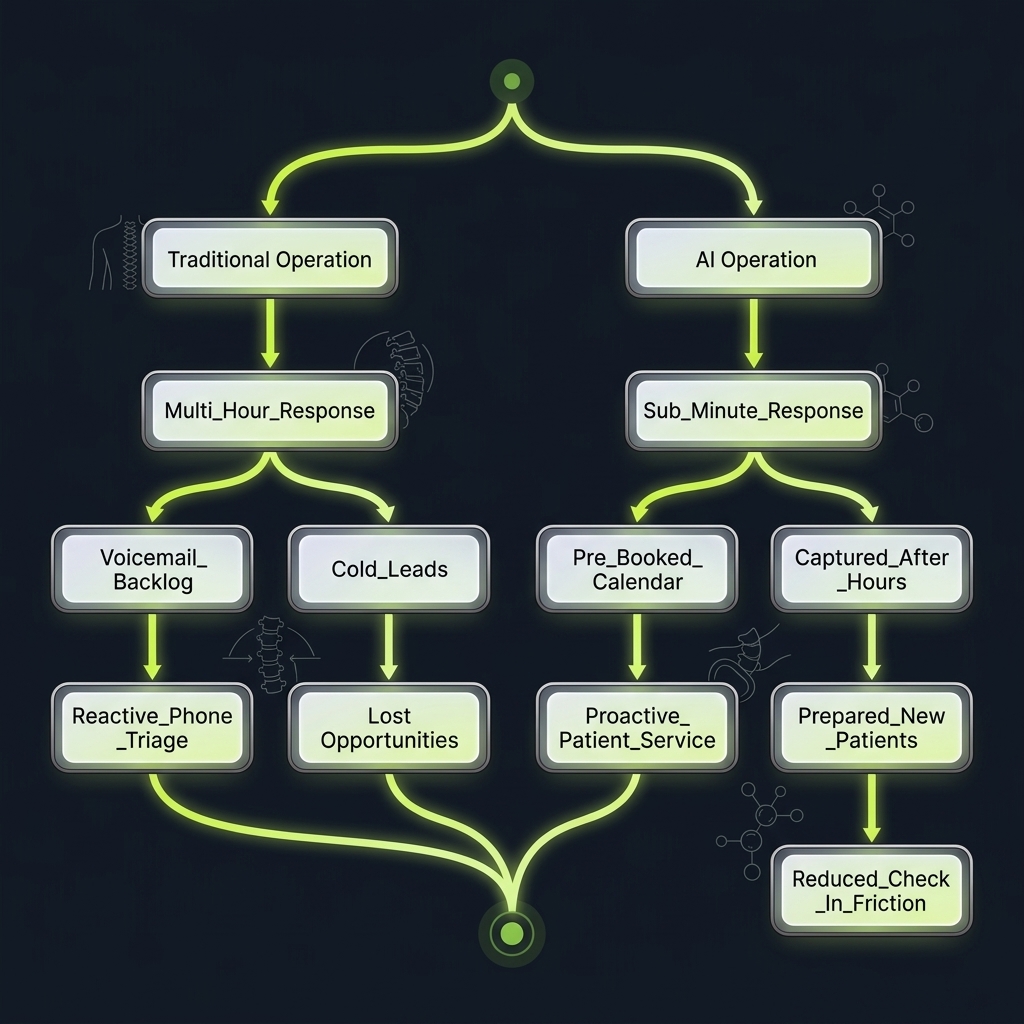
The Results: What Changed Operationally
The quantitative shift shows up in three areas.
Response time moved from multi-hour or next-day lags to sub-minute engagement. According to the 2026 LeanData Revenue Operations Benchmark Report, companies using AI-powered instant response bots hit a median first-response time of 47 seconds and are exactly 11 times more likely to qualify a lead compared to those waiting more than five minutes.
Your practice now responds in 47 seconds whether the inquiry arrives at 2 PM Tuesday or 9 PM Saturday.
Captured inquiries increased measurably. The after-hours and weekend prospects who previously went cold now convert into scheduled appointments. The exact lift depends on your baseline inquiry volume and local competition, but the directional change is consistent: fewer leaked opportunities.
Front-desk workload shifted away from reactive phone triage toward proactive patient service. Staff spend less time playing phone tag with prospects and more time delivering value to patients physically in the office.
The implementation timeline ran faster than traditional software deployments. Setup involves connecting the AI to your existing scheduling system, loading your practice knowledge base, and configuring the communication channels. Most practices complete this in days, not months.
Two secondary benefits surfaced that were not primary objectives.
First, morning administrative focus improved. Your team arrives to a calendar that already contains new appointments booked overnight. They start the day executing scheduled care, not digging out from a voicemail backlog.
Second, new patients arrive better prepared. They have already completed intake forms. They know where to park. They understand what to expect from the first visit. This reduces the administrative friction at check-in and improves the patient experience before the first adjustment.
Individual practice results vary based on location, search demand, local competition, baseline inquiry volume, and operational setup. The mechanism, however, remains constant: faster response captures more prospects.
How Can My Practice Improve Patient Response Times?
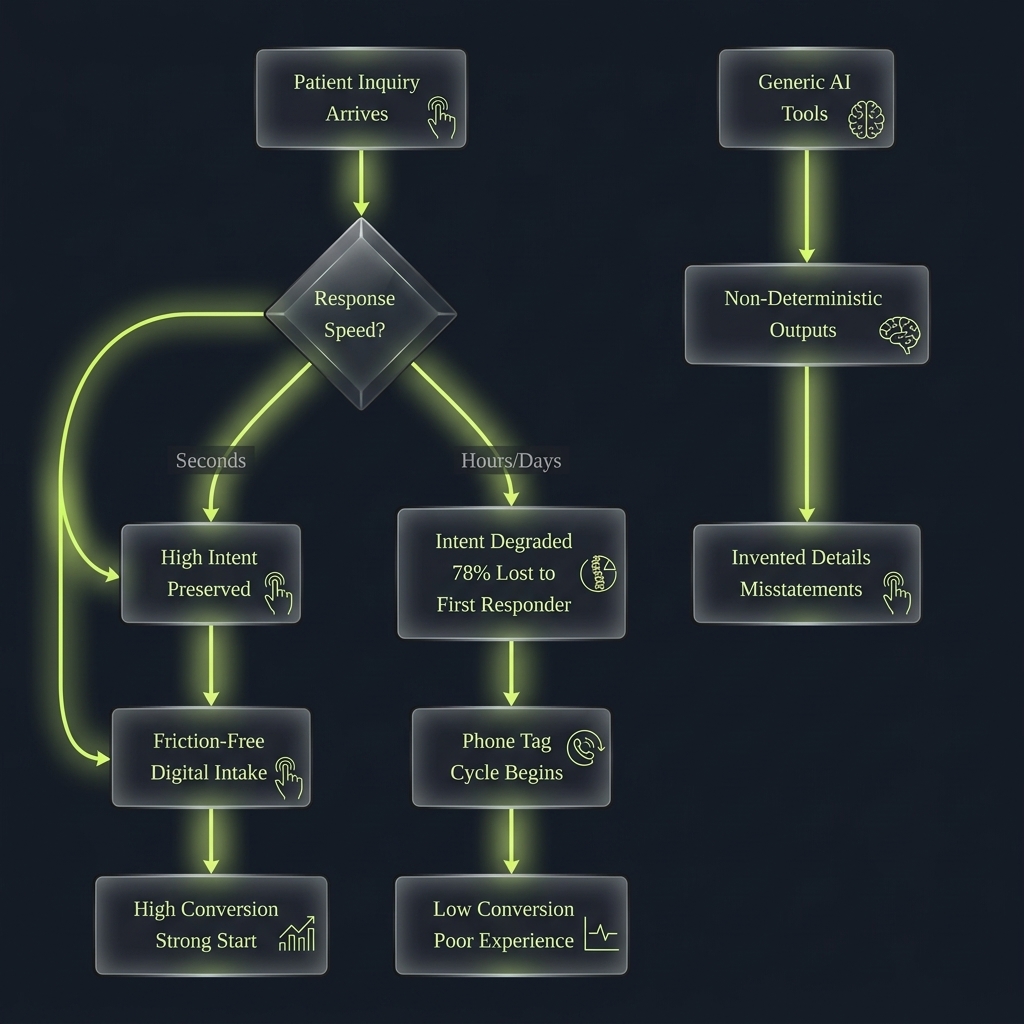
Practices improve patient response times by prioritizing speed-to-lead as the primary conversion lever, since 78% of buyers choose the first responder. Implementing immediate response systems that operate in seconds rather than hours prevents prospect intent from degrading, while eliminating friction through digital intake tools comparable to modern service industries maximizes conversion rates.
What This Means for Your Practice
The scenario above demonstrates four operational principles that apply regardless of your current software stack or practice size.
Speed-to-Lead is the Primary Conversion Lever
In local healthcare markets, the business that provides the fastest, clearest pathway to care secures the patient. This is not a marketing theory. It is an operational reality validated across industries.
B2B and consumer sales research consistently demonstrates that 78% of buyers purchase from the company that responds to their inquiry first. First response wins. Second response fights for scraps.
Delayed follow-ups degrade intent. The prospect who called at 7 PM Tuesday with acute pain is highly motivated in that moment. By 10 AM Wednesday when you return the call, the urgency has faded or they have already booked elsewhere.
Your conversion rate is a function of response speed. Optimize for seconds, not hours.
Modern Intake Must Eliminate Friction at the Point of Interest
Patients expect digital convenience comparable to modern service industries. They book restaurant reservations from their phones. They schedule car service through apps. They expect the same control over their healthcare appointments.
Forcing intake through phone-tag cycles creates operational drag and degrades satisfaction before the first visit. The patient experience begins the moment they express interest, not when they walk through your door.
Practices that remove friction at the inquiry stage convert more prospects and start the relationship on stronger footing.
Generic AI Tools Create More Problems Than They Solve
The availability of consumer AI platforms tempts some practice owners to build custom solutions using tools like ChatGPT or other general-purpose language models.
This approach carries three risks.
First, non-deterministic outputs. The AI might invent practice details, misstate policies, or generate responses that sound authoritative but are factually wrong. You cannot audit every conversation in real time.
Second, ongoing time overhead. Building effective prompts, testing edge cases, and maintaining quality control becomes a part-time job. You are a chiropractor, not a prompt engineer. Your time is worth more than $200 per hour in the adjusting room. Spending ten hours per month managing AI prompts costs you $2,000 in opportunity cost, minimum.
Third, compliance exposure. Standard large language models are not inherently HIPAA-compliant out-of-the-box and are not natively programmed to adhere to FTC advertising guidelines for healthcare. They require specific configurations and guardrails. Without them, they will write claims your practice cannot legally make. They will offer diagnostic language. They will create risk.
The tool is powerful. The tool is also dangerous without healthcare-specific guardrails.
Systematization Beats Manual Effort Every Time
In my 16 years running marketing for health professionals, I have observed that manual intake processes break down the moment a practice gets busy, staff members call in sick, or life intervenes.
The front desk that reliably returns calls within an hour during slow weeks falls apart during flu season when patient volume spikes and two staff members are out sick. The manual system depends on perfect conditions. Perfect conditions do not exist.
True chiropractic business growth requires an automated, robust operational system that executes perfectly without human intervention. The system does not get tired. It does not call in sick. It does not forget to follow up.
You need a system that operates in the background, captures inquiries as they arrive, books appointments directly into your calendar, and hands you a prepared patient ready for their first visit.
Some platforms operate this whole loop end-to-end, content that drives search traffic, AI assistants that convert inquiries instantly, and communication systems that keep patients engaged between visits, so the practice owner never touches the machinery. Omniply runs that stack for chiropractic practices specifically, reviewed by the practice but executed without ongoing manual work.
The alternative is building and maintaining it yourself. That is a part-time job you do not have time for.
Conclusion
Capturing new patients reliably requires a systematic, immediate response mechanism that works around the clock. The practice that answers first wins.
AI appointment scheduling solves the after-hours capture problem, but generic tools carry operational and regulatory risks that most practice owners underestimate. Non-deterministic outputs, ongoing maintenance overhead, and compliance exposure make DIY AI a liability.
The strategic question is not whether automation works. The data proves it does. The question is whether you have the time and technical expertise to build, prompt, test, and maintain it safely.
Most practice owners do not. Most should not try.
Evaluate whether your current intake system is silently leaking prospective patients during non-business hours. Count the missed calls. Calculate the revenue cost. Decide whether the gap is worth closing.
If it is, you need a system that operates without you. The machine answered the call this week. It will answer the next one tonight.
Frequently Asked Questions
Can ChatGPT Handle Appointment Booking for a Clinic?
ChatGPT and similar general-purpose AI tools can generate conversational responses, but they lack the infrastructure required for safe clinical appointment booking. They cannot natively integrate with scheduling software, they produce non-deterministic outputs that may invent practice details, and they contain no built-in healthcare compliance guardrails. Using them requires significant ongoing prompt engineering, quality control, and technical integration work that most practices are not equipped to manage safely.
How Much Does Automated Appointment Booking Cost?
Pricing varies widely based on feature set, integration complexity, and whether the solution is self-managed or fully operated. Basic scheduling widgets start around $50 to $100 per month but require manual setup and maintenance. Comprehensive platforms that include AI conversation handling, EHR integration, and compliance management typically run $300 to $800 per month depending on practice size and inquiry volume. Calculate cost against the revenue value of converted appointments to determine ROI.
Does Automated Scheduling Replace Front Desk Staff?
No. Automated systems handle routine scheduling logistics, FAQs, and after-hours inquiries, which frees front desk staff to focus on in-person patient service, insurance verification, and complex scheduling scenarios that require human judgment. The technology shifts workload away from reactive phone triage toward proactive patient care, but it does not eliminate the need for skilled administrative staff.
Is Automated Text Scheduling HIPAA Compliant?
It depends entirely on the platform architecture. Under the HIPAA Security Rule and Privacy Rule, handling Protected Health Information requires encrypted communication channels, signed Business Associate Agreements with all vendors in the data chain, secure data storage, and audit logging. Consumer-grade text platforms and generic chatbots typically do not meet these requirements. Verify that any system handling patient communications is explicitly designed for healthcare use and provides documented HIPAA compliance controls.
How Long Does It Take to Set up Automated Booking?
Implementation timelines range from a few days to several weeks depending on system complexity and EHR integration requirements. Simple booking widgets with manual calendar syncing can deploy in 24 to 48 hours. Fully integrated AI systems that connect directly to your scheduling software, load practice-specific knowledge, and configure multi-channel communication typically require one to two weeks for proper setup and testing. Managed platforms handle most of this work without requiring significant practice owner time.
What is the Average Chiropractic Practice No-show Rate?
MGMA and other healthcare management benchmarks confirm that average healthcare no-show rates range between 5% and 30% depending on patient population, appointment type, and reminder systems in place. Private practices with strong confirmation protocols, like chiropractic clinics, typically maintain rates comfortably in the 8% to 15% range. Automated confirmation messages, pre-appointment reminders, and digital intake processes have been shown to reduce no-show rates by improving patient preparation and commitment.
How Do After-hours Patient Texts Get Handled?
In practices using AI front desk systems, after-hours texts trigger immediate automated responses that screen the inquiry, provide relevant practice information, and offer direct scheduling options if appropriate. The system operates continuously without requiring staff to be on call. Messages that require human judgment or fall outside automated protocols get flagged for staff review the next business day, but routine scheduling and FAQ inquiries resolve immediately without human intervention.