
A prospective patient opens ChatGPT on their phone and asks for the best clinic in your ZIP code.
Your practice is not in the output.
Your competitor across town is.
That single prompt just handed a $2,000 care plan to another office. Your front desk will never even know the phone didn't ring.
This silent loss stems from AI Invisibility. Most practice owners spend thousands on standard local search while completely ignoring ChatGPT SEO.
AI models do not scan the web like standard search engines. They synthesize recommendations based on specific data footprints. If your practice lacks that footprint, you are invisible to local prospects.
You cannot treat a condition you have not diagnosed.
This guide provides a five-minute diagnostic test to check your practice's visibility in AI search right now. You will see exactly how AI evaluates your practice and why obvious fixes fail.
Here is how to run the check.
Key Takeaways
- AI Search Migration: AI platforms generated over 1.1 billion referral visits in June 2025 alone, representing a 357% year-over-year increase as patients shift from Google to ChatGPT for provider recommendations.
- Hallucination Impact: Small and medium healthcare practices face AI hallucinations at a 5% rate (versus 2% for large brands), with 66% of consumers encountering incorrect business information that directly impacts their decision to visit.
- Visibility Optimization: Princeton University research published at KDD 2024 found that "Statistics Addition" and "Cite Sources" methods boosted visibility in generative engine responses by 30% to 40% through structured data implementation.
- Review Velocity Priority: Practices sustaining 6 new reviews per month for 6 months reached top-3 Google Business Profile rankings in 89% of observed cases, as AI models prioritize recent review momentum over total count.
- Silent Revenue Loss: One lost patient per week costs corrective-care chiropractic practices $104,000 annually (52 patients × $2,000 average lifetime value), with front desks never knowing prospects searched elsewhere.
How Are Patients Changing the Way They Search Online?
Patients are shifting from traditional search engines to AI platforms like ChatGPT, asking conversational questions instead of typing keywords. Rather than scanning search results, they receive direct recommendations from AI models that synthesize answers from structured data across the web. This represents a permanent migration, with AI platforms generating over 1.1 billion referral visits monthly.

The Search Behavior Shift Nobody Warned You About
According to Similarweb's 2025 Generative AI Landscape Report, AI platforms generated over 1.1 billion referral visits in June 2025 alone, representing a 357% year-over-year increase. That is not experimental behavior. That is a permanent migration.
Patients are no longer typing "chiropractor near me" into Google and scanning blue links. They are opening ChatGPT and asking conversational questions: "I have severe sciatica and need help fast; who should I see in Austin?"" The AI responds with three names. Yours is either on that list or it is not.
Traditional search engine optimization taught you to chase keyword rankings and backlinks. Generative Engine Optimization works differently. Large language models synthesize answers from structured data, content freshness, citation consistency, and sentiment signals across the entire web. They do not rank pages. They recommend businesses.
If your practice information is inconsistent, outdated, or simply absent from the data sources these models scrape, you vanish. The algorithm does not penalize you. It just never considers you.
And according to the 2026 Deloitte Global Health Survey and Searchlab's healthcare marketing research, 82% of patients research providers online before making a decision. If the AI cannot find you, neither can they.
What Do I Need to Run a ChatGPT SEO Audit?
To run a ChatGPT SEO audit, practitioners need a ChatGPT account (free version works), exact business details including name, address, phone and website, three specific clinical services using patient search language, and names of two direct competitors. A blank document for logging results completes the requirements. All materials are readily accessible to existing businesses.

What You Need Before You Start
This audit requires four things, all of which you already have.
First: a ChatGPT account. The free version works. Log in at chatgpt.com.
Second: your exact practice details. Name as it appears on your sign. Full street address. Primary phone number. Website URL. No approximations.
Third: your top three clinical services. Not "chiropractic care." Specific offerings: spinal decompression, pediatric adjustments, sports injury rehab. The language patients use when they search.
Fourth: the names of your two closest direct competitors. You are not checking their websites. You are checking whether the AI recommends them instead of you.
Open a blank document to log your results. You will need it.
How Do I Open a Clean ChatGPT Session?
To open a clean ChatGPT session, users should launch a private browsing window, navigate to chatgpt.com and log in, then click "New Chat" in the top left corner. This ensures no prior conversation history remains visible, eliminating session memory that could contaminate results when testing how the AI responds without existing context.
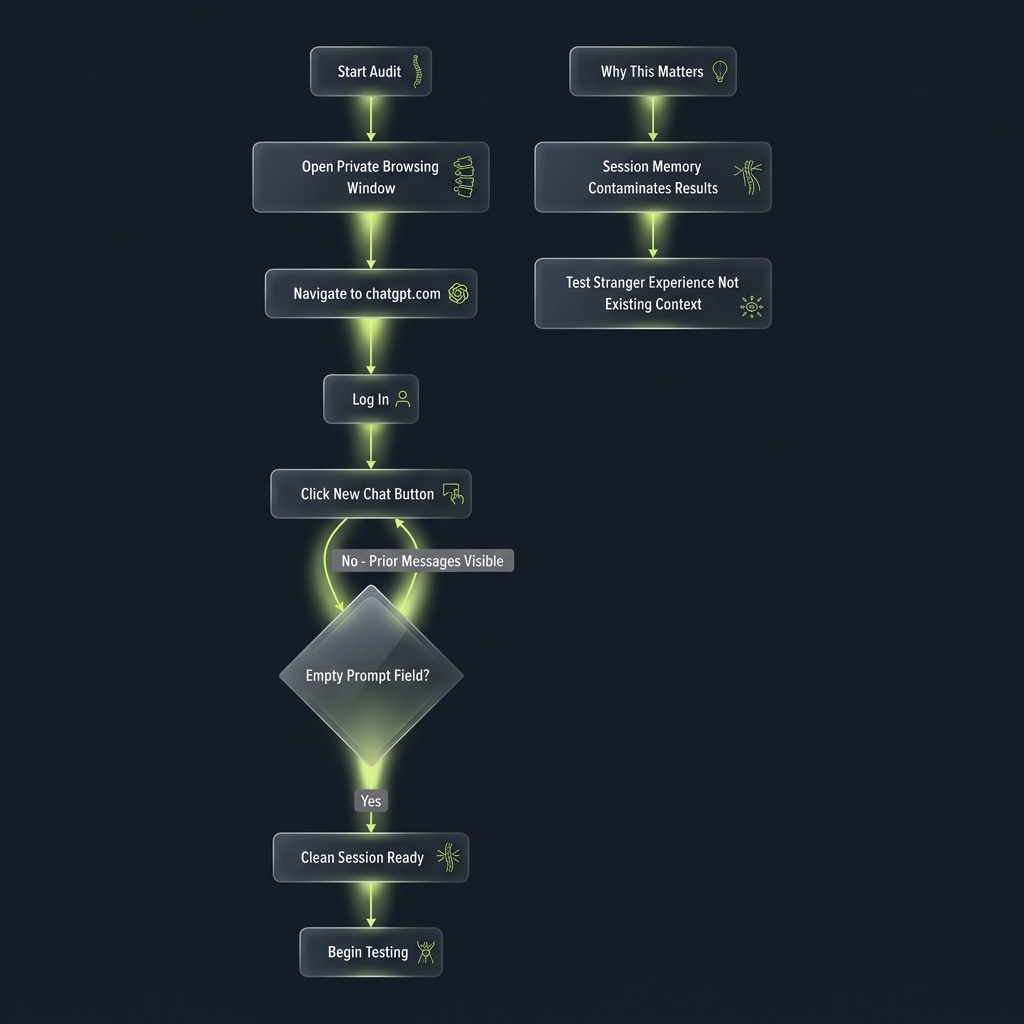
Step 1: Open a Clean Session
Open a private browsing window. Navigate to chatgpt.com and log in. Click "New Chat" in the top left corner.
You should see an empty prompt field with no prior conversation history visible.
This step matters because generative models retain session memory. If you mentioned your practice name in an earlier conversation, the AI carries that context forward. You are not testing how ChatGPT treats someone who already knows you. You are testing how it treats a stranger.
Running the audit inside an existing chat thread contaminates the results. If you see prior messages when you open ChatGPT, click "New Chat" to purge the memory.
How Do I Test My Practice's Local AI Visibility?
To test local AI visibility, practitioners should enter a prompt into ChatGPT asking "Who are the top-rated [specialty] in [City, State]?" with their specific location. The AI will generate a list of 3-5 recommended practices. Providers should check if their practice appears and note their position relative to competitors, revealing their baseline indexing strength.
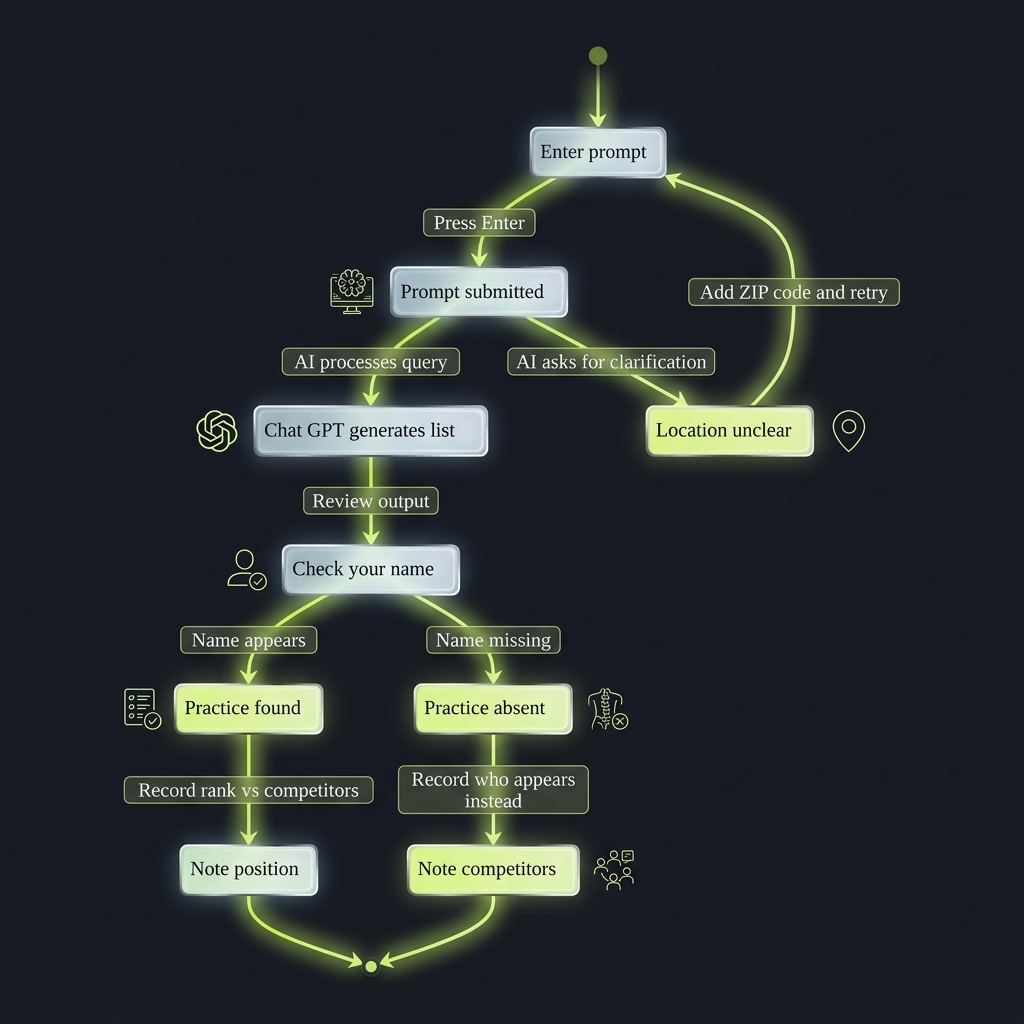
Step 2: Test Broad Local Discovery
Copy this prompt exactly, replacing the bracketed text with your city and state:
"Who are the top-rated chiropractors in [City, State]? List the top 3-5 options and explain why they are recommended."
Press enter.
ChatGPT will generate a bulleted list of local practices. It may mention reputation, services, or review highlights. Read the entire output.
Is your practice name on the list? If yes, note your position. If no, note which competitors appear.
If ChatGPT asks you to clarify your location, you were too vague. Re-enter the prompt with your exact city and ZIP code: "in Austin, TX 78704."
This test measures baseline indexing. High-volume, non-branded queries like "best chiropractor near me" generate the most new-patient searches. If you are absent here, you are losing the largest slice of the market.
How Do I Test My Service-specific AI Search Rankings?
To test service-specific AI search rankings, practitioners should query ChatGPT with detailed prompts including their condition, location, and specialized treatment (e.g., "severe sciatica in [City] needing non-surgical spinal decompression"). The AI should return one to three clinic names. If it provides general advice instead, refine by requesting "specific local clinic names and physical locations" to verify visibility.
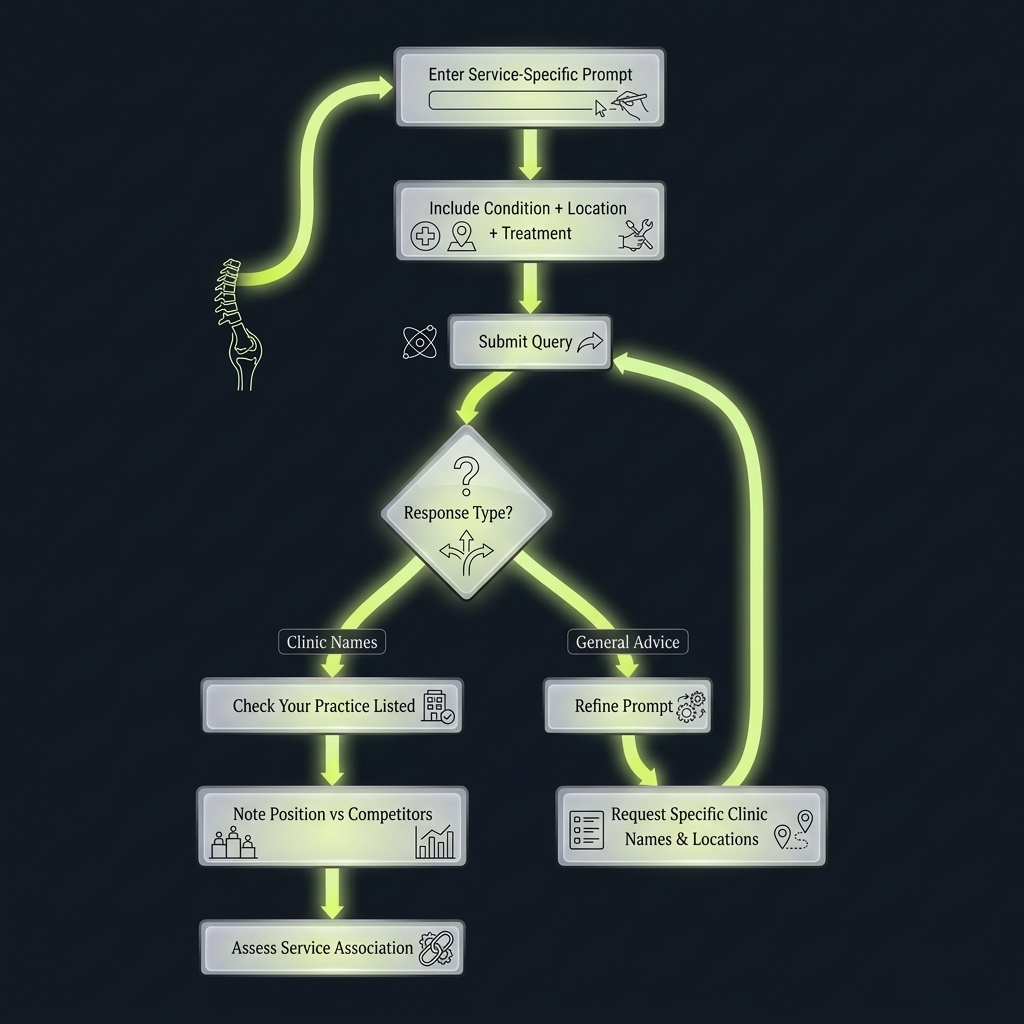
Step 3: Test Service-Specific Queries
Now test whether the AI connects your practice to the conditions you treat. Enter this prompt, customizing the condition and location:
"I am suffering from severe sciatica and lower back pain in [City, State]. Which local chiropractic clinic specializes in non-surgical spinal decompression and acute pain treatment?"
Press enter.
ChatGPT should return one to three clinic names associated with the specific treatment you mentioned. Check whether your practice appears. Check whether competitors do.
If the AI responds with general clinical advice instead of clinic names, refine the prompt: "List specific local clinic names and their physical locations."
This test reveals whether the model understands your clinical capabilities beyond generic "back adjustment" categories. Patients searching for specialized care are higher-intent. They convert faster and stay longer. If the AI does not associate your name with your core services, you are invisible to your best prospects.
How Do I Check If AI is Hallucinating My Business Info?
To check for AI hallucinations, businesses should prompt ChatGPT or similar AI tools with their exact business name and location, requesting specific details like address, phone number, website, and hours. They must then carefully compare every returned detail against actual business information, logging any discrepancies, as even small errors significantly damage consumer trust and conversion rates.
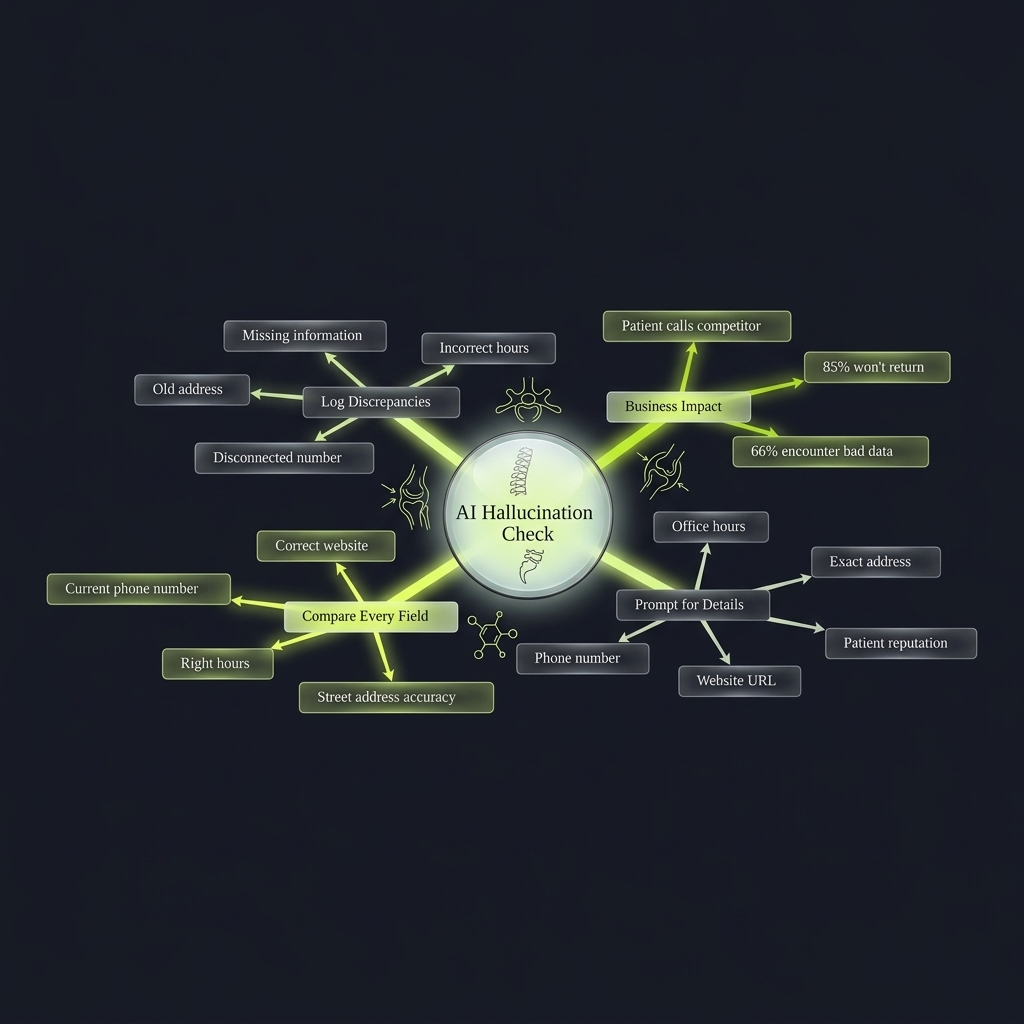
Step 4: Check for Hallucinations
Now test accuracy. Enter this prompt using your exact practice name:
"Provide the exact address, phone number, website, office hours, and patient reputation summary for [Your Practice Name] in [City, State]."
Press enter.
Read every detail the AI returns. Compare it to your actual information.
Is the street address correct? Is the phone number current? Is the website URL accurate? Are the office hours right?
A 2026 Searchable study found that small and medium enterprises are hit hardest by AI hallucinations, receiving confident fabrications at a rate of 5% (compared to 2% for large brands), with an additional 6.3% of key business information completely missing from AI outputs. If ChatGPT displays an old address, a disconnected phone number, or incorrect hours, log every discrepancy.
Hallucinations are not cosmetic errors. Data Axle and BrightLocal consumer trust surveys found that 66% of consumers have encountered or attempted to visit a business based on incorrect online information, and 85% say that bad data directly impacts their decision to return or visit that business in the future.
A patient who calls the wrong number does not call back. They call the next name on the list.
How Do I Compare My Practice Against Local Competitors?
To compare against local competitors, practices should use AI tools like ChatGPT with a head-to-head prompt that includes their practice name and two competitor names along with their city and state. The AI's comparative breakdown reveals positioning by evaluating reputation, technology, offerings, and patient experience, showing whether the practice appears as a top-tier option.
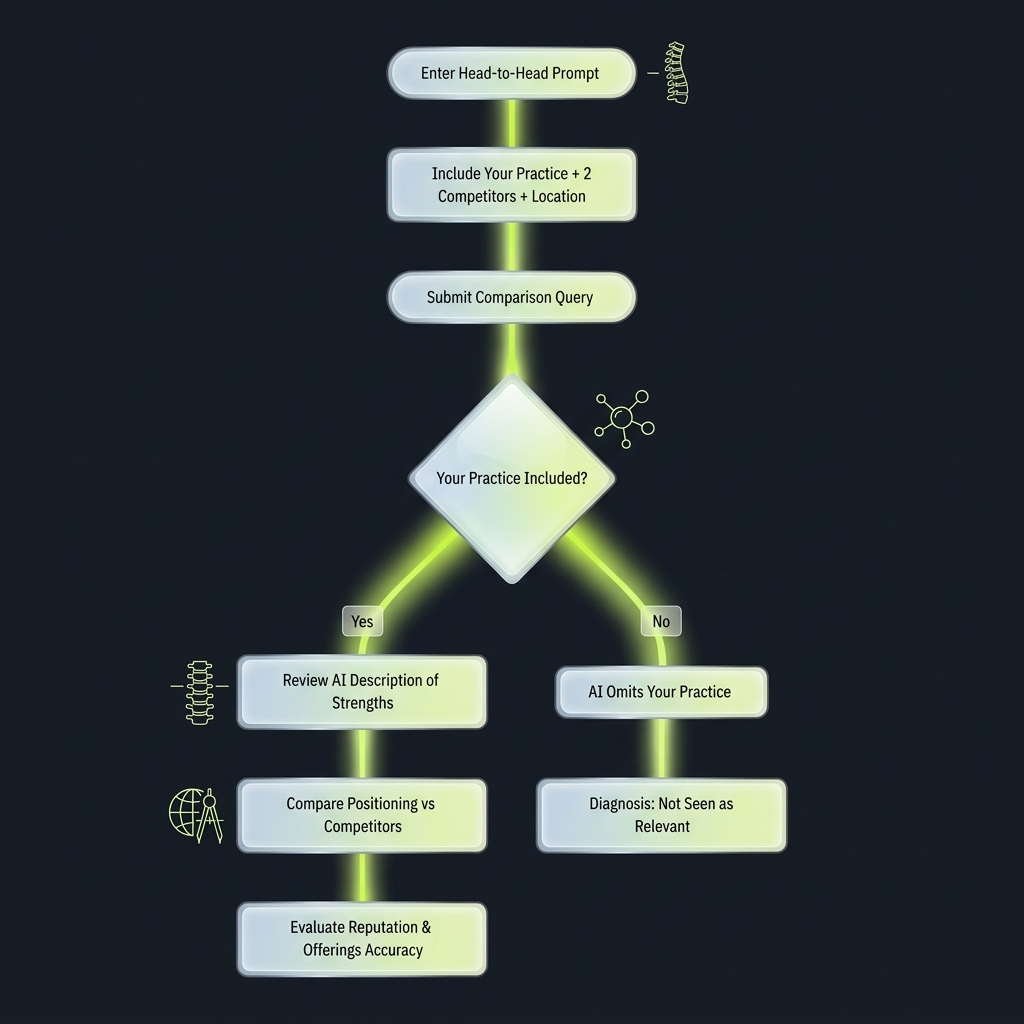
Step 5: Run a Head-to-Head Comparison
This is the test that reveals positioning. Enter this prompt, inserting your practice name and two competitors:
"Compare [Your Practice Name] with [Competitor A] and [Competitor B] in [City, State]. Which practice is best for a patient looking for long-term corrective care and fast appointment availability?"
Press enter.
ChatGPT will generate a comparative breakdown. It may evaluate reputation, technology, unique offerings, or patient experience. Read how it describes each practice.
Does your practice appear in the comparison? If yes, does the AI describe your strengths accurately? If no, the model has already decided you are not a top-tier option.
If ChatGPT omits your practice entirely and focuses only on competitors, that is the diagnosis. The AI does not see you as relevant.
How Do I Calculate My AI Visibility Score?
To calculate an AI visibility score, businesses conduct four tests covering broad local discovery, service-specific search, brand accuracy, and competitor comparison. Each category where the business appears accurately and favorably earns 2.5 points, totaling a maximum of 10 points. The final score indicates whether the business is an AI market leader, inconsistently visible, or digitally invisible.
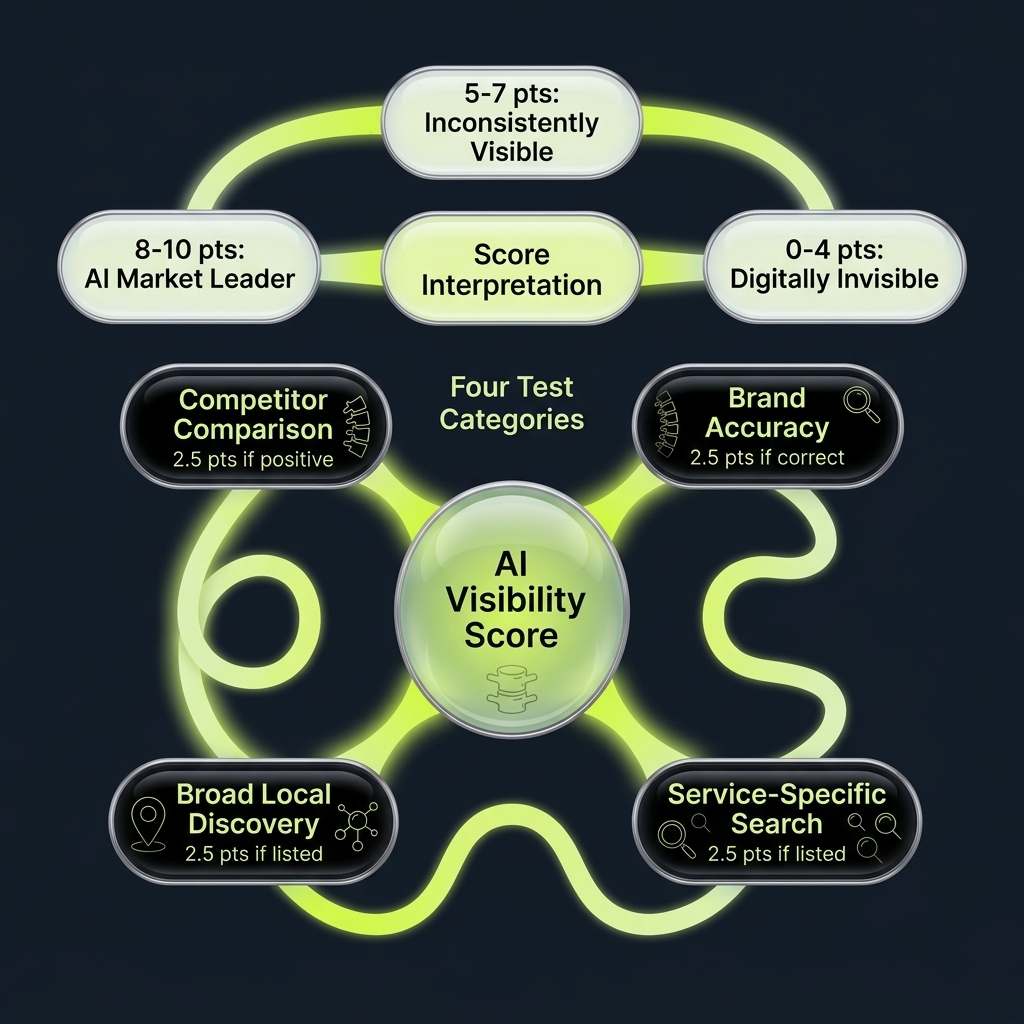
Step 6: Calculate Your AI Visibility Score
Tally your results across the four tests. Assign 2.5 points for each category where your practice appeared accurately and favorably:
- Broad local discovery (Step 2): 2.5 points if listed
- Service-specific search (Step 3): 2.5 points if listed
- Brand accuracy (Step 4): 2.5 points if all details were correct
- Competitor comparison (Step 5): 2.5 points if included and described positively
Your total score falls into one of three categories:
8–10 points: AI Market Leader. You are visible, accurate, and competitive in AI search.
5–7 points: Inconsistently Visible. You appear in some contexts but not others. Patients find you sometimes.
0–4 points: Digitally Invisible. The AI does not recommend you. You are losing market share daily.
Log your score. This is your baseline.
Why Did I Get a Low Score on My Assessment?
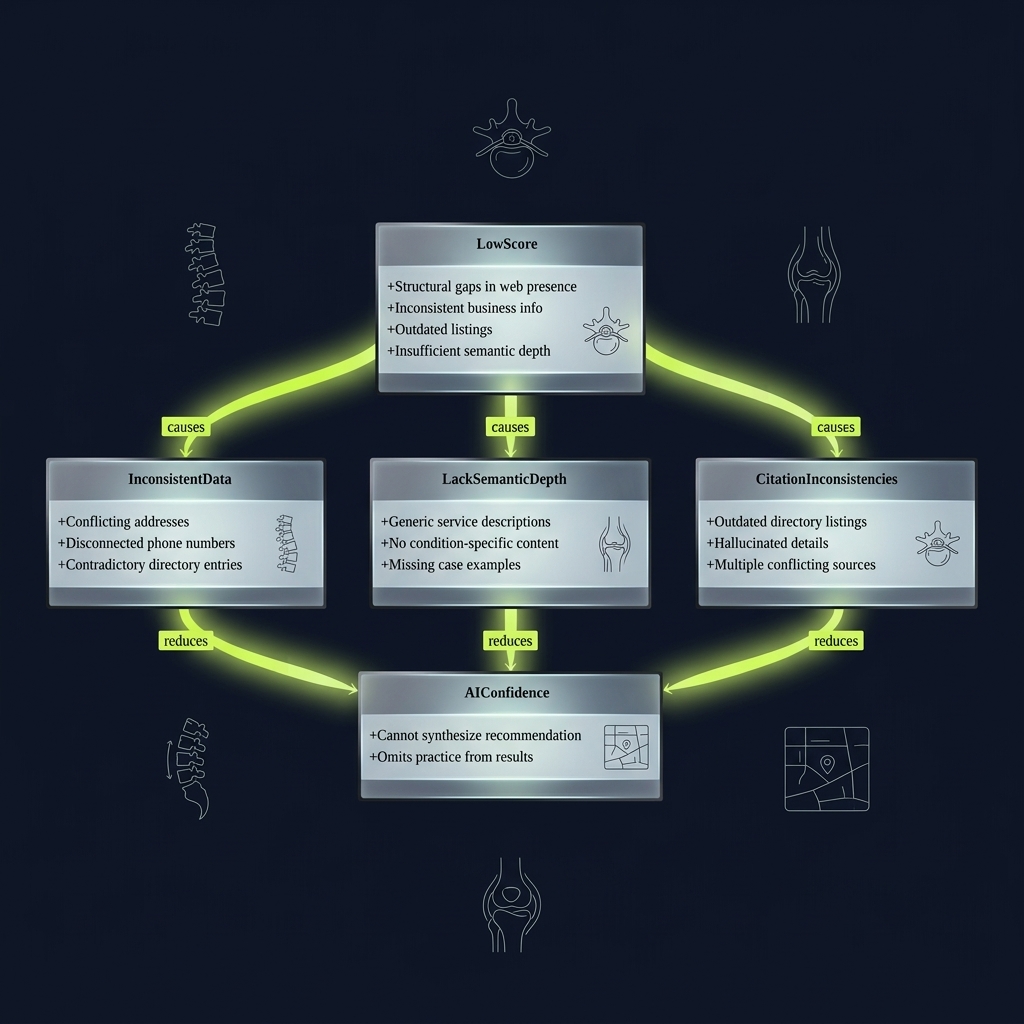
A low assessment score indicates structural gaps in web presence, including inconsistent business information across directories, outdated listings with conflicting addresses or phone numbers, and insufficient semantic depth in website content. These issues prevent AI models from confidently synthesizing accurate recommendations, as they rely on consistent, detailed data from multiple authoritative sources to generate responses.
What the Results Mean
If your practice scored below 7, you have structural gaps in your web footprint. The AI is not ignoring you out of malice. It is working with incomplete or conflicting data.
Generative models synthesize recommendations from third-party directories, review platforms, structured data on your website, and fresh content indexed across the web. If those sources contradict each other, one listing shows your old address, another shows your current one, a third has a disconnected phone number, the model cannot confidently recommend you.
A peer-reviewed study conducted by researchers from Princeton University, Georgia Tech, and IIT Delhi, presented at the KDD 2024 conference, tested various optimization methods and found that "Statistics Addition" and "Cite Sources" boosted visibility in generative engine responses by 30% to 40%. That is not theory. That is measured output from Generative Engine Optimization research.
If you appeared in broad searches but not service-specific ones, your website lacks the semantic depth AI models need to connect your practice to the conditions you treat. Generic "we offer chiropractic care" language does not create associations. Detailed service pages, case examples, and condition-specific content do.
If ChatGPT hallucinated your details, you have citation inconsistencies across the web. Every outdated directory listing is training data for the AI. Fix one and leave ten, and the model still guesses wrong.
Why Do Simple Fixes Fail to Improve AI Visibility?
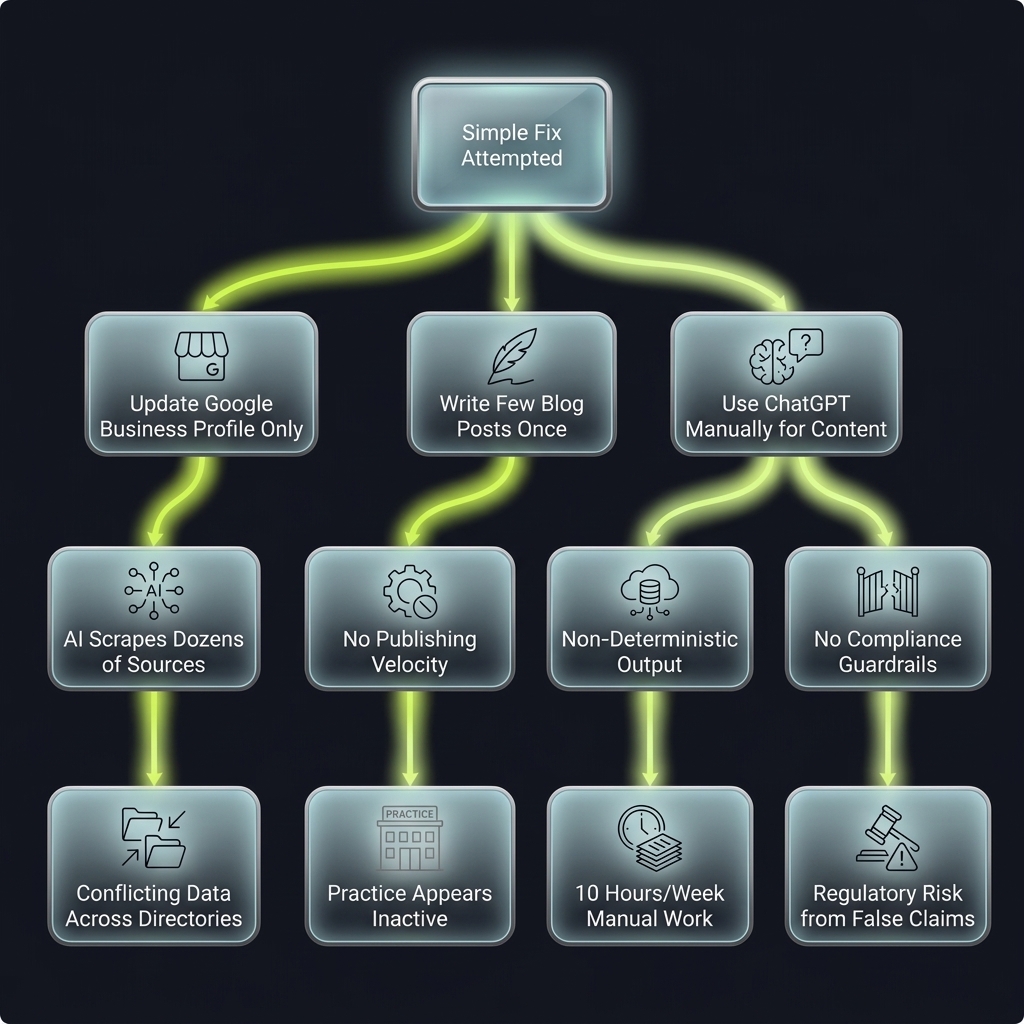
Simple fixes fail because they address only partial aspects of AI visibility. Updating Google Business Profile ignores dozens of other data sources AI models scrape. One-time blog posts lack the consistent publishing velocity AI prioritizes for authority signals. Manual ChatGPT content creation produces non-compliant claims violating healthcare advertising regulations while consuming excessive time without systematic quality control.
Why Obvious Fixes Fail
Most practice owners who discover AI invisibility try three things. All three fail for specific reasons.
Fix 1: Update Google Business Profile and call it done. Google is one data source. ChatGPT scrapes dozens. Fixing Google while leaving Yelp, Healthgrades, and fifty other directories outdated does not solve the problem. The AI still sees conflicting information.
Fix 2: Hire someone to write a few blog posts. One-time content does not move the needle. AI models prioritize recency. A practice that published three articles in 2023 and nothing since looks inactive. Consistent publishing velocity signals authority.
Fix 3: Manually prompt ChatGPT to write content for the practice. This is the most common trap. Generic AI tools produce non-deterministic output. The same prompt generates different results every time. You spend hours editing, fact-checking, and rewriting. And nothing in the tool prevents it from generating claims you are not allowed to make.
Under FTC Truth-in-Advertising guidelines and state medical board regulations, deceptive medical advertising is strictly prohibited. Healthcare marketers are legally required to substantiate clinical claims with scientific evidence, cannot guarantee specific medical outcomes (as individual results vary), and must include proper disclosures (such as "results not typical" or disclosing material connections) when using patient testimonials. ChatGPT does not know your state's rules. It will write "we cure sciatica" or "patients see results in one visit" without hesitation. Publishing that content exposes you to regulatory penalties.
The time sink is worse than the compliance risk. Attempting to manually write prompts, draft weekly articles, design newsletters, and generate social content requires ten hours per week. That is 520 hours per year. You did not open a practice to become a content marketer.
How Does the AI Search Visibility System Actually Work?
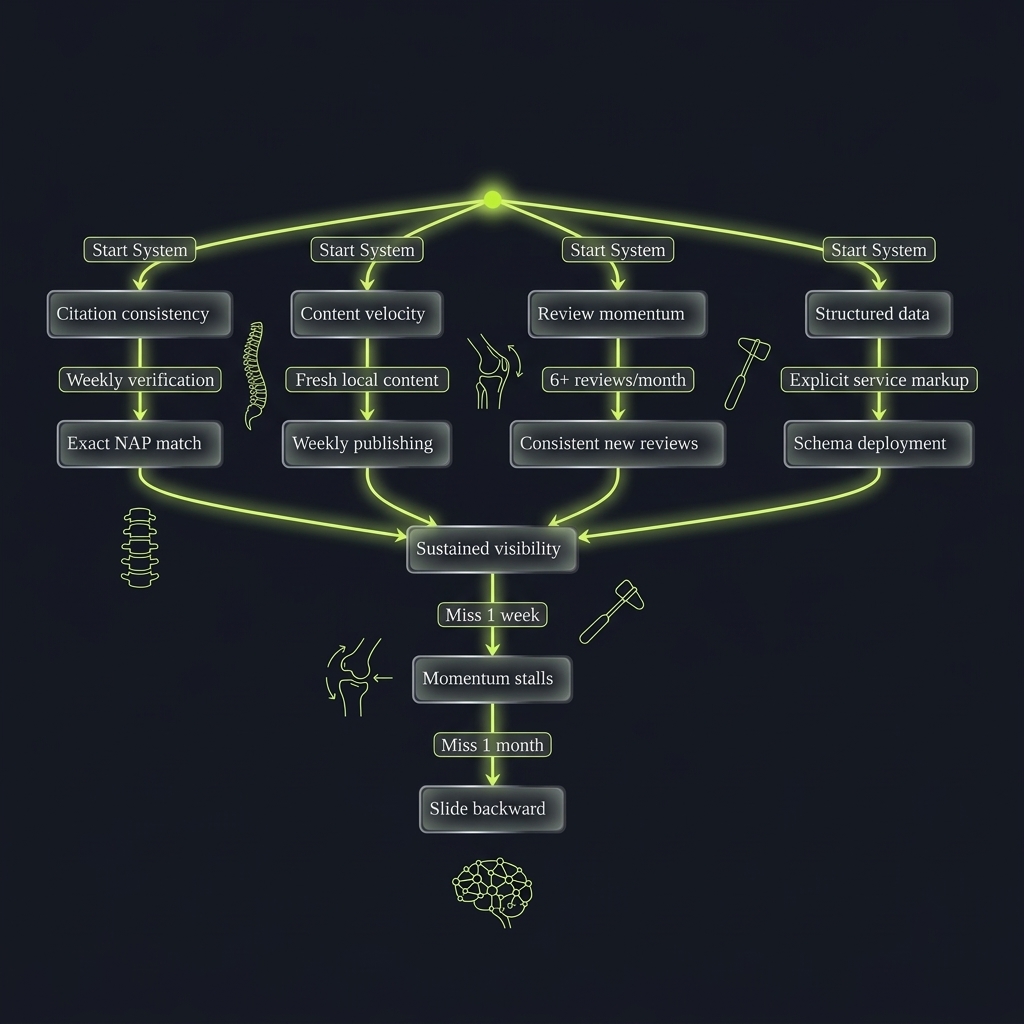
The AI search visibility system operates through four simultaneous loops: citation consistency ensuring exact NAP matching across all directories, weekly content velocity publishing locally optimized articles, review momentum generating consistent new patient reviews, and structured schema markup that explicitly communicates services and location data to AI crawlers for accurate indexing and ranking.
The System That Actually Works
Sustained AI visibility requires four operational loops running simultaneously.
Loop 1: Citation consistency. Your practice name, address, and phone number must match exactly across every directory, review site, and listing on the web. Not "close enough." Exact.
Loop 2: Content velocity. Fresh, locally optimized content published every week. Articles that answer patient questions, explain treatments, and establish topical authority. AI models index recency as a ranking signal.
Loop 3: Review momentum. Consistent new reviews signal active patient satisfaction. Macbach's "State of Healthcare Marketing · 2026 edition" report analyzed review velocity versus total review count and found that Google's algorithm heavily weights recent review velocity. Practices that sustained 6 new reviews per month for 6 months reached a top-3 Google Business Profile ranking in 89% of the observed cases. AI models read review volume and recency as trust signals.
Loop 4: Structured data. Schema markup on your website that explicitly tells AI crawlers what services you offer, where you are located, and what conditions you treat. This is the difference between the AI guessing and the AI knowing.
These loops do not run themselves. They require weekly execution, systematic tracking, and continuous optimization. Miss a week and momentum stalls. Miss a month and you slide backward.
According to Grand View Research and Searchlab's 2026 healthcare marketing statistics, the healthcare digital marketing market is valued at $6.4 billion for the year and is projected to grow at a compound annual growth rate of 18%. Your competitors are investing in this. The question is whether you are keeping pace.
What Does Losing One Chiropractic Patient a Week Cost?
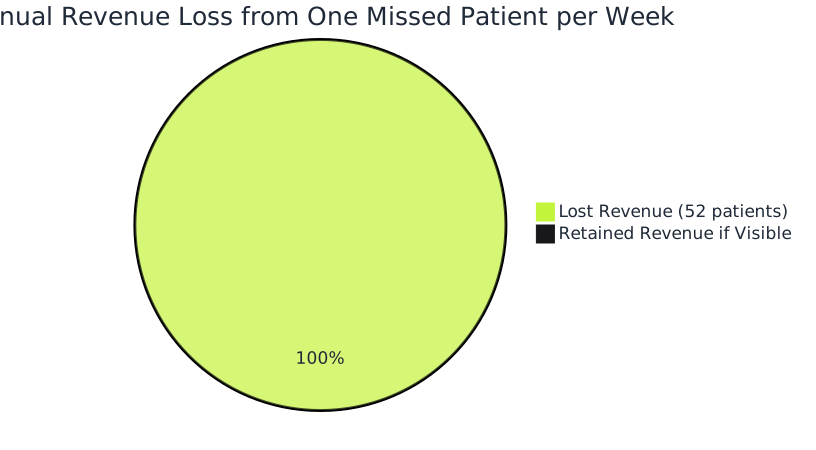
Losing one chiropractic patient per week costs a corrective-care practice approximately $104,000 annually in lost revenue. Based on an average new-patient lifetime value of $2,000, which includes initial exam, X-rays, care plan, and follow-up visits, 52 lost patients per year represent significant silent revenue loss to competitors recommended by AI systems instead.
What Happens If You Do Nothing
Run the math on one lost patient per week.
Average new-patient lifetime value in a corrective-care practice: $2,000. That is initial exam, X-rays, care plan, and follow-up visits. Conservative estimate.
One lost patient per week: 52 patients per year. 52 × $2,000 = $104,000 in annual revenue walking past your practice to a competitor the AI recommended instead.
You will never see those patients. Your front desk will never know they searched. The loss is silent and compounding.
AI adoption is not slowing. It is accelerating. Every month you remain invisible, the gap widens.
Why is Executing a Manual Content Strategy so Difficult?
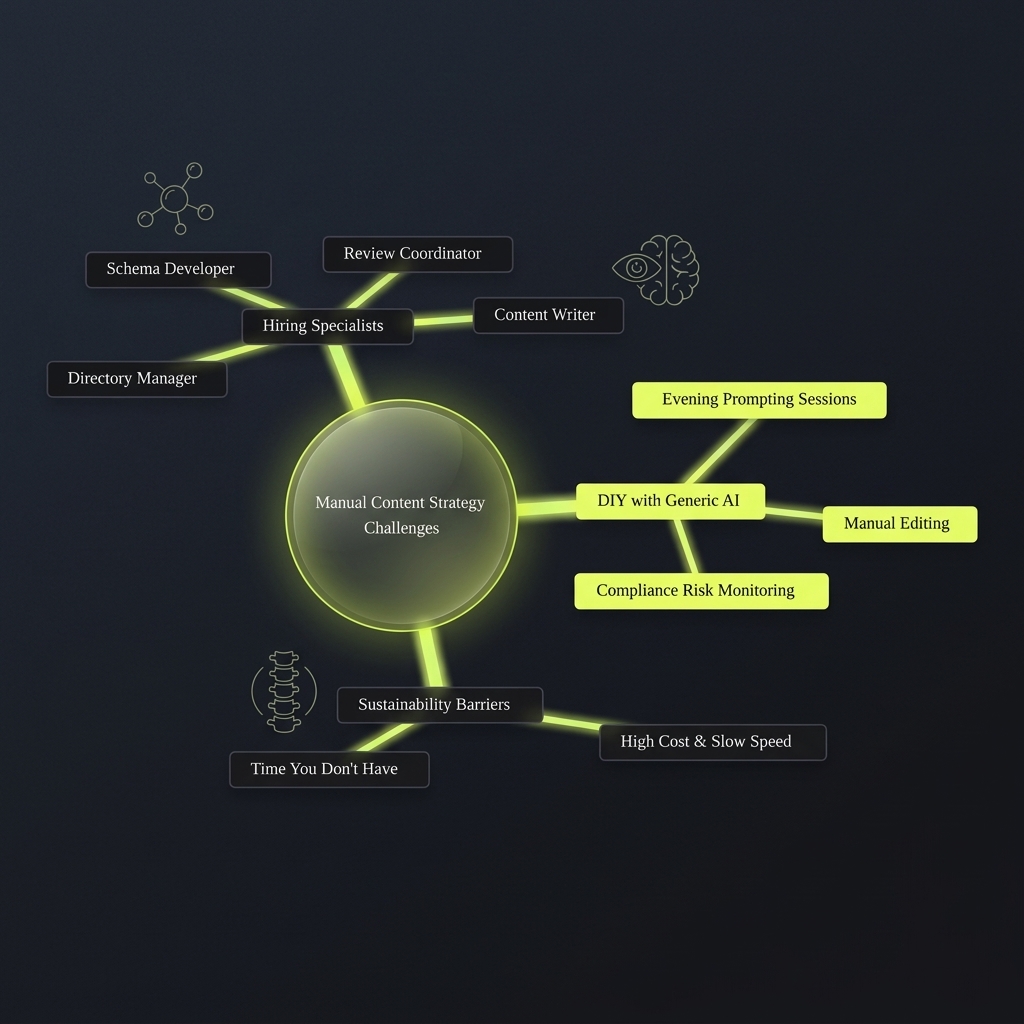
Manual content strategy execution is difficult because it requires hiring multiple specialists, content writers, directory managers, review coordinators, and developers, making it expensive and slow. Alternatively, using generic AI tools demands significant time for prompting, editing, and compliance monitoring. Neither approach is sustainable, as one drains budgets while the other consumes scarce time, preventing consistent implementation.
The Execution Problem
You now understand the system. The problem is operating it.
Manual execution requires hiring a content writer, a directory manager, a review coordinator, and a web developer who understands schema markup. You need someone to draft articles, someone to publish them, someone to monitor AI outputs, and someone to update citations when you find discrepancies.
Or you use generic AI tools and spend your evenings prompting, editing, and praying you did not accidentally publish a compliance violation.
Neither option is sustainable. The first is expensive and slow. The second consumes the time you do not have.
Platforms that operate this whole loop end-to-end, weekly content generation, citation management, review capture, and compliance guardrails built in, solve the execution problem by removing you from the operational path. Tools like Omniply run the system automatically, generating content in your practice's voice and publishing it on schedule, so the work happens whether you are in the office or not.
The system works when it runs consistently. Consistency requires automation.
What Should I Do After Checking My AI Visibility Score?
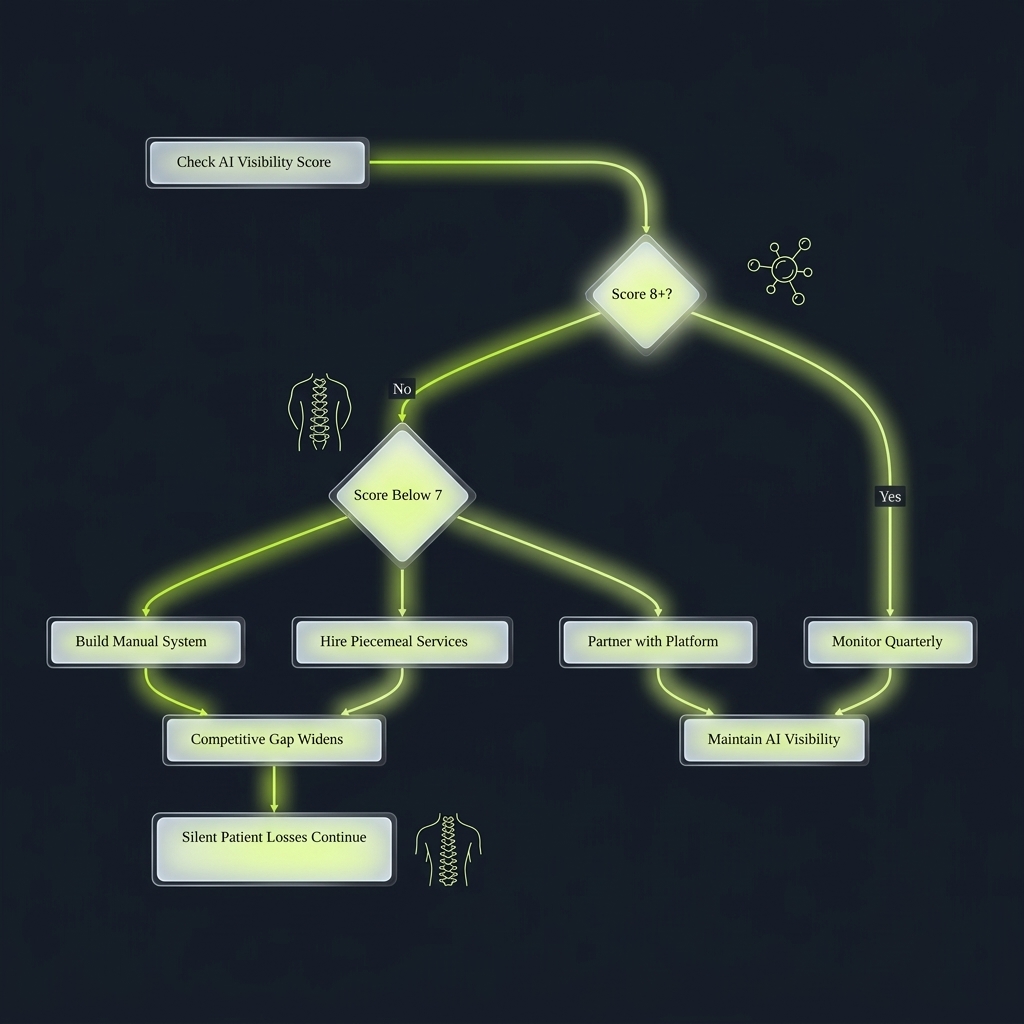
After checking an AI visibility score, businesses scoring 8 or above should monitor quarterly to maintain performance. Those scoring below 7 must choose between building a manual system, hiring piecemeal services, or partnering with a dedicated platform. Immediate action is critical, as competitive gaps widen rapidly and delayed response results in ongoing patient acquisition losses.
Your Next Step
You have your AI visibility score. You know where you stand.
If you scored 8 or above, your current system is working. Monitor it quarterly to ensure it stays current.
If you scored below 7, you have a decision to make. You can attempt to build and operate the system manually. You can hire it out piecemeal. Or you can partner with a platform that runs it for you.
The competitive gap is not widening slowly. It is widening now. Every week you delay is another week of silent losses.
The patients are searching. The AI is recommending. The only question is whose name it returns.
Frequently Asked Questions
How Does ChatGPT Get Its Local Business Information?
ChatGPT synthesizes information from web scraping, structured data on practice websites, third-party directories, review platforms, and publicly indexed content. It does not pull from a single database. It aggregates signals across the entire web and generates responses based on the most consistent and authoritative data it finds.
Why is My Practice Not Showing up on ChatGPT?
Three common causes: insufficient web presence (too little indexed content), citation inconsistencies (conflicting information across directories), or lack of structured data (no schema markup telling AI models what you do and where you are). The AI cannot recommend what it cannot confidently identify.
Can ChatGPT Write Compliant Promotional Copy for a Clinic?
No. Generic AI tools have no built-in understanding of healthcare advertising regulations. They will generate outcome guarantees, unsupported clinical claims, and testimonial language that violates state and federal rules. Every piece of AI-generated content requires manual compliance review before publication.
How Do Patients Use ChatGPT to Find Local Doctors?
Patients ask conversational questions: "Who is the best chiropractor for sciatica in Austin?" or "I need a clinic that takes same-day appointments near me." They expect named recommendations with explanations. The AI responds with a shortlist. If your practice is not on it, the patient never considers you.
How Do I Fix Wrong Clinic Details on ChatGPT?
Audit your primary web citations: Google Business Profile, Yelp, Healthgrades, and any other directories where your practice appears. Correct every instance of outdated addresses, phone numbers, or hours. Add or update schema markup on your website to explicitly state your current information. AI models re-scrape the web periodically; corrections propagate over time.
How Much Time Does Updating AI Search Profiles Take?
Initial citation cleanup: 4–6 hours to audit and correct major directories. Ongoing content creation to maintain AI visibility: 10+ hours per week if done manually. The time cost is why most practices either abandon the effort or automate it.