
Your afternoon schedule has three empty slots, but your front-desk phone is silent.
You have over 1,200 past patients sitting dormant in your EHR database. Winning them back costs a fraction of acquiring someone new, yet your team has no time to reach out. They are already buried under insurance verification and daily check-ins.
Most chiropractic marketing acts like a temporary painkiller. If you stop paying for ads, the pain of empty slots returns instantly. You need a system that builds equity.
This is the power of a Compounding Content Engine.
By using AI to turn your clinical expertise into a self-sustaining local media loop, you secure a steady flow of bookings on autopilot.
This article breaks down the three-step framework to build this engine. We will show you how to multiply your time and keep your tables full without writing a single line of copy yourself.
Key Takeaways
- Patient Acquisition Costs: Chiropractic practices pay $150 to $600 per new patient through paid ads, while SEO-optimized content creates compounding search equity that attracts patients for years without additional spend.
- Review Velocity Threshold: Google automatically filters businesses below 4.0 stars from local "best" searches, and top-ranking practices average 47 reviews—making systematic review generation essential for visibility in competitive markets.
- Regulatory Compliance Risk: State chiropractic boards impose civil penalties up to $10,000 per advertising violation, and AI hallucination rates on medical queries reach 43-67%, creating severe liability for practices using generic AI tools without clinical oversight.
- Response Time Conversion: Practices responding to patient inquiries within 5 minutes are 400% more likely to book appointments, making front-desk speed more critical than SEO rankings for converting organic traffic into revenue.
- Content Publishing Cadence: Publishing one symptom-focused article weekly for 52 weeks builds more Google authority than 52 articles in one month, creating 104 compounding search assets after 24 months that own local market share.
How Do Chiropractors Escape the Feast-or-famine Cycle?
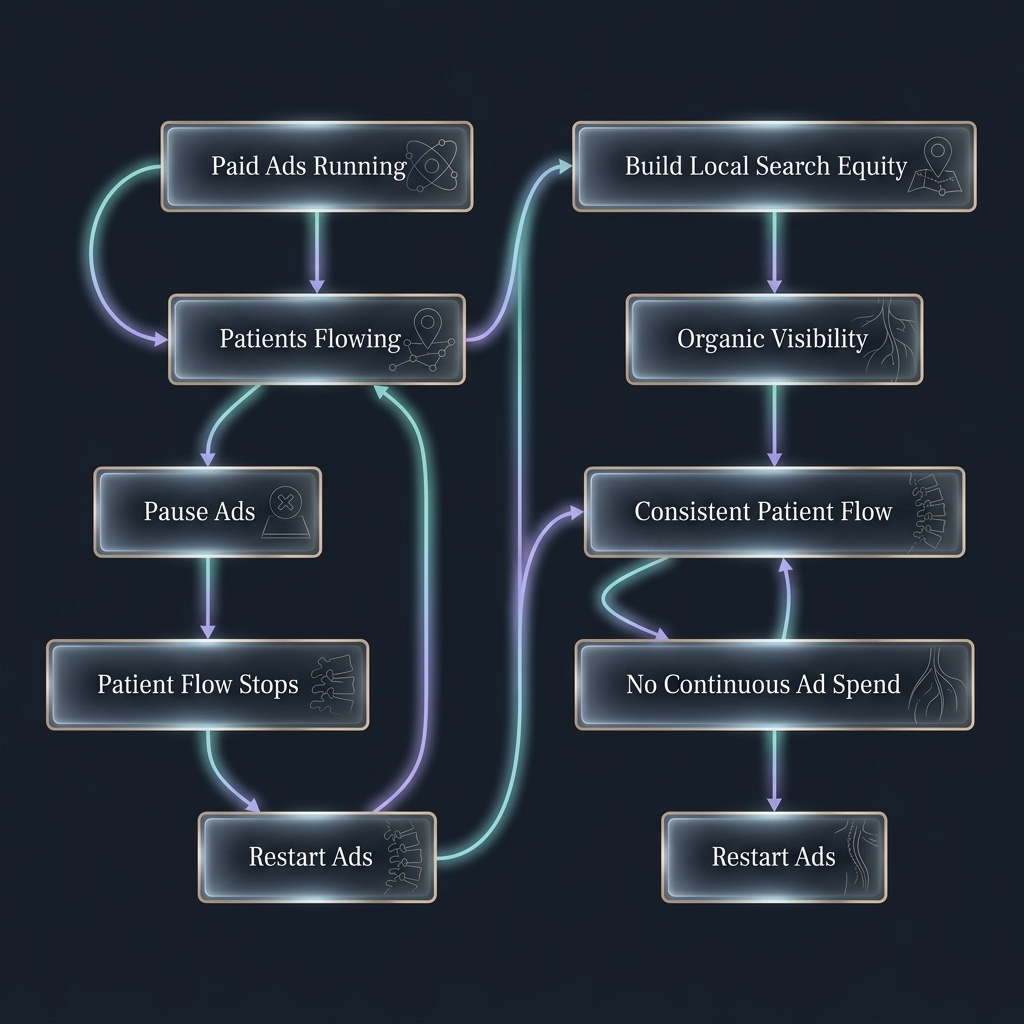
Chiropractors escape the feast-or-famine cycle by building local search equity and implementing self-sustaining patient acquisition systems that don't depend on continuous paid advertising spend. Instead of renting attention through ads that stop working when paused, successful practices create long-term content strategies and organic visibility that generate consistent patient flow without requiring constant time investment or marketing expenditure.
The Feast-or-Famine Trap in Local Chiropractic Practice
The silent anxiety of Monday morning: you walk into your clinic and open the schedule. Three gaps in the afternoon. Five the next day. Your Google Ads are running. Your Facebook posts are up. But the moment you pause spending, the patient flow dries up.
Patient acquisition costs vary wildly by medical specialty, ranging anywhere from $50 to over $600. For chiropractic practices specifically, the typical range runs $150 to $600 per new patient. That is the cost of renting attention. The economics only work if every new patient converts into a long-term wellness plan, and most do not.
I have spent 16 years running marketing for health professionals and local practices. The patterns are predictable. The elite playbook taught by top-tier practice coaches works flawlessly when executed. It fails the moment clinical duties, staff turnover, or life gets in the way.
The problem is not the strategy. The problem is execution velocity. You are running a clinical operation, not a media company.
This guide covers the mechanics of local search equity, the regulatory realities of medical marketing, the consolidation backfill content strategy, and how to build a self-sustaining patient acquisition strategy that does not require your time.
What Makes Chiropractic Marketing Unique?
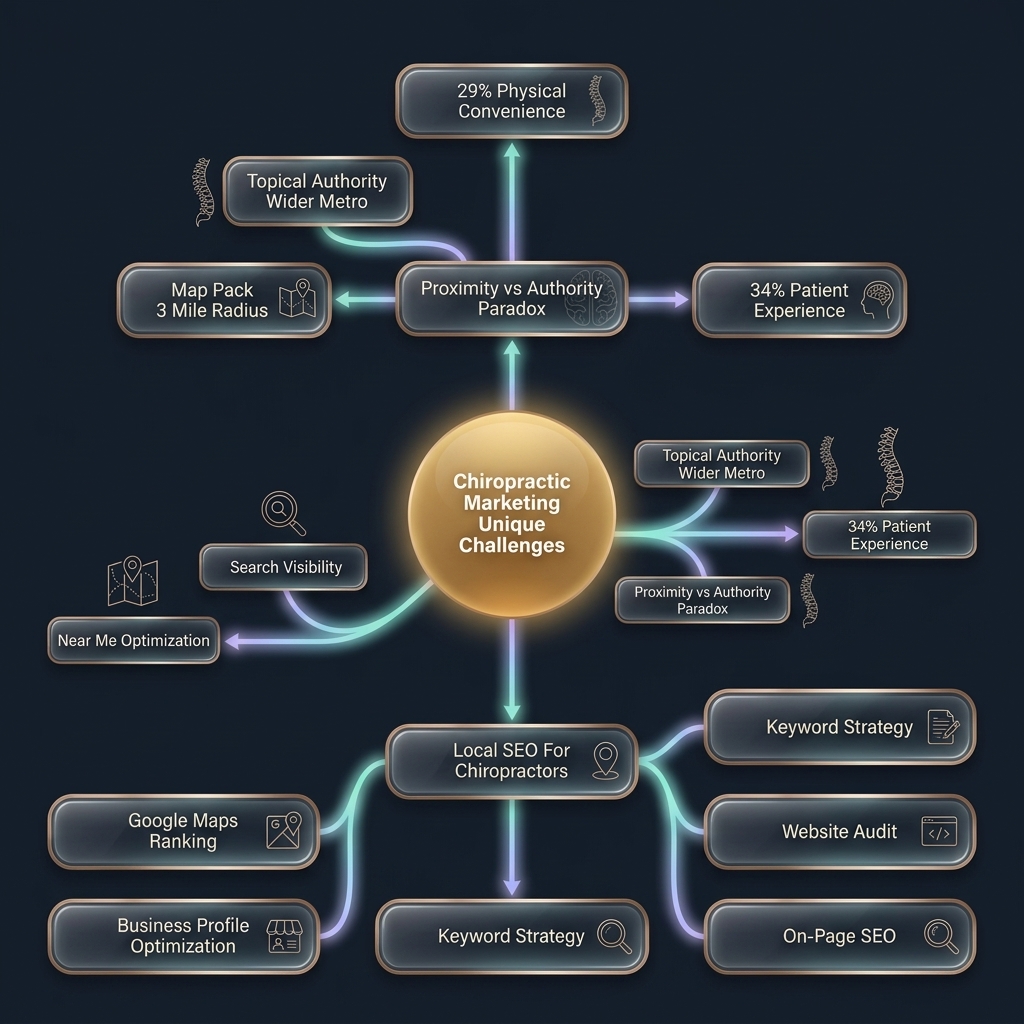
Chiropractic marketing requires balancing physical vulnerability with trust-building, as patients research providers extensively before booking. Unlike low-involvement services, prospects search for specific pain solutions rather than generic "chiropractor" terms. Success demands both local proximity optimization and topical authority across broader metropolitan areas, addressing the symptom-to-solution journey where most practices lose potential patients.
Why Chiropractic Patient Acquisition is Uniquely Different
Generic local SEO advice tells you to stuff keywords into basic FAQ pages and claim your Google Business Profile. That works for booking a plumber. It does not work for choosing someone to manually adjust your spine.
Unlike low-involvement local services, chiropractic care involves physical vulnerability. Patients need to feel a clinical connection before they ever click "Book Appointment." Over 28% of adults ages 26-34 use AI for medical advice and researching providers before engaging with a health system. They are reading your content, your reviews, and your clinical philosophy before they ever call.
The symptom-to-solution search journey is where most practices lose the patient. People rarely search for "chiropractor" first. They search for their pain: "sharp lower back pain when sitting," "how to relieve sciatica at home," or "is cracking your neck safe."
If your practice only ranks for generic search terms but lacks content addressing specific pain points, you miss the patient at the peak moment of their buying intent. Forty-six percent of all Google searches have local intent. That means half of all searches are looking for a nearby solution to a problem they have right now.
The local proximity and authority paradox creates the trap. Google's local map pack algorithm heavily weighs proximity. Your clinic shows up for searchers within three miles. But organic search rankings weigh topical authority and trustworthiness. To capture patients outside that three-mile radius, the ones searching for specific solutions across your wider metropolitan area, your website must prove to Google that you are the absolute authority on musculoskeletal health in your market.
Thirty-four percent of patients rank patient experience and 29% rank physical convenience as the top drivers of care selection. You need both proximity and authority. Most practices optimize for one and lose the other.
What is a Compounding Local Patient Flywheel?
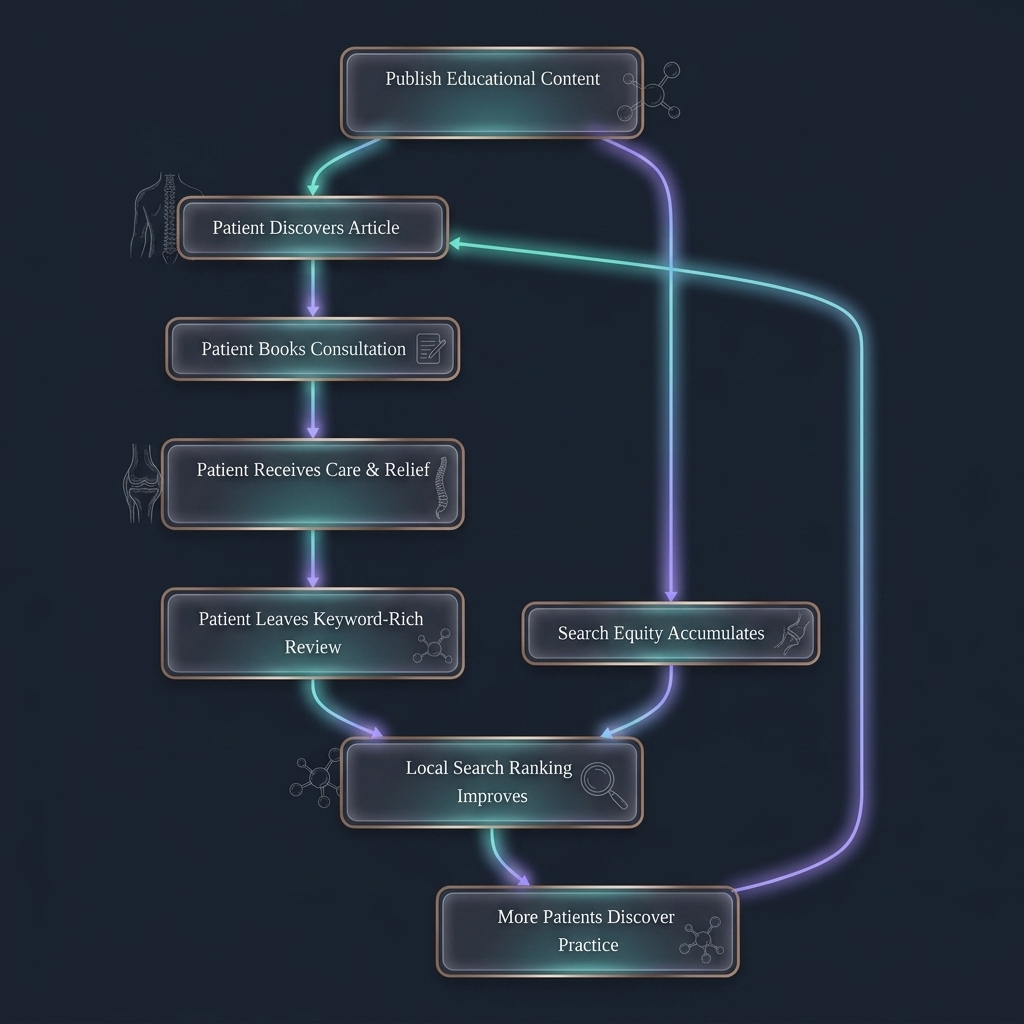
A compounding local patient flywheel is a self-reinforcing growth mechanism where educational content attracts patients who then leave keyword-rich Google reviews, boosting local search visibility and attracting more patients. Unlike paid ads, this creates search equity that compounds over time, with each published article serving as a perpetual asset that builds topical authority and drives continuous patient acquisition.
The Anatomy of the Compounding Local Patient Flywheel
Paid ads are like renting an apartment. The moment you stop paying, you are evicted. SEO-optimized, localized content is like buying land. An article written today about "pregnancy-safe back pain relief in [Your City]" continues to attract, educate, and convert patients for years without additional ad spend.
This is search equity. It compounds.
Google Business Profile signals account for 32% of local pack ranking influence in 2026. Review signals account for 20%, an increase from 16% in 2023. Fully optimized profiles make customers 2.7 times more likely to view a business as reputable and 50% more likely to consider a purchase.
But here is the mechanism most practices miss: Google filters local "best" searches automatically to only show businesses with a rating of 4.0 stars or higher. Top-ranking businesses on Google local searches have an average of 47 reviews. If you have 12 reviews and a 4.8 rating, you are invisible in competitive searches.
The review flywheel works like this: consistent, high-value educational content naturally prompts patient engagement. A patient reads your article on disc herniation, books a consultation, gets adjusted, feels relief, and remembers that your practice educated them before they ever walked in. That patient leaves a detailed, keyword-rich Google Business Profile review. That review boosts your local search visibility. More searchers find you. The loop accelerates.
Sixty-four percent of customers read Google reviews prior to visiting a local business. The content you publish is not just attracting the searcher. It is priming them to become the reviewer who attracts the next searcher.
The math: if you publish one high-quality, symptom-focused article per week, you create 52 compounding search assets per year. Each one ranks for long-tail queries your competitors are not targeting. Each one builds topical authority. Each one funnels patients into your review system. After 24 months, you own 104 pieces of digital real estate. Your competitors are still renting attention on Facebook.
What Are the Biggest Mistakes in Chiropractic Practice Marketing?
The biggest mistakes in chiropractic practice marketing include publishing content inconsistently rather than maintaining steady weekly cadences, making absolute medical claims that violate state board regulations and risk fines up to $10,000, failing to comply with HIPAA and FTC testimonial rules, and outsourcing marketing to generalists unfamiliar with healthcare-specific regulatory requirements.

What Outsiders Miss: Insider Intelligence From 16 Years in Practice Marketing
The Consolidation Backfill Strategy
Many practices make the mistake of publishing twenty articles in a single month and then remaining silent for half a year. Google's Helpful Content system rewards steady, predictable, and fresh publishing cadences.
Consolidation backfill is the mechanism. You systematically map out your clinic's core treatment modalities: spinal decompression, active rehabilitation, sports injury, prenatal care, pediatric adjustments. Each modality gets a content cluster. Each cluster includes symptom articles, treatment explainers, and local case studies.
The publishing rhythm matters more than the volume. One article per week, every week, for 52 weeks builds more authority than 52 articles published in January and silence until December. Google interprets the steady cadence as active service to the community. The algorithm rewards recency and consistency over bursts.
The Regulatory Minefield of Medical Claims
Generic copywriters and standard marketing agencies do not understand HIPAA, FDA guidelines, or state chiropractic board advertising regulations. Chiropractic marketing in the United States is governed by over 50 separate state rule sets, each with distinct forbidden claims and testimonial restrictions.
Making absolute claims, "Chiropractic care cures asthma" or "We guarantee 100% pain relief", can result in heavy fines, license suspension, or search engine de-indexing. State chiropractic boards can impose civil penalties up to $10,000 for each separate advertising or practice violation. That is Minnesota; other states vary, but the risk is universal.
The Federal Trade Commission's Consumer Review Rule, effective October 2024, made fake or incentivized testimonials a federal offense carrying civil penalties. Between 2024 and 2026, there were 11 OCR HIPAA settlements involving AI and tracking-tech misuse.
You cannot outsource compliance to a freelancer on Upwork. The content you publish must stay strictly within safety and compliance boundaries while still converting. That requires domain expertise, not just healthcare content marketing experience.
The Front-Desk Leak That Kills Organic ROI
You can rank #1 for every local search term. If your front-desk response times are slow, your marketing investment is wasted.
Practices that respond to patient inquiries within 5 minutes are 400% more likely to book the new patient. The psychological timeline of a patient in pain: they submit a contact form. If they do not hear back within 5 minutes, they click the next chiropractor on Google.
Your SEO drives the inquiry. Your front desk converts the inquiry. If the handoff is broken, the compounding effect dies. Content marketing must be directly integrated with immediate, automated lead-capture and front-office follow-up systems.
The math: assume your practice generates 40 web inquiries per month. If your response time averages 45 minutes, you convert 10 of those inquiries into booked appointments. If you cut response time to under 5 minutes, you convert 40 of those inquiries. Same traffic. Four times the conversion. That is the front-desk leak.
The Silent Value of the Nurture Loop
Only a small percentage of website visitors are ready to book an adjustment today. Many are simply researching their chronic pain options. If your site lacks a friction-free way to capture their contact information and nurture them with weekly educational updates, you lose them forever.
Healthcare email marketing averages a 43.46% open rate. Email marketing delivers an average return on investment of $36 for every $1 spent. Eighty-one percent of companies use email as a core part of their marketing strategy.
The nurture loop works like this: a searcher finds your article on sciatica relief. They download your free guide, "5 Stretches to Relieve Sciatic Nerve Pain at Home." You capture their email. Every week, they receive a short educational update from your practice: new articles, clinical insights, patient success stories. When their pain inevitably flares up again, your practice is the only logical choice. You have been teaching them for six months.
HIPAA privacy rules require explicit authorization for communications defined as marketing. The nurture loop must be opt-in, compliant, and valuable. Generic newsletters do not work. The content must match the clinical voice of your practice and address the specific pain points your patients are searching for.
How Do I Build a System for Local Dominance?
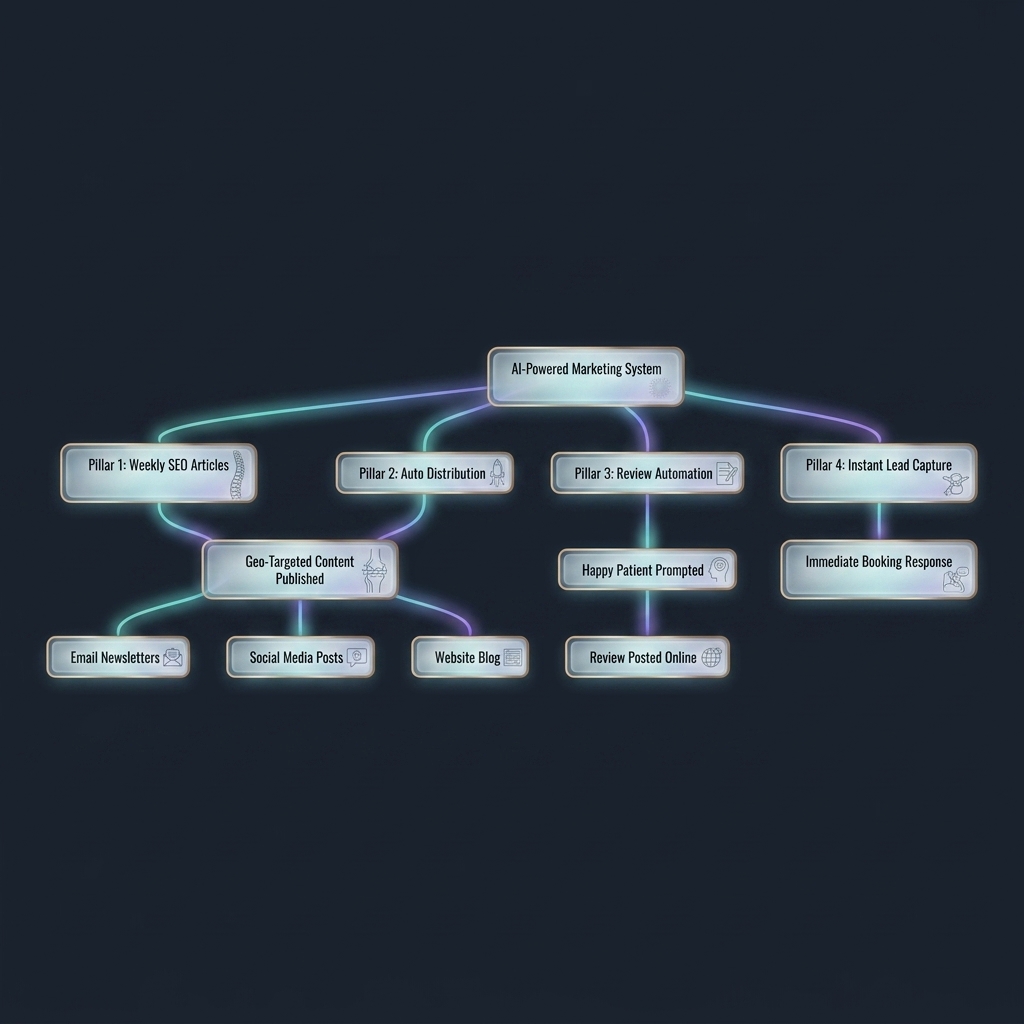
Build local dominance through four automated pillars: publish weekly geo-targeted, symptom-focused articles for SEO authority; automatically distribute content across email and social channels; implement systematic review prompts for satisfied patients; and deploy instant lead capture with immediate follow-up. This creates a compounding system that operates without relying on staff between patient visits.
The Systematic Architecture for Local Dominance
Most practices fail at marketing because it relies on the doctor or a busy front-desk receptionist finding time between patient visits to write blogs, post on social media, and send newsletters. The solution is not working harder. It is installing a system that runs on autopilot.
The shift from manual to-do lists to an operating system is the difference between a practice that grows and a practice that churns. Forty-two percent of health systems are utilizing artificial intelligence in marketing as of 2026, an increase of 19 points compared to 2024. The ones winning are not using AI to write faster. They are using AI to operate the entire system.
The four pillars of the compounding system:
Pillar 1: Consistent Local SEO Presence. Weekly, symptom-focused, geo-targeted articles published directly to your practice website to build search equity. Each article targets long-tail queries your competitors are not covering. Each one builds topical authority. Each one compounds.
Pillar 2: Multi-Channel Distribution. Automatically syndicating every article into patient newsletters and social media posts to maximize touchpoints. The same clinical insight appears on your blog, in your email, and on your Facebook page. One piece of content, three distribution channels, zero additional labor.
Pillar 3: Review Momentum Automation. A systematic process for prompting happy, adjusted patients to share their feedback where local searchers look first. Not incentivized. Not fake. Just a frictionless system that reminds satisfied patients to leave a review at the moment they feel the most relief.
Pillar 4: Instant Lead Capture. Ensuring every piece of content funnels back to a fast-response mechanism that captures patient intent instantly. No form submissions that sit in an inbox for two hours. Immediate acknowledgment, immediate follow-up, immediate booking.
The manual approach is a business liability. Pulling your staff away from patient care to manage content creation, graphic design, and SEO formatting costs more than the marketing itself. If your front-desk manager spends 10 hours per week on social media and newsletters, that is 40 hours per month. At $25 per hour, that is $1,000 in labor. Add the opportunity cost of the patient calls they did not answer while writing captions, and the real cost is closer to $2,500 per month.
The systematic approach costs less and runs without supervision.
What Are the Risks of Using Generic AI Tools?
Generic AI tools produce bland, non-deterministic content that search engines penalize, frequently hallucinate medical facts with rates between 43-67% on clinical queries, create legal liability for fabricated claims, and still require extensive editing and fact-checking. These tools lack industry-specific compliance knowledge and generate content that violates regulatory guidelines while wasting practitioners' time.

The Pitfalls of Generic AI Tools
Copy-pasting prompts into ChatGPT feels like a shortcut. It is not. Generic AI models produce bland, repetitive, and non-deterministic content that Google's spam filters easily identify and penalize.
AI hallucination is a severe problem in healthcare, with some studies showing medical AI hallucination rates ranging between 43% and 67% on complex clinical queries. While there is no singular industry consensus on a blanket average hallucination rate for all major AI models in 2026, the underlying premise is factually correct: unverified AI models frequently fabricate medical facts and generate unapproved medical claims that violate state board guidelines.
A Canadian tribunal explicitly ruled in 2024 that a company cannot escape liability by blaming its AI chatbot for fabricated policies. If your AI writes "chiropractic adjustments cure migraines," you are liable, not the AI.
The time-consuming burden of prompting, editing, fact-checking, and formatting AI-generated drafts still falls on the busy clinician. You trade writing from scratch for editing garbage. Neither saves time.
ECRI ranked AI risks as the #1 health technology hazard for 2025, above device failures and drug errors. Forty-seven percent of enterprise AI users in 2026 reported making at least one business decision based on information that turned out to be hallucinated. Over 300 court cases involving AI-fabricated citations were documented by 2025.
What to look for in a true chiropractic content partner: a platform that understands chiropractic terminology, respects state-by-state regulatory frameworks, and matches the unique clinical voice of your practice. Platforms that operate this whole loop end-to-end, like Omniply, which Azavea Inc. built to combine professional SEO articles, patient newsletters, social posts, and fast front-desk response tools into a single, practice-reviewed system—eliminate the hallucination risk, the compliance risk, and the time burden. The system cannot get tired, cannot get busy, and cannot skip a week.
How Do I Turn Marketing Into an Appreciating Asset?
Transform marketing into an appreciating asset by shifting from rented attention to owned assets. Published articles work continuously, earned reviews compound local search visibility, and email lists maintain patient engagement. Healthcare practices implementing compliant AI and optimized conversion systems reduce patient acquisition costs by 19-23%, building long-term equity rather than temporary visibility.

Transforming Marketing From an Expense Into an Appreciating Asset
Running a chiropractic practice is about clinical excellence and community impact. You should not have to run a second business as a full-time digital marketer just to keep your tables full.
The global revenue from email marketing successfully reached $12.33 billion in 2024. Broad Google Ads campaigns often result in high patient acquisition costs, reaching up to $610 for certain medical specialties. Healthcare organizations successfully lowering patient acquisition costs are treating online reputation and owned content as the foundation of their marketing.
The shift from rented attention to owned assets is the shift from expense to equity. Every article you publish today works for your clinic 24/7. Every review you earn compounds your local search visibility. Every email you send keeps your practice top-of-mind when pain flares up again.
Best-in-class health systems deploying compliant AI cut patient-acquisition costs by 19% in six months. High-performing medical practices lower their effective patient acquisition cost by up to 23% by optimizing their conversion systems.
The bottom line: do you want to keep renting temporary attention, or do you want to own your local market?
The compounding content engine is not a marketing tactic. It is a business system that builds equity while you adjust patients.
Frequently Asked Questions
Can I Use ChatGPT to Write My Practice Newsletter?
You can, but you assume full liability for every claim it makes. AI hallucination is a severe problem in healthcare, with some studies showing medical AI hallucination rates ranging between 43% and 67% on complex clinical queries. If the AI writes a claim your state board considers unapproved, you are liable, not the AI. You also inherit the full burden of editing, fact-checking, and formatting, which eliminates the time savings.
What Are the HIPAA Rules for Social Media Marketing?
HIPAA privacy rules require explicit authorization for communications defined as marketing. You cannot share patient information, even de-identified, without written consent. You cannot use patient photos or testimonials without a signed release. Rules vary by jurisdiction; consult your compliance officer before posting any patient-related content.
How Much Time Does Content Marketing Actually Take?
Manual execution consumes 10 to 15 hours per week: writing, editing, formatting, posting, and distributing. That is 40 to 60 hours per month. At $25 per hour in staff labor, that is $1,000 to $1,500 per month before you account for the opportunity cost of missed patient calls. Systematic automation reduces that to under one hour per week of review time.
Should My Front Desk Staff Manage Our Social Media?
No. Front desk staff should answer phones, verify insurance, and book appointments. Every hour they spend writing captions is an hour they are not converting inquiries. Practices that respond to patient inquiries within 5 minutes are 400% more likely to book the new patient. Social media management is a distraction from that core function.
Should a Practice Hire an Agency or Use Software?
Agencies require monthly retainers, typically $2,000 to $5,000, and still demand your time for approvals and direction. Software operates the system without meetings, without revisions, and without retainers. The right software understands chiropractic regulations, matches your clinical voice, and runs the entire loop end-to-end.
How Long Does It Take for Content Marketing to Work?
Search equity compounds over 12 to 24 months. The first three months build the foundation. Months four through twelve generate measurable traffic increases. After 24 months, you own a digital asset that drives consistent patient flow without ongoing ad spend. The timeline requires consistency. One article per week for 52 weeks beats 52 articles in one month.
How Often Should a Local Clinic Post on Social Media?
Three to five times per week maintains visibility without overwhelming your audience. The content must be valuable, not promotional. Educational posts, clinical insights, and patient success stories outperform promotional offers. The key is consistency. Posting daily for two weeks and then going silent for a month trains your audience to ignore you.