
Look at your schedule for next Tuesday at 2:00 PM. If you see empty slots, you are paying for lease space with hope.
Most owners try to fix empty tables by working harder. They spend nights trying to write blog posts or force their front desk to chase dead leads. It does not work. It just burns out your staff.
The issue is not your clinical skill. The issue is your infrastructure. Modern chiropractic practice management is not about personal hustle. It is about leverage.
A clinic that grows on autopilot relies on The Three Engines of systematic growth. These are hardcoded operational habits that run without your daily input.
This article dissects the anatomy of those systems. We will look at the exact math of a self-sustaining clinic, the three leaks at your front desk, and how to build a business that fills its own schedule.
You do not need more promotional tactics. You need a machine.
Key Takeaways
- Disjointed Marketing Costs: Mid-sized chiropractic practices spending $1,500 monthly on Google Ads lose 50% of traffic to outdated websites and 80% of leads to four-hour response delays, netting only three patients at $500 per conversion while the average Patient Acquisition Cost across healthcare is $286.
- Three-Pillar Flywheel System: Sustainable chiropractic practice management requires interconnected Presence (local SEO and review velocity), Response (instant lead capture via SMS and web-chat), and Retention (educational newsletters that turn retained patients into recurring referral sources) rather than isolated tactics that evaporate when campaigns end.
- Execution Wall Reality: Running a manual growth flywheel demands 12 hours weekly for SEO content, social media, review management, and automation workflows, skills chiropractors lack, while 93% of physicians already experience burnout from excessive administrative burdens according to the 2023-2024 athenahealth Physician Sentiment Survey.
- HIPAA Compliance Risk: OpenAI's consumer tiers (Free, Plus, Pro, Team) are ineligible for Business Associate Agreements, making ChatGPT use with Protected Health Information a federal HIPAA violation, while generic AI generates unsubstantiated clinical claims that expose practices to state chiropractic board sanctions and FTC enforcement actions.
- Patient Lifetime Value: A typical chiropractic patient completing a 12-visit care plan at $65 per visit generates $780 in revenue, while maintenance patients at 24 annual visits produce $1,560 yearly, making retention-focused systems more profitable than continuously replacing churned patients at $286 acquisition cost.
How Do I Break Through a Chiropractic Practice Plateau?
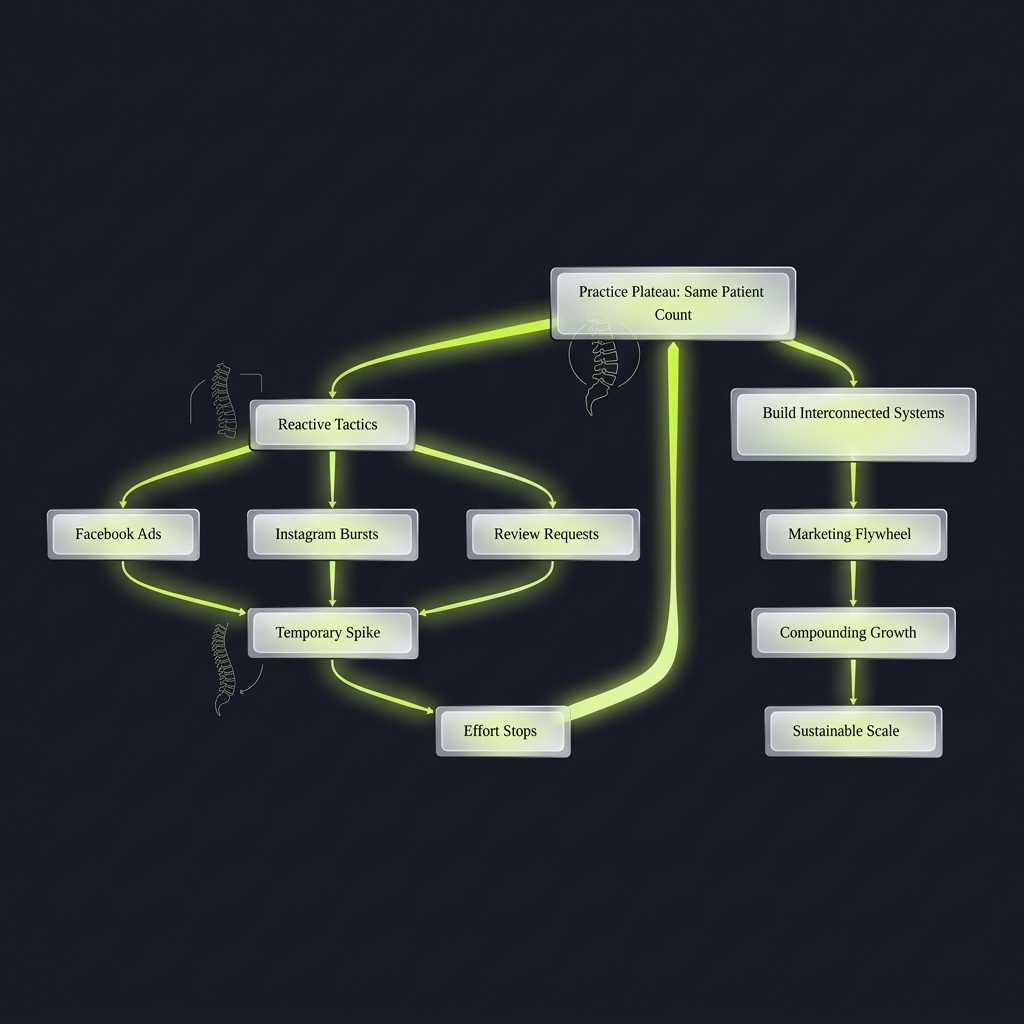
Breaking through a chiropractic practice plateau requires replacing reactive tactics with interconnected systems that function as a flywheel rather than a treadmill. Instead of panic-driven Facebook ads or sporadic social media posts, practitioners must build sustainable marketing architecture where each process feeds the next, creating compounding growth that scales beyond trading time for linear revenue.
The Exhaustion of the Invisible Plateau
The Friday Night Ledger Reality
It is 6:30 PM on Friday. The last patient just left. You sit alone in the adjustment room and pull up your EHR dashboard.
Active patient count: 247. Same as last month. Same as three months ago.
You adjusted 38 people this week. Your shoulders ache. Your schedule was full, but the numbers are flat. You are trading your body for linear revenue, and the ceiling is already visible.
This is the invisible plateau. You are not failing. You are just running in place while the lease, payroll, and your own exhaustion compound.
The Single-Layer Marketing Trap
Most practice owners mistake activity for architecture. They see a dip in new patients and panic into motion: a Facebook ad campaign, a burst of Instagram posts, a plea to the front desk to ask for more reviews.
These are not systems. They are reactions.
A system is a set of interconnected processes where each output feeds the next input. A tactic is a one-time effort that dies the moment you stop feeding it attention.
The U.S. Bureau of Labor Statistics projects chiropractic employment will grow 10% from 2024 to 2034, which is much faster than the 3% average growth rate across all occupations. More chiropractors means more competition for the same local patient pool. Organic word-of-mouth that sustained practices a decade ago no longer scales fast enough to outpace market saturation.
You need a flywheel, not a treadmill.
Why Are My Disjointed Marketing Tactics Costing so Much?
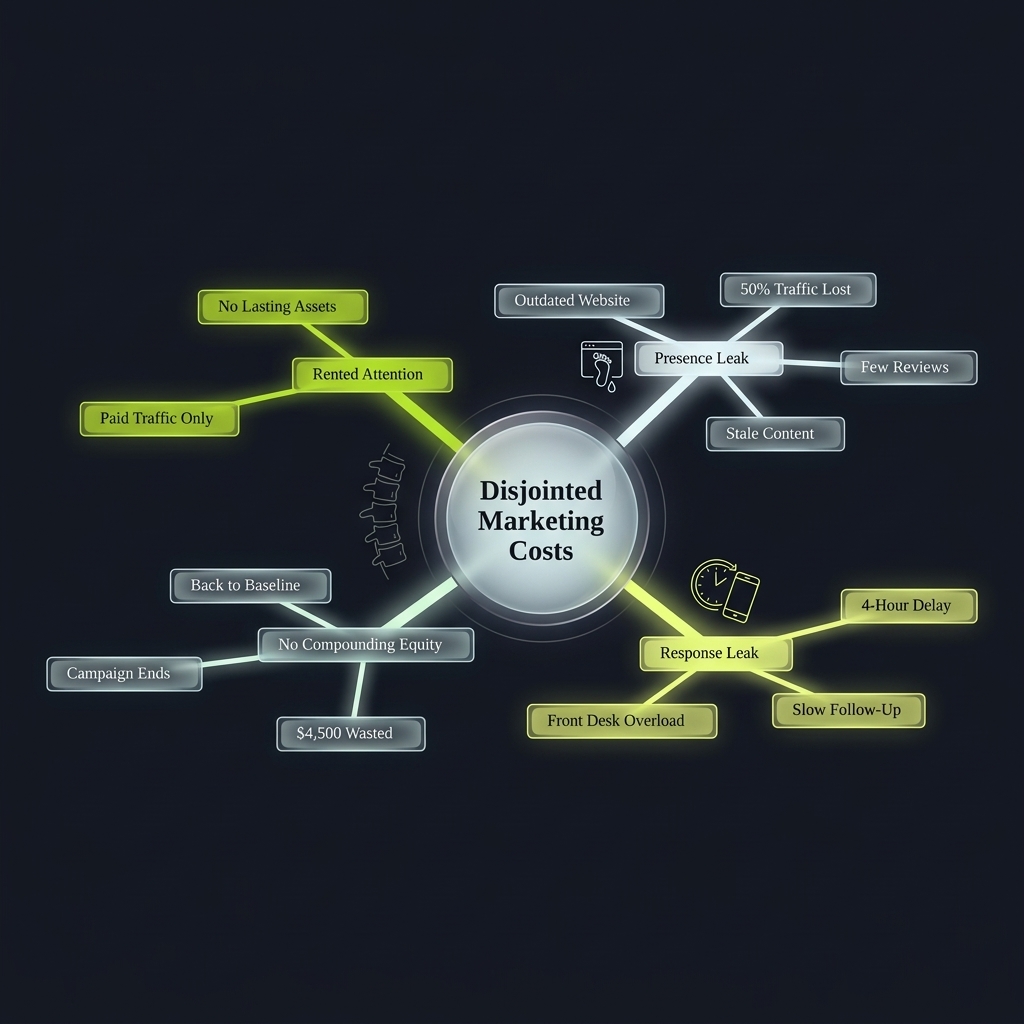
Disjointed marketing tactics cost significantly because they operate in silos without building compounding equity. Each isolated campaign creates multiple leaks: outdated websites lacking credibility cause 50% of paid traffic to leave immediately, slow response times lose additional leads, and when campaigns end, practices return to baseline with no lasting assets, wasting thousands on rented attention that evaporates.
The High Cost of Disjointed Tactics
The Anatomy of the Single-Layer Fix
Here is the cycle: Your patient count dips. You feel the financial pressure. You sign up for a lead-generation service or hire someone to run Google Ads.
The leads come in. A few convert. Most vanish. The campaign ends. Three months later, you are back where you started, but you spent $4,500 and got nothing that compounds.
The problem is structural. Isolated tactics operate in silos. They do not build equity. They do not make the next month easier.
A Facebook ad that drives traffic to a static website with no follow-up system is not a growth strategy. It is rented attention that evaporates the second you stop paying.
The Math of the Leaky Bucket
Let's make this concrete. Take a mid-sized practice spending $1,500 per month on localized Google Ads.
The ads run. Traffic hits the website. Here is where the leaks start.
Presence Leak: Your website has not been updated in 18 months. The blog section has three posts from 2022. Your Google Business Profile has 14 reviews, the last one from six months ago.
Google's Search Quality Evaluator Guidelines explicitly categorize medical and healthcare information as "Your Money or Your Life" (YMYL) topics. Because inaccurate information in this space can directly impact a user's health, safety, or financial stability, Google requires these pages to demonstrate high levels of E-E-A-T: Experience, Expertise, Authoritativeness, and Trustworthiness.
A stale site with no review momentum sends the opposite signal. Fifty percent of ad-driven visitors leave within 10 seconds because the site does not feel current or credible.
You just lost half your ad spend before anyone picked up the phone.
Response Leak: The remaining 50%, about 30 people, submit a contact form or call. Your front desk is excellent, but they are also checking in patients, answering insurance questions, and managing the schedule. Average response time to a web lead: four hours.
The foundational Lead Response Management Study, conducted by Dr. James Oldroyd at MIT in partnership with InsideSales.com, analyzed over 15,000 web-generated leads. The data confirmed that the odds of successfully qualifying a lead drop by a factor of 21 if a business waits 30 minutes to respond rather than responding within the first 5 minutes.
Four hours? You are functionally invisible. Eighty percent of those 30 leads are gone before you respond.
You are down to six warm leads.
Retention Leak: Three of those six book an initial visit. They show up. You deliver excellent care. But there is no systematic follow-up communication outside of appointment reminders. No educational newsletter. No recall sequence for patients who ghost mid-care-plan.
According to 2025 healthcare benchmark data from Anzolo Medical, the average Patient Acquisition Cost across digital marketing channels is $286, though this number can scale up or down depending on the specific medical specialty and market competitiveness.
You just spent $1,500 to net three new patients, which is $500 per conversion. If 15% of your active patient base churns every month because there is no engagement layer keeping you top-of-mind, you are replacing patients at the same rate you acquire them.
Your growth is zero. Your ad spend bought motion, not momentum.
Why the Obvious Fixes Structurally Fail
The Cheap SEO Agency: You hire a content mill for $500 per month. They publish four generic blog posts: "5 Benefits of Chiropractic Care," "What to Expect at Your First Visit."
The posts are keyword-stuffed, clinically sterile, and written by someone who has never adjusted a patient. They rank for nothing. No one reads them. Google's algorithms, trained to suppress low-quality medical content, ignore them entirely.
You wasted $500 and six months.
The Ad Agency Trap: You pay a retainer for Facebook and Google Ads. Leads spike. But the agency optimized for volume, not intent. Half the leads thought the exam was free. A quarter never show up.
The agency hit their KPI, leads delivered, but your schedule is still half-empty two weeks later. You paid for noise, not patients.
The Manual Staff Hustle: You ask your front-desk CA to post on Instagram, chase leads via text, and solicit reviews during checkout. They try. They care. But they are already working a full-time job.
The posts are inconsistent. The follow-ups get dropped when the phone rings. Within a month, they are burned out and you are back to square one.
You cannot scale a system that runs on personal heroics.
What is the Chiropractic Practice Growth Flywheel?
The chiropractic practice growth flywheel is a closed-loop system with three interconnected pillars: Presence (building authority through local SEO and reviews), Response (instantly capturing and converting patient interest), and Retention (maximizing lifetime value and generating referrals). Each component reinforces the others, creating momentum that requires less effort over time while continuously driving practice growth.

The Chiropractic Practice Growth Flywheel
From Tactics to a Unified System
The solution is not working harder. It is building a closed-loop flywheel where every component makes the next component easier.
A flywheel is a mechanical system that stores rotational energy. The more it spins, the less effort it takes to keep it spinning.
In chiropractic business growth, the flywheel has three core pillars:
- Presence: Attracting high-intent local searchers before they ever call.
- Response: Capturing and converting attention instantly, at the peak of interest.
- Retention: Maximizing patient lifetime value and turning satisfied patients into active referral sources.
These are not independent tactics. They are gears in a single machine.
Pillar 1: Presence (the Authority Foundation)
Presence is not about being seen. It is about being trusted before the patient picks up the phone.
The rater8 2025 Patient Review Survey polled 1,008 U.S. adults and found that 84% of patients check online reviews prior to choosing a provider. Exactly 40% have canceled an appointment or changed their care plan based solely on online reviews.
Your Google Business Profile is your storefront. If it is stale, you are invisible.
But reviews alone are not enough. Google's local search algorithms favor clinics with active content updates and consistent review velocity. A practice publishing one high-quality, localized article per week signals to search engines that the clinic is current, engaged, and authoritative.
The mechanism: Search engine optimization compounds. A blog post published today ranks modestly. Six months from now, it is still ranking, still driving traffic, still building authority.
Publish 52 articles in a year, and you have 52 compounding assets working for you while you sleep. This is equity, not expense.
Pillar 2: Response (the Conversion Engine)
Modern healthcare consumers do not want to leave a voicemail. They want instant confirmation.
A 2025 study on clinical communication found that providing patients with mobile-friendly digital options, such as text messaging and online screening forms, promotes greater accessibility, inclusivity, and patient-centric engagement.
The patient who submits a web form at 7:00 PM expects a response within minutes, not the next business day. If your front desk is the only response layer, you are losing leads every evening, every weekend, and every time the phone is busy.
The fix: instant, automated response mechanisms. SMS confirmations. Web-chat that answers common questions. Online booking that lets high-intent prospects schedule without human friction.
This is not about replacing your staff. It is about protecting your ad spend. Every lead that gets an immediate, helpful response is a lead that stays warm until your team can close them.
Pillar 3: Retention (the Lifetime Value Loop)
The cheapest patient to acquire is the one you already have.
If your average patient visit is worth $65 and the typical care plan is 12 visits, a single retained patient is worth $780. Lose them at visit six, and you just left $390 on the table.
Retention is not about aggressive upselling. It is about staying top-of-mind with value-first communication. A monthly newsletter with posture tips, injury-prevention advice, and clinic updates keeps you present in the patient's life outside of pain episodes.
The compounding effect: educated, engaged patients write better reviews. They refer friends. They come back for maintenance care instead of waiting until they are in crisis.
A retained, engaged patient becomes a recurring referral source over the years. Those referrals are free. They are pre-sold. They trust you before they walk in the door.
That is the retention loop feeding the presence loop.
The Compounding Flywheel Effect
Here is how the three pillars interlock:
Retention feeds Presence: Engaged patients leave thoughtful reviews and share your content on social media. Your review velocity climbs. Your local search authority strengthens.
Presence feeds Response: High-intent searchers who find your content before calling are pre-educated. They already trust your expertise. Conversion friction drops by half.
Response feeds Retention: A frictionless onboarding experience, instant confirmation, clear next steps, professional follow-up, sets the tone for the entire care relationship. The patient feels taken care of from minute one.
Each rotation of the flywheel makes the next rotation easier. This is how a practice grows on autopilot.
What is the Execution Wall in Business Growth?
The execution wall refers to the operational bottleneck healthcare practices face when implementing growth strategies. It occurs when practitioners lack the time, skills, and bandwidth to execute essential marketing tasks like content creation, patient engagement, and automation workflows, which collectively require approximately 12 hours weekly of specialized work beyond their clinical responsibilities.

The New Problem: the Execution Wall
The Loop Diagnostic Map
Before you build anything, audit what you have.
Take a single sheet of paper. Draw three columns: Presence, Response, Retention.
Presence Audit: When was your last original blog post published? What is your monthly Google Review velocity? If the answer is "I do not know," you have a presence leak.
Response Audit: Call your own office from an unknown number at 7:00 PM. Submit a web form. How long does it take to get a helpful response? If the answer is "tomorrow morning," you have a response leak.
Retention Audit: How many times did your inactive patient database hear from you last month with purely educational, non-promotional content? If the answer is zero, you have a retention leak.
This 30-minute diagnostic costs nothing. It will immediately expose why your patient count has been flat for two years.
The Reality of the Skills Stack and Time Commitment
Now comes the hard part. Running this flywheel manually requires:
- Writing and optimizing SEO-friendly articles: 4 hours per week.
- Drafting and formatting monthly patient newsletters: 3 hours per month.
- Managing social media syndication and community engagement: 3 hours per week.
- Monitoring, responding to, and driving Google Reviews: 2 hours per week.
- Building, testing, and maintaining SMS and email automation workflows: 5 hours per month.
Add it up: roughly 12 hours per week, every week, forever.
You went to chiropractic school to adjust patients, not to run a multi-department content agency. You do not have the time. Your front desk does not have the bandwidth.
And even if you carved out the hours, you would still need the skills of a copywriter, an SEO specialist, an automation engineer, and a graphic designer.
In the 2023-2024 Physician Sentiment Survey, conducted by The Harris Poll and commissioned by athenahealth, polling over 1,000 practicing physicians, 93% experience burnout on a regular basis, with "excessive documentation requirements" and administrative burdens cited as the leading drivers.
Adding 12 hours of manual systems work per week does not fix burnout. It accelerates it.
The Generic AI Trap
The obvious shortcut: use ChatGPT or another consumer AI tool to generate content.
It does not work. Here is why.
The Time Drain: AI is non-deterministic. Every output requires prompting, editing, formatting, and manual publishing. You shift from writer to editor, but you are still trading your time.
The 4-hour writing task becomes a 2-hour editing task. You saved two hours, but you are still spending two hours you do not have.
The Clinical Disconnect: Generic AI has no clinical voice. It produces dry, robotic, overly academic content that reads like a medical textbook.
Patients in pain do not connect with textbooks. They connect with practitioners who sound like human beings.
The Compliance Minefield: This is the killer. Under the Health Insurance Portability and Accountability Act (HIPAA), healthcare providers are forbidden from entering Protected Health Information (PHI) into third-party software unless a Business Associate Agreement (BAA) is in place.
Entering PHI into unauthorized consumer AI tools constitutes a HIPAA violation.
But the risk goes deeper. Large Language Models are predictive text engines and lack inherent legal or clinical reasoning, meaning they frequently hallucinate or generate copy that violates state board advertising rules, such as guaranteeing outcomes or making unsubstantiated clinical claims.
These are general regulatory and liability risks of medical marketing, exposing your practice to state chiropractic board sanctions, FTC enforcement actions, and malpractice liability.
You cannot afford to publish content that promises outcomes you cannot legally guarantee. One patient complaint to your state board, and you are facing an investigation that costs more than a year of ad spend.
Generic AI is cheap. It is also dangerous.
The System is the Solution (but You Should Not Build It)
The growth flywheel is the correct architecture. The math proves it. The mechanism is sound.
But running it manually is a part-time job that pulls you away from the table, your patients, and your family.
The most profitable practices do not build systems from scratch. They plug into proven infrastructure that operates seamlessly in the background.
Platforms that operate this whole loop end-to-end, like Omniply, which generates weekly SEO articles, patient newsletters, social posts, and compliance-reviewed communication from your own clinical voice, exist precisely because the manual alternative is unsustainable.
You cannot adjust patients and build software at the same time. Choose where your hands belong.
Frequently Asked Questions
Can I Use ChatGPT to Write Patient Emails?
Not safely. Under HIPAA, healthcare providers are forbidden from entering Protected Health Information into third-party software unless a Business Associate Agreement is in place.
OpenAI's consumer and self-serve business tiers, Free, Plus, Pro, and Team/Business, are not eligible for a BAA. OpenAI only signs BAAs for its Enterprise, API, and specific Healthcare deployments.
Entering PHI into unauthorized consumer AI tools constitutes a HIPAA violation. Beyond compliance, generic AI has no guardrails for health-advertising regulations and will write diagnostic claims or outcome guarantees that expose your practice to state board sanctions.
How to Get Front Desk Staff to Use Software
The software must save them time, not create new work. If the tool requires manual data entry, complex workflows, or adds steps to their existing process, they will abandon it.
The best systems run in the background and automate tasks they were already doing manually: lead follow-up, appointment reminders, review requests. Show them the time saved, not the features added.
How to Get New Patients Without Posting Online
You cannot, sustainably. Eighty-four percent of patients check online reviews before selecting a provider. If you have no digital presence, you are invisible to the majority of your local market.
The alternative to posting online is relying entirely on referrals, which caps your growth at the rate your existing patients remember to mention you.
What is a Normal Budget for Clinic Software?
For chiropractic practice management software, expect $200 to $500 per month for EHR and scheduling platforms. For automation and content systems that handle your online presence, response workflows, and patient communication, budget $300 to $800 per month depending on practice size.
Compare this to the $286 average cost to acquire a single new patient through paid ads. Software that retains existing patients or converts leads faster pays for itself in saved acquisition cost.
Is Texting Patients HIPAA Compliant?
Yes, with the right safeguards. Routine messages like appointment reminders and confirmations are standard practice, and federal guidance permits texting when the patient has been informed of the risks and consents. The caution: Standard SMS messages are not end-to-end encrypted and lack the access controls and audit logs required by the HIPAA Security Rule.
So keep clinical details out of plain text messages. For anything touching Protected Health Information, use a platform built for healthcare communication, with a Business Associate Agreement in place, that encrypts messages and maintains audit logs.
How Many Visits Does the Average Chiropractic Patient Make?
It varies widely by condition and care plan, but industry benchmarks suggest 8 to 12 visits for acute care patients and 20+ visits annually for maintenance patients.
If your average visit value is $65, a patient completing a 12-visit care plan generates $780 in revenue. A maintenance patient at 24 visits per year is worth $1,560 annually. Retention directly multiplies revenue per patient.
How to Get Old Patients to Come Back
Systematic recall communication. Send a monthly educational newsletter that provides value without asking for anything. After 90 days of inactivity, trigger a gentle recall sequence: a postural health tip, a seasonal injury-prevention guide, a simple check-in.
The goal is to stay top-of-mind so that when they experience discomfort again, you are the first call they make. Do not sell. Educate.
How to Sync Clinic Software With EHR
Most modern platforms offer API integrations or native connectors with major EHR systems. Check your EHR's integration marketplace first. If direct integration is not available, use a middleware tool like Zapier to pass data between systems.
The key is ensuring patient information flows automatically without manual re-entry, which reduces front-desk workload and eliminates data-entry errors.