
Three miles away, a competitor with half your clinical skill is booking twenty more new patient exams a week than you. They own the top spot on the Google map pack. Your practice is buried on page two, costing you roughly $8,000 every month in lost adjustments.
Most marketing agencies tell you to write weekly blog posts to fix this. That is a waste of your time. You run a clinic, not a media company.
Effective chiropractic SEO does not require you to become a content creator. It requires your front desk to execute a repeatable operational protocol.
Google does not care about your clinical expertise. It cares about structured data. We call this Signal Density, and it is the only leverage point that matters for local search.
This guide breaks down the three operational adjustments that force Google to rank your clinic higher. Here is how you win the map.
Key Takeaways
- Map Pack Revenue Impact: Practices ranking in Google's top three local positions capture 40-50% of 1,200 monthly chiropractic searches, generating 54 new patient exams worth $78,000 annually compared to position seven's two exams.
- Review Velocity Beats Volume: Google prioritizes practices with 80 reviews accumulated in six months over competitors with 200 reviews spread across eight years, with 75% of patients requiring minimum 4.0-star ratings before booking.
- Paid Ads Cost $3,240 Monthly: Healthcare cost-per-click averaged $3.17 in 2025, with high-intent chiropractic keywords ranging $4.50-$9.80, requiring $3,240 monthly ad spend to generate 54 new patient exams that organic map pack positions deliver free.
- Execution Requires 8.5-12 Weekly Hours: Dominating local SEO demands continuous content creation (3 hours), social syndication (2 hours), review management (1.5 hours), and patient newsletters (2 hours) every week, while 56% of small business owners have one hour daily or less.
- HIPAA Violations Cost $30,000-$50,000: The U.S. Department of Health and Human Services fined Manasa Health Center $30,000 and Dr. Igbinadolor $50,000 for disclosing protected health information in Google review responses, with AI hallucination rates of 8-20% creating additional compliance risk.
Why is My Chiropractic Clinic Not Showing on Google Maps?
Chiropractic clinics fail to appear in Google Maps because they don't emit the structured digital signals Google's local search algorithm evaluates. The system ranks practices based on technical optimization factors like reviews, citations, and local SEO signals rather than clinical quality, credentials, or facility investment. Most practices never properly configure these algorithmic ranking factors.
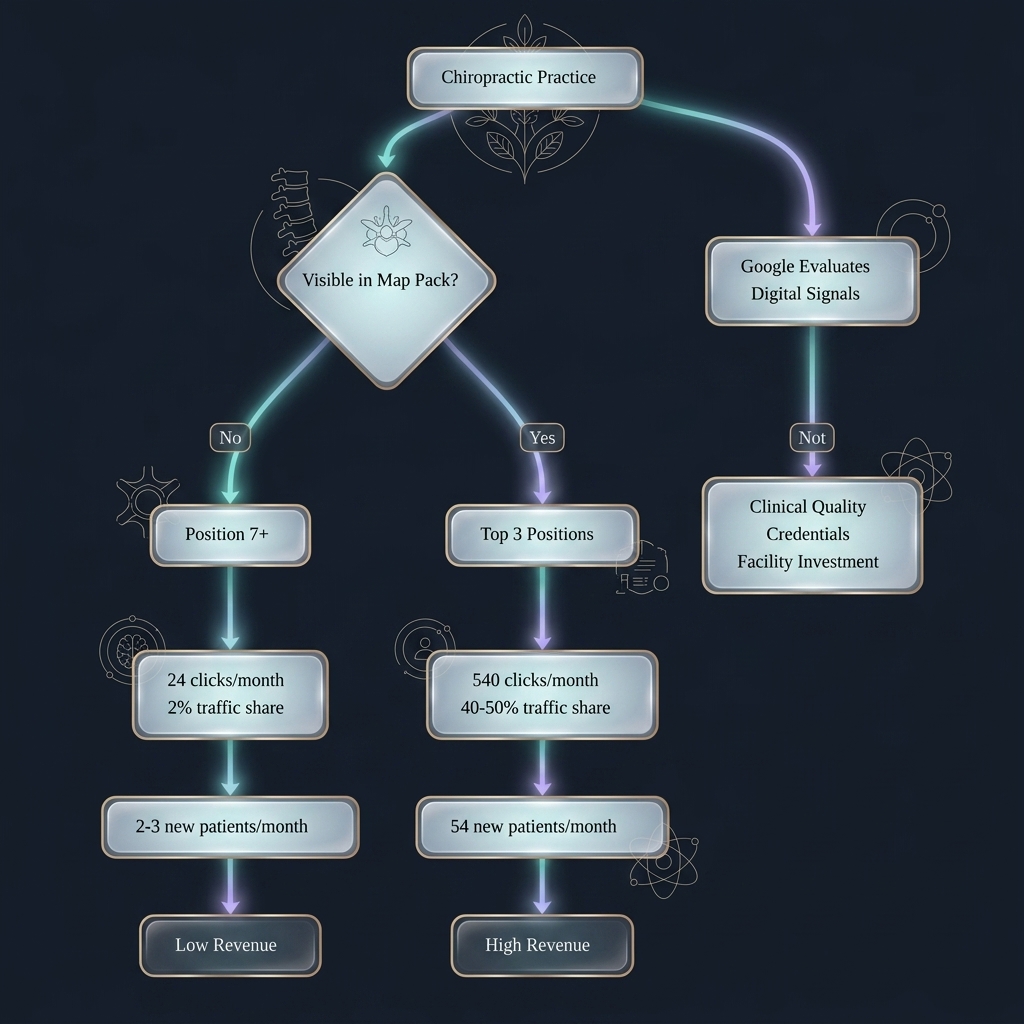
The Invisible Leak in the Local Map Pack
It is Monday morning. The adjustment tables are prepped. The front desk staff is logged in and ready. Your schedule has gaps.
You open a browser and type "chiropractor near me" into Google. Three practices appear in the map pack at the top of the results. None of them is yours.
One competitor has 47 reviews to your 112. Another operates out of a strip mall while you invested in a standalone facility with state-of-the-art equipment. The third graduated two years after you did and has no specialty certifications.
Yet they are visible. You are not.
This is not a reflection of clinical quality. This is Invisibility by Algorithm. Google's local search crawler does not evaluate your credentials, your patient outcomes, or the cleanliness of your adjustment rooms. It evaluates structured digital signals that most practices never emit.
Your clinical excellence is completely invisible to the ranking system.
The Mathematics of Position Seven
The Google map pack is not a vanity metric. It is the primary patient acquisition channel for local healthcare practices. According to research by SOCi analyzing billions of data points across multi-location businesses, practices appearing in the local 3-pack receive 126% more traffic and 93% more conversion-oriented actions, phone calls, website clicks, direction requests, than businesses ranked in positions four through ten.
Here is what that means in practice revenue.
Assume a mid-sized market generates 1,200 monthly searches for chiropractic-related terms: "chiropractor near me," "back pain treatment," "sciatica adjustment," and similar queries. Multiple SEO studies consistently show that the top three map pack positions capture between 40% and 50% of all clicks. That is roughly 540 clicks split among three practices.
Position seven, where many technically competent practices languish, receives less than 2% of search traffic. That is 24 clicks per month.
If 10% of clicks convert to new patient exams, the map pack practices are splitting 54 new patients every month. You are fighting for two.
At a conservative first-year patient value of $1,500, the revenue gap is $78,000 annually. Missing the map pack for twelve months costs your practice the equivalent of a full-time associate's salary.
This is the invisible leak draining your growth.
Why the Obvious Band-Aids Bleed Cash
The first instinct is to buy visibility through Google Ads. You can appear at the top of search results immediately by paying for each click.
According to WordStream/LocaliQ digital marketing benchmarks, the average cost-per-click in healthcare advertising reached $3.17 in 2025, marking a 23% increase from the 2023 baseline. For high-intent chiropractic keywords, "sciatica treatment," "back pain chiropractor," "sports injury adjustment", the cost ranges between $4.50 and $9.80 per click in major metropolitan markets.
Do the math. To generate 54 new patient exams per month at a 10% click-to-conversion rate, you need 540 clicks. At $6 per click, that is $3,240 in ad spend every month. The moment you stop paying, the traffic stops.
Worse, patients skip past the sponsored listings. They trust peer-validated organic results over paid placements. The map pack earns the click because it represents community consensus, not purchased position.
The second instinct is to hire an agency that promises to "optimize your website and Google Business Profile once for $3,000."
This fails because Google's local algorithm is not a static exam you pass once. It is a real-time assessment of ongoing activity. A one-time optimization loses search authority within 45 days as competitors continue emitting fresh signals. Your ranking decays while theirs compounds.
The system rewards continuous output, not historical setup.
What is the Continuous Signal Flywheel in Local SEO?
The continuous signal flywheel in local SEO is a strategic approach where businesses consistently generate fresh digital signals through ongoing activity rather than treating optimization as a one-time task. Practices that emit frequent, consistent signals through content updates, reviews, and profile activity outperform static competitors by demonstrating operational quality and relevance to Google's algorithm, regardless of domain age.
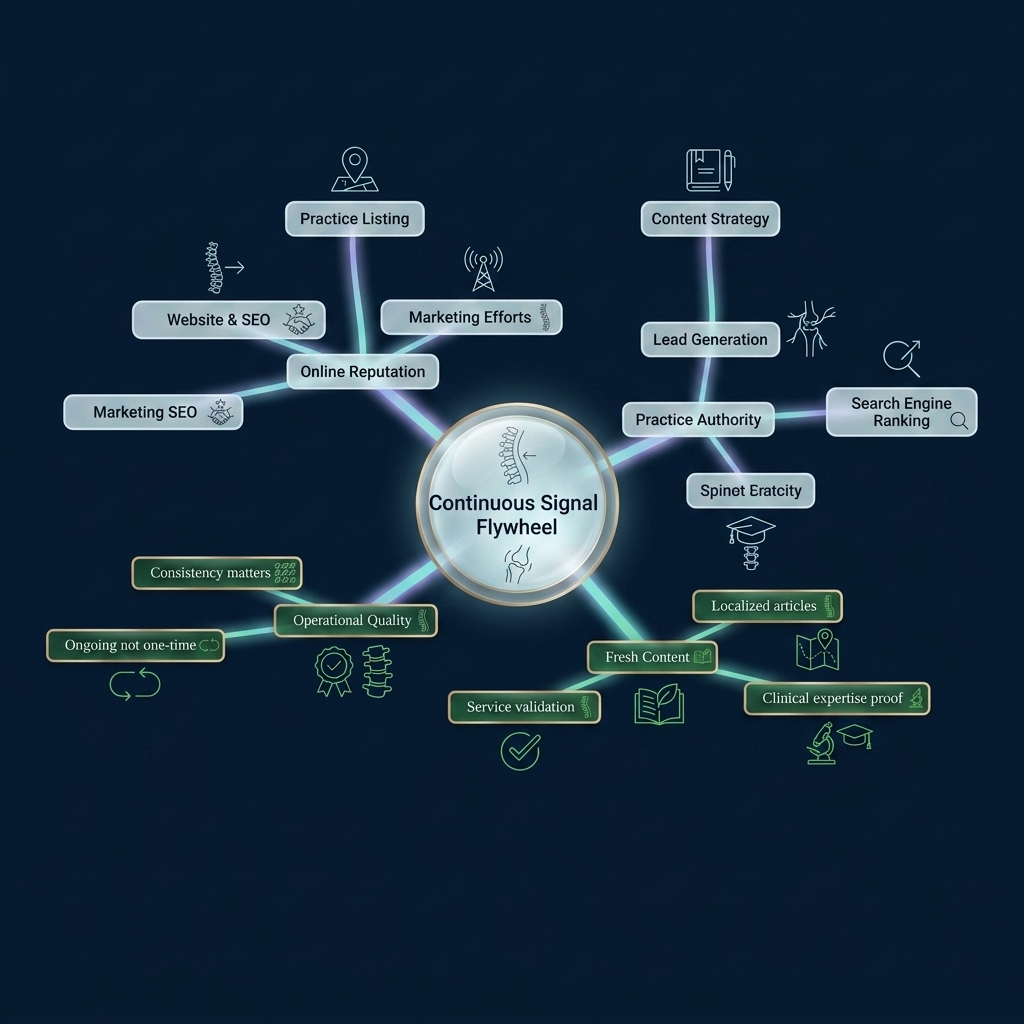
The Continuous Signal Flywheel
Stop viewing local SEO strategy as a technical checklist. It is not a one-time IT task.
Your digital presence is a signal generator. The practices that dominate the map pack emit structured data continuously. Google's algorithm interprets signal frequency, consistency, and freshness as proof of operational quality.
A practice emitting five fresh signals per week will overtake a practice that has been static for two years, regardless of domain age or historical authority.
How Google Decides Local Map Rankings
Relevance measures how well your Business Profile matches the search query. If someone searches "prenatal chiropractor," Google scans your profile and website for semantic proof that you treat pregnant patients.
Distance is geographic proximity between the searcher's location and your practice address. You cannot control this.
Prominence is where the leverage exists. Prominence is Google's assessment of how well-known and trusted your practice is, based on review count, review recency, review velocity, website authority, and profile activity.
Prominence is the only pillar you can systematically improve.
The Four Operational Pillars That Generate Prominence
Pillar One: Fresh Website Content
Publishing localized, clinically accurate content on your main website signals to Google that your practice is actively serving the community. The algorithm scans your site to validate the services and conditions you claim to treat on your Business Profile.
If your profile lists "sports injury rehabilitation" but your website has no content demonstrating expertise in that area, Google discounts the claim. If your site publishes a detailed article explaining how you treat rotator cuff injuries in overhead athletes, the algorithm registers the semantic match and boosts your relevance for related searches.
This is not about keyword stuffing. This is about proof of operational scope.
Pillar Two: Review Velocity and Sentiment
Total review count matters, but velocity matters more. Google values how frequently you receive new reviews and how recent they are.
A practice with 200 reviews accumulated over eight years will lose to a practice with 80 reviews accumulated over the past six months. The second practice demonstrates active patient flow and current operational quality.
Sentiment matters beyond the star rating. Patients write reviews using natural language: "adjusted my lower back pain," "helped my sciatica," "prenatal chiropractor who understands pregnancy discomfort." These semantic signals feed Google's understanding of your clinical specialization.
The threshold is clear. Surveys from Press Ganey, Software Advice, and BrightLocal consistently show that upwards of 75% of patients use 4.0 stars as their minimum threshold for choosing a healthcare provider. Below that line, you are invisible regardless of map pack position.
Active engagement amplifies the signal. BrightLocal's Local Consumer Review Survey found that 89% of consumers are fairly or highly likely to use a business that responds to all of its online reviews, positive and negative. Response rate is a direct ranking factor.
Pillar Three: Active Profile Signals
Your Google Business Profile is not a static listing. It is a real-time communication channel.
Practices that regularly upload photos, publish posts, update service descriptions, and add new business attributes signal to the algorithm that the business is open, engaged, and providing a superior user experience.
Freshness is the mechanism. A profile updated weekly ranks higher than a profile untouched for six months, all else equal.
Pillar Four: Response Speed and Engagement
How quickly you respond to user inquiries, messages, and reviews acts as a direct ranking signal. Google prioritizes businesses that provide immediate utility to searchers.
A practice that responds to messages within two hours signals operational responsiveness. A practice that ignores messages for three days signals the opposite.
The algorithm rewards speed because speed predicts patient satisfaction.
Why the System Compounds
These four pillars feed into each other. Fresh website content drives organic search traffic. Increased traffic signals relevance to Google. Relevance boosts map pack visibility. Map pack visibility drives new patient bookings. New patients generate fresh reviews. Fresh reviews accelerate map pack rankings.
This is the Signal Flywheel. Unlike paid ads, which stop delivering the second you stop paying, the flywheel builds structural equity. Over time, the energy required to maintain your position decreases as the momentum of accumulated authority takes over.
The practices that win the map pack are not running a marketing campaign. They are operating a continuous system.
What is the Execution Wall in Business Marketing?
The execution wall in business marketing refers to the gap between understanding effective marketing strategies and having sufficient time to implement them. It represents the practical barrier where business owners, despite knowing what marketing activities work, lack the 8-12 weekly hours required to consistently execute content creation, social media management, review responses, and patient communications alongside their primary professional responsibilities.
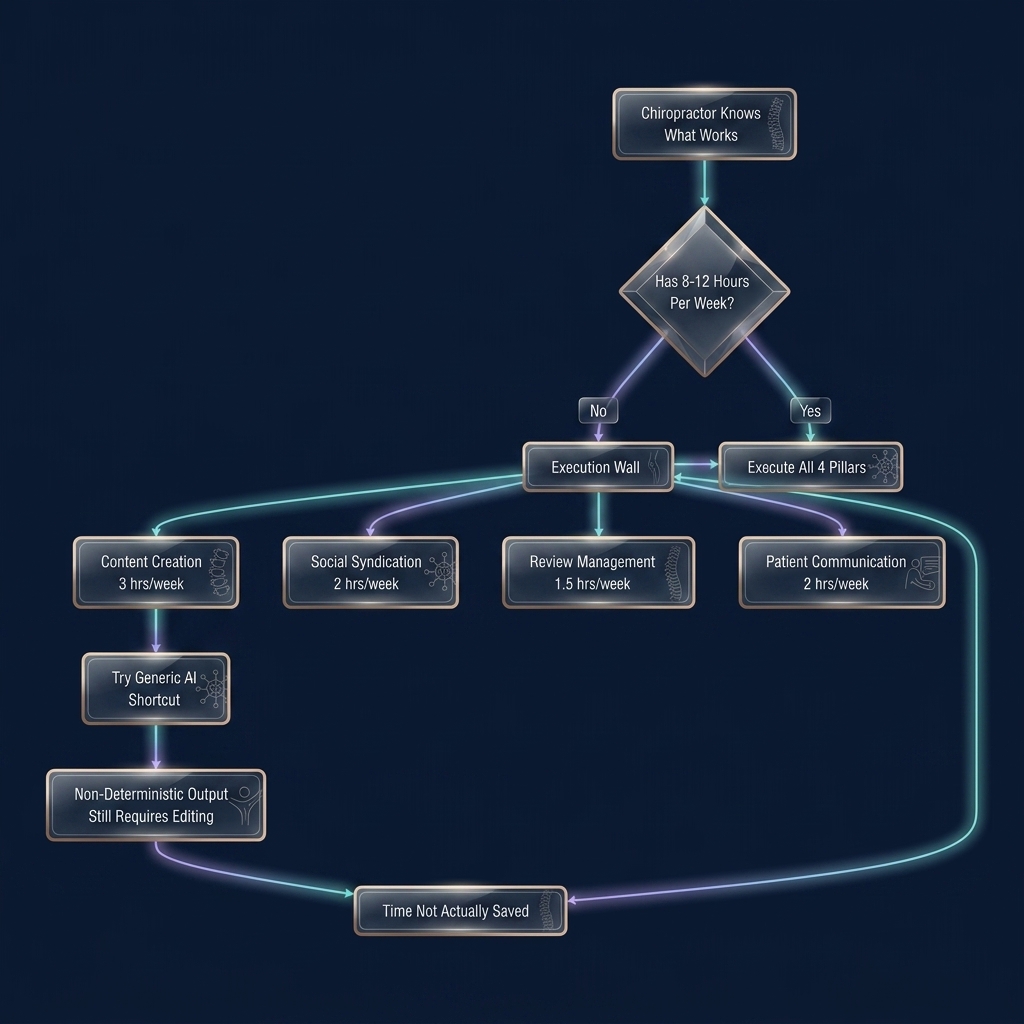
The Execution Wall
The system works. Every time it is executed, it produces results. Every time clinical life interrupts execution, it fails.
Here is the arithmetic of running the complete system.
The Weekly Time Ledger
To dominate a competitive local market, you must operate all four pillars continuously. Here is what that requires:
Content Creation: Writing, optimizing, and publishing one high-quality, clinically accurate, locally-targeted article to your website. Three hours per week.
Social and Profile Syndication: Repurposing that article into social media posts and Google Business Profile updates. Two hours per week.
Review Management: Actively monitoring, requesting, and responding to patient reviews across platforms without violating HIPAA. One and a half hours per week.
Patient Communication: Drafting and sending educational newsletters to keep your existing patient base warm and active. Two hours per week.
Total time commitment: 8.5 to 12 hours every single week.
You did not attend chiropractic school to spend ten hours a week acting as a digital marketing coordinator. Every hour spent writing SEO copy or formatting social posts is an hour taken away from patient care, clinical education, or your personal life.
Research compiled by Constant Contact in their Small Business Now report found that 56% of small business owners have one hour or less per day to spend on marketing activities. The execution wall is not a failure of understanding. It is a failure of available time.
The Generic AI Trap
The obvious shortcut is to use ChatGPT or similar tools to generate your articles, social posts, and review responses in minutes instead of hours.
This fails on three levels.
First, generic AI is non-deterministic. It requires constant prompting, fact-checking, and editing. The output still needs to be copied, pasted, formatted, and uploaded. You save writing time but not execution time.
Second, nothing in the tool ensures compliance with health advertising regulations. The AI will confidently write copy that promises to "cure chronic sciatica in three sessions" or "eliminate migraines permanently." These are unsubstantiated clinical claims your state board does not allow you to make.
Third, responding to patient reviews using generic AI creates direct HIPAA liability. In June 2023, the U.S. Department of Health and Human Services Office for Civil Rights announced a $30,000 settlement and corrective action plan with Manasa Health Center, a New Jersey psychiatric practice, after they impermissibly disclosed protected health information in response to negative patient reviews on Google. In 2022, the HHS OCR imposed a $50,000 civil monetary penalty against Dr. U. Phillip Igbinadolor, D.M.D. & Associates, a North Carolina dental practice, after they responded to a negative Google review by disclosing the patient's full name, dental condition, and treatment details.
Your state board does not care that an AI wrote the text. You own the license. You own the fines, public reprimands, and license suspensions that result from non-compliant public claims.
Recent studies measuring the accuracy of AI models used in clinical decision support and medical documentation generation report hallucination rates between 8% and 20%. A recent industry survey confirms that 91.8% of clinicians report having encountered medical AI hallucinations during their practice. Unverified AI cannot be trusted with healthcare marketing compliance.
The Strategic Conclusion
The system required to dominate the Google map pack is undeniable. It works every time it is executed. It fails the moment clinical obligations interrupt execution.
You cannot build a modern practice with a marketing engine that runs on your spare time.
The only sustainable path is to have the system operated for you by platforms that operate this whole loop end-to-end: tools like Omniply that generate weekly SEO articles, social posts, patient newsletters, and review responses from your practice's own voice, with built-in compliance review, so the flywheel runs automatically while you focus on the adjustment table.
The choice is not whether to run the system. The choice is whether you run it manually or have it run for you.
The practices that own the map pack made that decision months ago. They are booking the patients you are losing.
Frequently Asked Questions
How Does Google Decide Local Map Rankings?
Google evaluates three core pillars: Relevance (how well your Business Profile matches the search query), Distance (geographic proximity to the searcher), and Prominence (how well-known your practice is, based on review count, review recency, website authority, and profile activity). Prominence is the only pillar you can systematically improve.
Is Replying to Google Reviews a HIPAA Violation?
Replying to reviews is not inherently a HIPAA violation, but disclosing any protected health information in a response is. You cannot confirm or deny that someone is a patient, reference specific treatments, or share any clinical details. The safest approach is a templated response that thanks the reviewer without acknowledging a clinical relationship. The U.S. Department of Health and Human Services has issued fines ranging from $30,000 to $50,000 for HIPAA violations in review responses.
Can I Use ChatGPT to Write Google Updates?
Generic AI tools like ChatGPT can generate content quickly, but they create three problems: they require constant prompting and editing (you save writing time but not execution time), they produce non-compliant health claims without safeguards, and they hallucinate medical facts 8% to 20% of the time. You own the regulatory liability for any claims the AI makes under your practice name.
How Much Time Does Google Business Profile Management Take?
To run the complete signal flywheel, fresh website content, profile updates, review management, and patient communication, requires 8.5 to 12 hours per week. A minimal protocol (one photo upload and one post per week) takes 20 minutes but will not move the needle in a competitive market.
Is Paying for Local SEO Services Worth It?
One-time optimization services fail because Google's algorithm rewards continuous activity, not historical setup. A one-time optimization loses authority within 45 days as competitors continue emitting fresh signals. Ongoing services that operate the full system, content, reviews, profile updates, patient communication, produce compounding returns, but only if they run every single week without interruption.
Can You Put Keywords in Google Business Name?
No. Google's official guidelines for representing your business on Google explicitly state that a profile name must reflect the business's real-world name. Including unnecessary information, taglines, or keyword stuffing is strictly prohibited and can result in the suspension of the Business Profile. Use your legal business name only.
How to Track Phone Calls From Google Maps?
Google Business Profile provides call tracking through its Insights dashboard, showing total calls, call duration, and call times. For more granular attribution, use a call tracking service that assigns a unique phone number to your Google listing, allowing you to measure which searches and profile interactions generate calls. This data isolates the return on your map pack position.