
Your front desk misses four phone calls every single Tuesday morning between 10:00 AM and noon. That is not a guess. It is a leak in your balance sheet costing you exactly $1,200 a week in unbooked initial consultations.
You do not have time to write blog posts. You run a clinic. You need those missed calls answered and scheduled without adding another $4,000-a-month salary to your overhead.
Software sales reps want you to buy custom AI software built from scratch. Other companies promise a cheap, $49 plug-and-play tool will solve everything.
Most owners fall into the Customization Trap or the Feature Void. One costs too much cash. The other costs too much time. Using the wrong technology to fix this bottleneck is like performing major surgery on a minor muscle strain.
This guide compares both paths using your actual clinic numbers. You will learn exactly when to buy off-the-shelf, when to build, and how to spot the hidden fees before you sign.
Key Takeaways
- Custom AI Cost: Building custom AI software for healthcare practices costs $40,000–$100,000 upfront plus $39,600 annually in API fees and developer retainers, totaling $102,600 in year one before generating patient bookings.
- Off-Shelf Hidden Labor: Generic AI tools like ChatGPT cost $49 monthly but require 104+ staff hours annually for prompt engineering and output review, creating $14,040 in hidden labor costs that offset the low subscription price.
- HIPAA Compliance Gap: ChatGPT's standard plans lack Business Associate Agreements required for HIPAA compliance, and maximum civil penalties reach $2,190,294 annually for multiple violations when Protected Health Information enters non-compliant systems.
- Search Engine Penalty: Google's March 2024 algorithm update reduced visibility for AI-generated generic content by 45%, costing multi-location practices up to $144,000 annually in lost revenue from dropped search rankings.
- Implementation Timeline Reality: Custom AI software requires three to six months for deployment plus two months for system integration, while off-the-shelf tools provide instant access but never achieve consistent usable output without dedicated staff curation.
Is It Better to Build or Buy Custom AI?
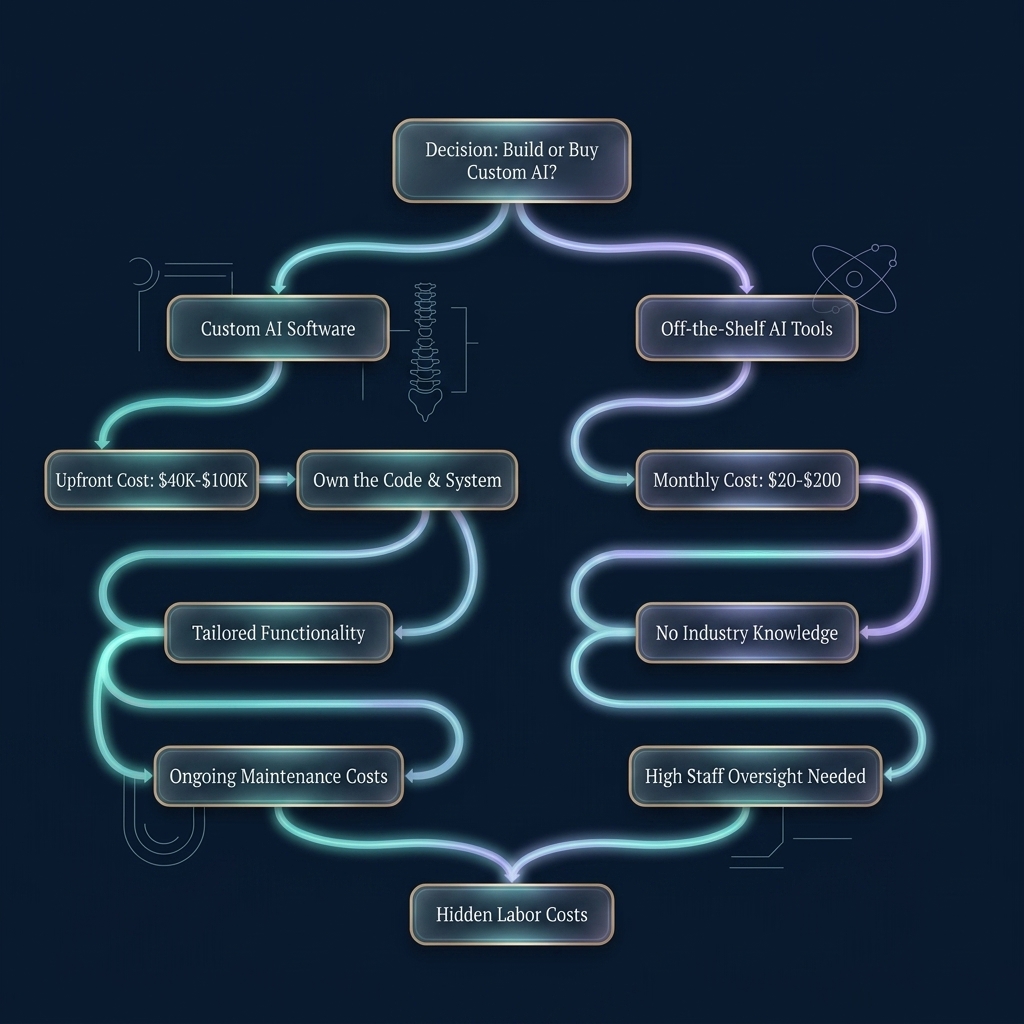
The decision depends on budget, control needs, and risk tolerance. Custom AI costs $40,000-$100,000 upfront plus ongoing maintenance but offers tailored functionality and compliance safeguards. Off-the-shelf tools cost $20-$200 monthly but require significant staff oversight to prevent errors and lack industry-specific knowledge, creating hidden labor costs that offset initial savings.
The Two Paths: What You Actually Get for Your Money
Custom AI Software: Hiring Developers to Build Your Own System
Custom AI software means you pay a development team to write code specifically for your practice. They connect your system to an Application Programming Interface (API) from OpenAI or Anthropic. They build a dashboard your staff can actually use. They write rules that prevent the system from hallucinating medical claims you cannot legally make.
You own the code. You also own the bugs, the security liability, and the monthly retainer to keep it running.
The average upfront cost to build custom software ranges from $40,000 to $100,000. That number climbs fast when you add Artificial Intelligence and machine learning. Then comes the monthly maintenance: developer retainers, API token fees, and emergency fixes when something breaks at 9 PM on a Friday.
Off-the-Shelf AI: Generic Tools Built for Everyone
Off the shelf AI means ChatGPT, Claude, or any mass-market text generator you access through a browser. You pay $20 to $200 a month. You get instant access to a text box.
The tool has no knowledge of chiropractic scope-of-practice rules. It does not know your clinical voice. It will cheerfully write that spinal adjustments cure diabetes if you do not catch it. Your front desk staff becomes the quality control layer, the prompt engineer, and the copy-paste operator.
The software cost is low. The labor cost is invisible until you calculate it.
How Much Does It Actually Cost to Build Custom AI?
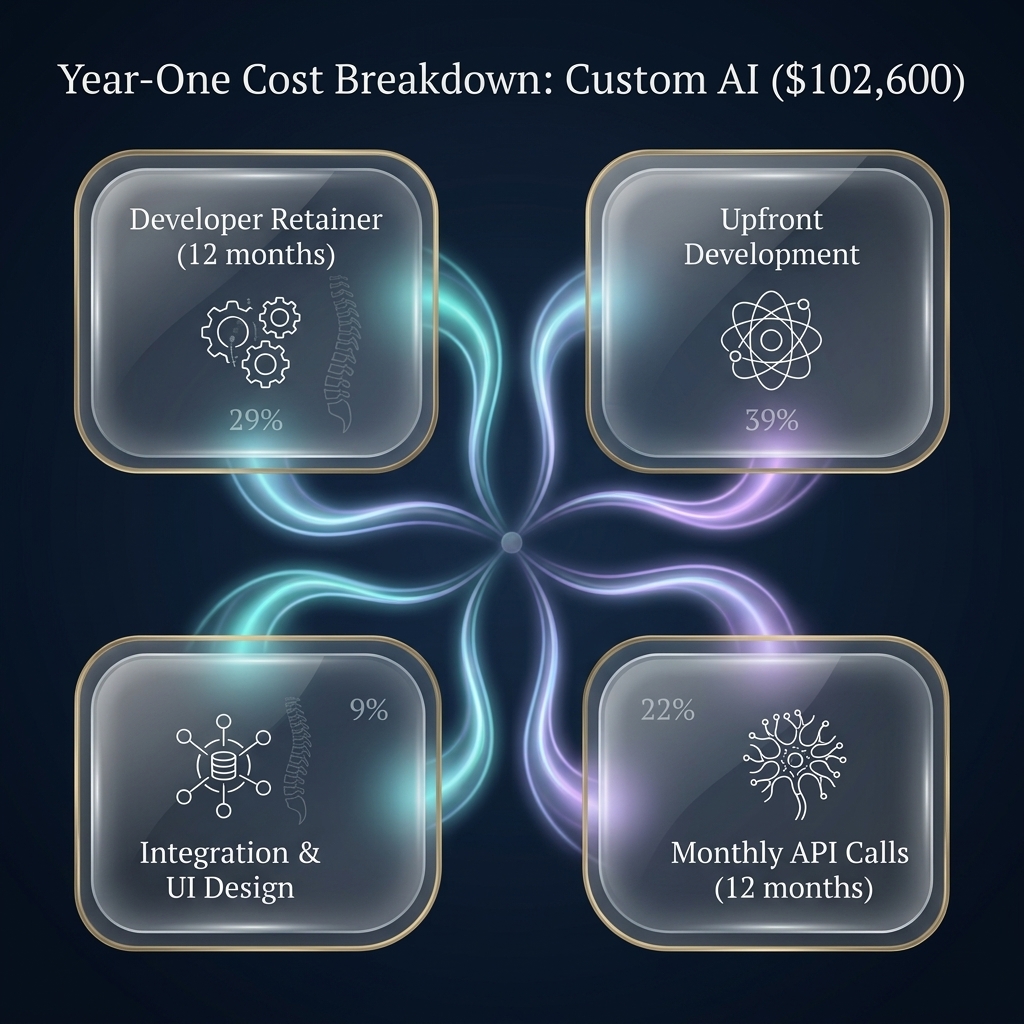
Custom AI systems for healthcare practices start at $40,000 minimum for basic functionality, with integration and interface design adding $15,000-$23,000 more. First-year costs typically reach $102,600 when including upfront development ($63,000) and ongoing monthly fees for API calls and developer retainers ($39,600). Scope creep frequently doubles initial quotes as feature requirements expand.
The Real Cost: Adding up What You Actually Spend
Custom AI: the Expanding Budget
Start with the build: $40,000 minimum for a functional system. Add $15,000 if you want it to integrate with your practice management software. Add another $8,000 for a user interface your staff will not hate.
Then the monthly burn begins. API calls cost money every time the system generates text. A busy three-location practice sending automated appointment reminders and follow-up emails can rack up $800 a month in token fees alone. Developer retainers run $2,500 to $5,000 a month to keep the system updated and fix bugs.
Do the year-one math: $63,000 upfront plus $39,600 in monthly fees. That is $102,600 before a single patient books an appointment through the system.
Scope creep is the silent killer. You start wanting a simple booking assistant. Three months in, you realize it needs to check insurance eligibility, send reminders, and handle cancellations. Each feature expands the timeline and doubles the quote.
Off-the-Shelf AI: the Hidden Labor Tax
The software costs $49 a month. The labor costs $18,000 a year.
Here is the math. Your front desk manager spends two hours a week writing prompts, reviewing outputs, editing robotic phrasing, and pasting approved text into your email system. That is 104 hours a year. At $35 an hour loaded cost, you just spent $3,640 on labor that produces no patient visits.
Now add the clinic owner's time. You spend one hour every Sunday reviewing the week's social posts and blog drafts because you cannot risk publishing something that violates advertising rules. That is 52 hours a year. If your clinical time is worth $200 an hour in forgone revenue, you just burned $10,400.
Total annual cost: $14,040 in labor plus $588 in software. And you still do not have consistent output because the tool has no memory, no guardrails, and no understanding of what a chiropractor is allowed to claim.
According to the Medical Group Management Association, 33% of medical practices cannot fill front-desk roles. You are asking the staff you do have to add prompt engineering to a job description that already includes phones, scheduling, insurance verification, and patient check-in.
The Verdict on Cost
Off-the-shelf wins on sticker price. Custom wins on control. Both lose on total cost of ownership when you account for time, labor, and the opportunity cost of the owner acting as project manager or editor-in-chief.
How Long Does Custom AI Software Take to Implement?
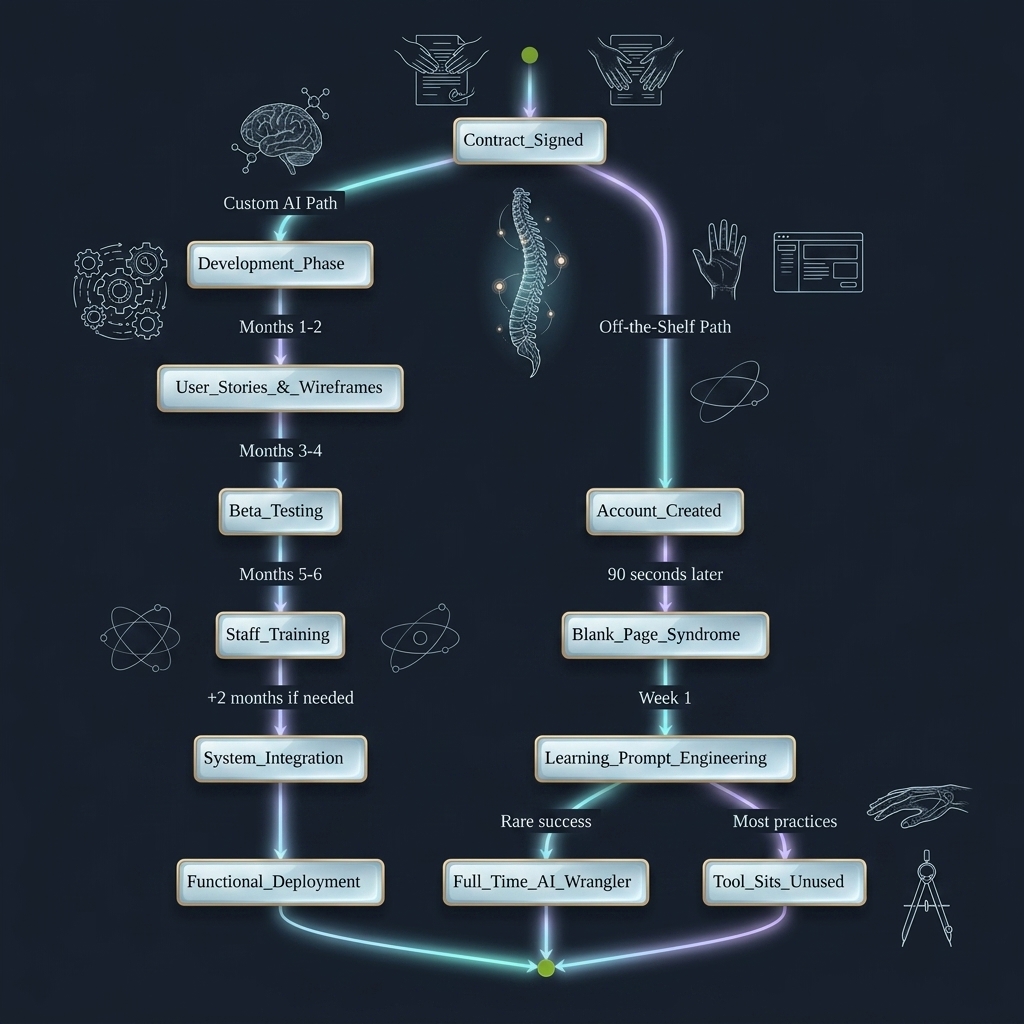
Custom AI software implementation for healthcare practices typically requires three to six months from contract signature to functional deployment. Organizations should expect an additional two months if integration with existing software systems is needed, bringing total implementation time to approximately eight months for fully integrated solutions.
Implementation: How Long Before It Actually Works
Custom AI: the Six-Month Waiting Game
Building custom software development turns you into a product manager. You write user stories. You sit through weekly status calls. You test beta versions and report bugs. You train staff on a system that will change three times before it stabilizes.
Timeline: three to six months from contract signature to functional deployment. Add two more months if you want it integrated with your existing software stack.
The friction point is focus. You are a chiropractor. You treat patients. Now you are reviewing wireframes and debating whether the "Book Appointment" button should be blue or green. Every hour spent managing developers is an hour not spent in the clinic.
Off-the-Shelf AI: the Instant Access Illusion
You create an account in 90 seconds. You have a text box. Now what?
The blank page syndrome hits immediately. Your front desk opens ChatGPT, types "write a blog post about back pain," and gets 500 words of generic advice that could apply to any practice in any city. It mentions nothing about your techniques, your philosophy, or your local market.
The tool is instant. The learning curve is not. Your team needs to learn prompt engineering: how to give context, set tone, specify length, and request revisions. Most practices enthusiastically adopt the tool for one week. Then the manual labor becomes obvious and the tool sits unused.
Speed to deployment: one day. Speed to consistent, usable output: never, unless someone on your team becomes the full-time AI wrangler.
The Verdict on Implementation
Off-the-shelf wins on speed to access. Custom wins on tailored functionality. Both require significant human capital to bridge the gap between what the tool does and what your practice actually needs.
How Does Automation Actually Affect Chiropractic Practice Growth?
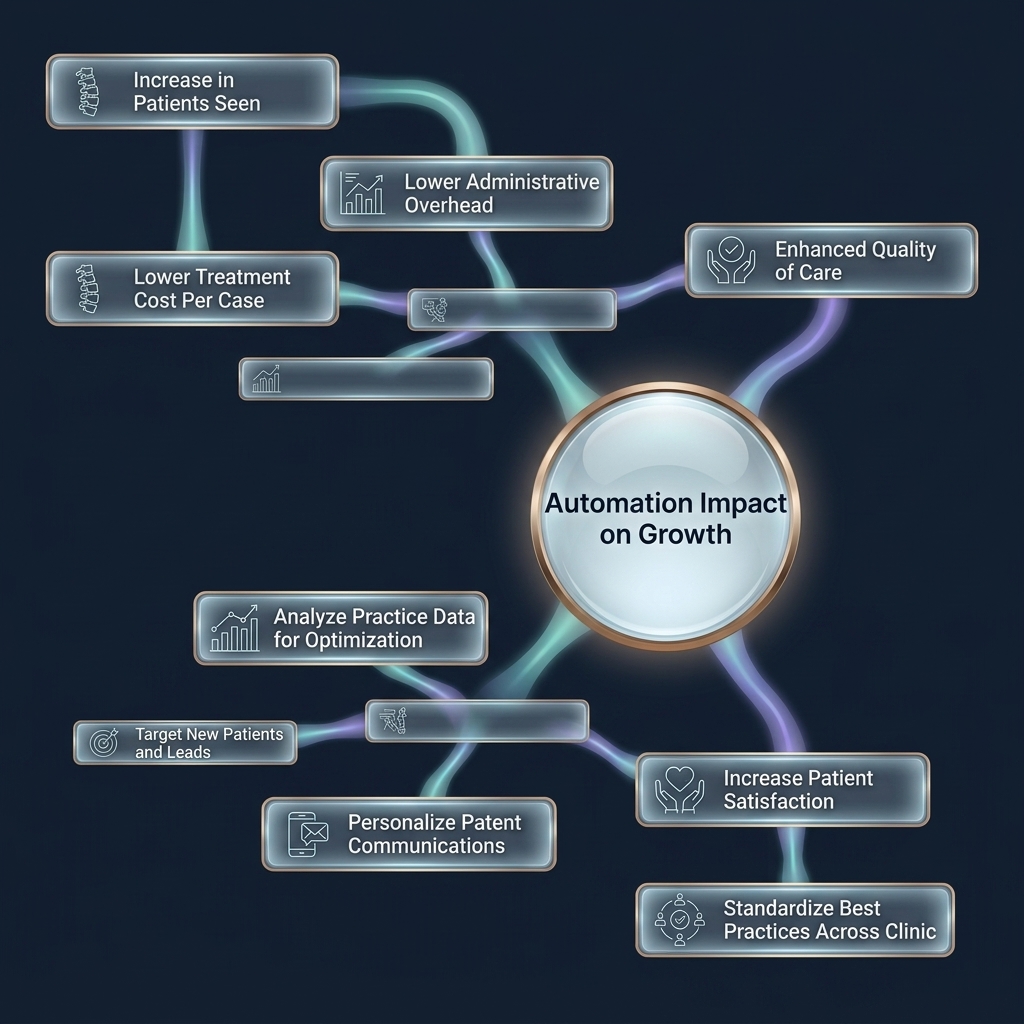
Automation affects chiropractic practice growth through differentiation and patient retention. Custom AI systems that mirror a practitioner's clinical voice create consistent patient experiences, crucial in a competitive market with 70,000 practitioners. However, generic AI tools produce undifferentiated content that search engines penalize, potentially costing multi-location practices up to $144,000 annually in lost revenue from reduced visibility and patient inquiries.
Patient Impact: What Actually Happens to Your Practice Growth
Custom AI: Precision at Scale
A well-built custom system can mirror your clinical voice perfectly. It sends appointment reminders that match your tone. It generates follow-up emails that reference your specific treatment protocols. It creates a consistent patient experience across every automated touchpoint.
The U.S. Bureau of Labor Statistics projects 10% growth in chiropractic employment through 2034, with 70,000 practitioners currently competing for patients. In that environment, a differentiated voice matters. Custom systems deliver that differentiation.
The risk is technical failure. When your custom system breaks, patient communication stops. No reminders go out. No follow-ups get sent. Patients miss appointments and you have no idea the system failed until you notice the drop in show rate three weeks later.
Off-the-Shelf AI: Generic Output, Diluted Brand
Generic healthcare AI tools produce generic content. The blog post about sciatica reads like every other blog post about sciatica. The social media caption sounds like it came from a template bank. Patients scroll past it because nothing signals it came from a real human with a distinct point of view.
Search engines notice too. In March 2024, Google integrated its "Helpful Content" system into its core algorithm, reducing visibility for unhelpful, unoriginal, search-engine-first content by 45%. If you are using a generic AI tool to mass-produce blog posts, you are actively training Google to ignore your website.
The math on this is brutal. A three-location practice that drops from page one to page two for "chiropractor [city name]" loses approximately 30% of organic search traffic. If that practice was getting 40 new patient inquiries a month from search, that is 12 lost leads. At a 50% conversion rate and $2,000 lifetime patient value, that is $144,000 in annual revenue disappearing because the content strategy backfired.
The Verdict on Patient Impact
Custom AI wins when you have the budget and technical capacity to maintain a high-quality system over multiple years. Off-the-shelf AI actively harms growth when used to produce volume content without human curation and brand alignment.
What Are the Regulatory Risks of Building Custom AI?
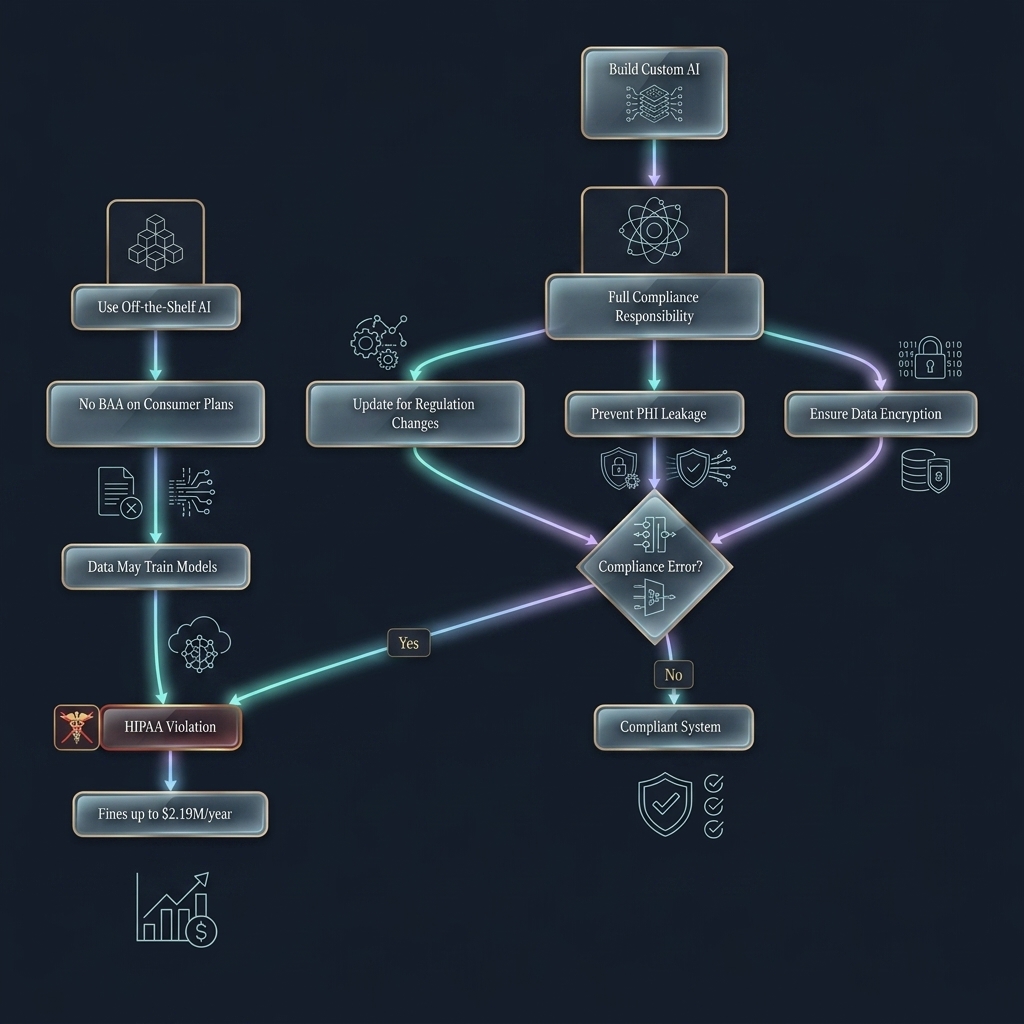
Building custom AI places full compliance responsibility on the healthcare practice. Organizations must ensure proper data encryption, prevent PHI leakage into training sets, and update systems as regulations evolve. Without healthcare compliance expertise, developers may create HIPAA violations through improper data logging or API integrations, exposing practices to fines exceeding $2 million annually.
Regulatory Risk: the Compliance Minefield
Custom AI and HIPAA Compliance
When you build custom AI software, you own the compliance burden. You must ensure the system encrypts data correctly. You must verify that no Protected Health Information (PHI) leaks into public model training sets. You must update the system every time state board advertising rules change.
The Health Insurance Portability and Accountability Act (HIPAA) sets strict penalties for violations. As of 2026, the maximum calendar-year civil fine caps at $2,190,294 for multiple violations of an identical provision. If your custom system logs patient names alongside treatment notes and that data touches a non-compliant API, you just created a reportable breach.
Most developers are not healthcare compliance experts. They build the system you request. You are responsible for knowing what to request.
Off-the-Shelf AI and Advertising Violations
Standard consumer AI tools have no concept of healthcare advertising law. Ask ChatGPT to write a blog post about chiropractic care for asthma and it will confidently state that adjustments can cure respiratory conditions. That claim violates scope-of-practice regulations in most states.
The terms of service for most generic AI platforms explicitly state that input data may be used for model training. If your front desk pastes patient names, conditions, or treatment details into a prompt, you just violated HIPAA. The platform is not liable. You are.
HIPAA compliant AI requires a Business Associate Agreement (BAA) with the software provider. OpenAI's standard consumer plans, ChatGPT Free and ChatGPT Plus, do not offer a BAA. While OpenAI does provide BAAs for its Enterprise, Edu, and API tiers, standard off-the-shelf consumer AI tools do not include them and cannot be legally used with Protected Health Information.
The Verdict on Compliance
Both paths carry high risk when not managed by someone with healthcare-specific knowledge. Custom AI puts the compliance burden entirely on you. Off-the-shelf AI makes violations dangerously easy because the tool has no guardrails against generating illegal claims or mishandling PHI.
How Much Does It Cost to Maintain Custom AI?
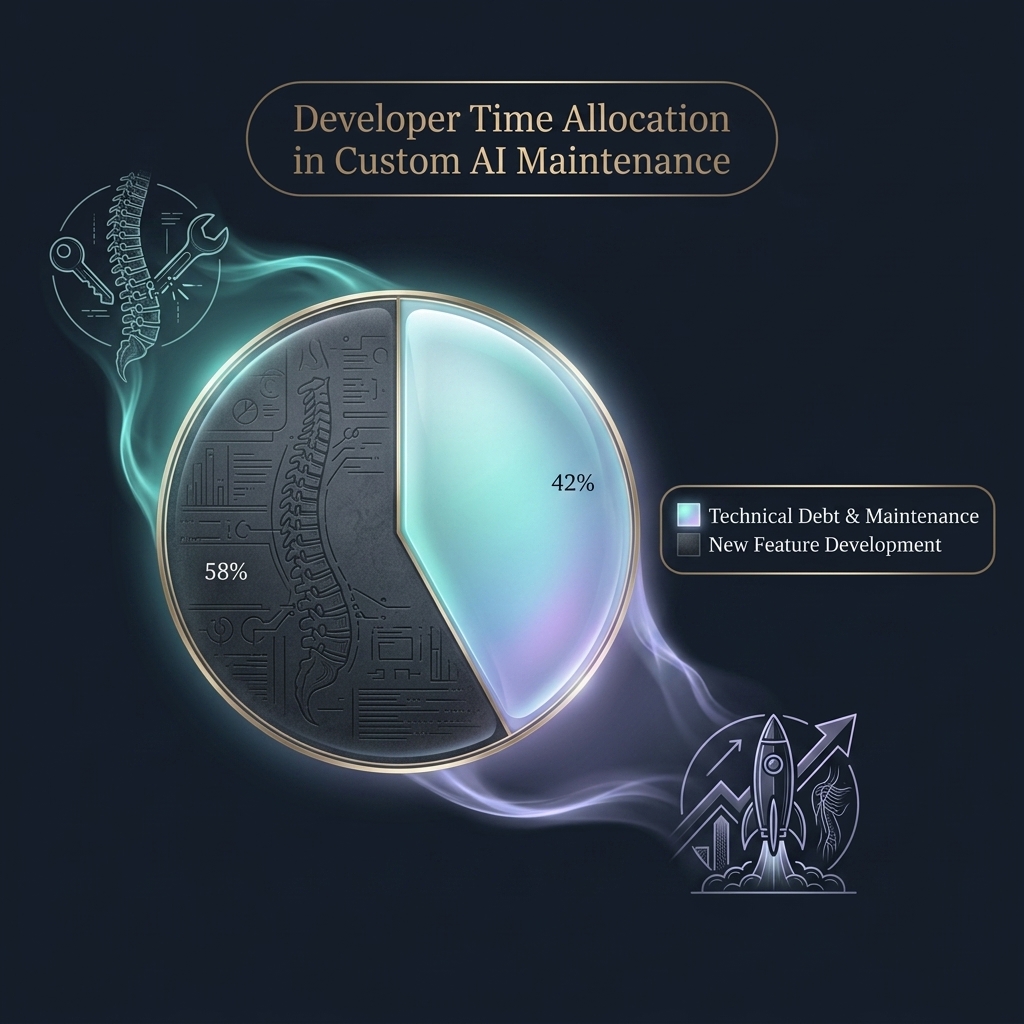
Custom AI maintenance costs consume 25% to 42% of developer time managing technical debt, including model updates, security patches, and code refactoring. These expenses come from monthly retainers paid to developers who must continuously maintain the system as AI platforms evolve and deprecate older versions, representing ongoing backward-looking costs rather than new feature development.
Maintenance: the Long-Term Operational Reality
Custom AI: Permanent Technical Debt
Artificial Intelligence models evolve fast. OpenAI deprecates older API versions. Security protocols change. Your custom system breaks unless a developer refactors the code.
Across the software industry, developers spend 25% to 42% of their time managing technical debt: maintenance, rework, and legacy code fixes. That time comes out of your monthly retainer. You are paying for backward-looking work instead of forward-looking features.
You also face developer lock-in. The agency that built your system knows the codebase. Switching to a new developer means they spend weeks learning the architecture before they can fix anything. You are married to the original builder or you pay the switching cost.
Off-the-Shelf AI: Zero Maintenance, Zero Ownership
Software as a Service (SaaS) platforms handle all technical maintenance. Models update automatically. Servers stay online. You pay your monthly fee and the system works.
The trade-off is ownership. You build no proprietary assets. The prompts you refine over months live inside someone else's platform. If you cancel, you walk away with nothing.
You also have no control over product direction. If the platform adds a feature you hate or removes one you depend on, you adapt or leave.
The Verdict on Maintenance
Off-the-shelf wins on operational simplicity. Custom wins on long-term asset ownership. Both require you to accept a dependency: either on a developer or on a platform.
Should I Build Custom AI or Buy Off-the-shelf?
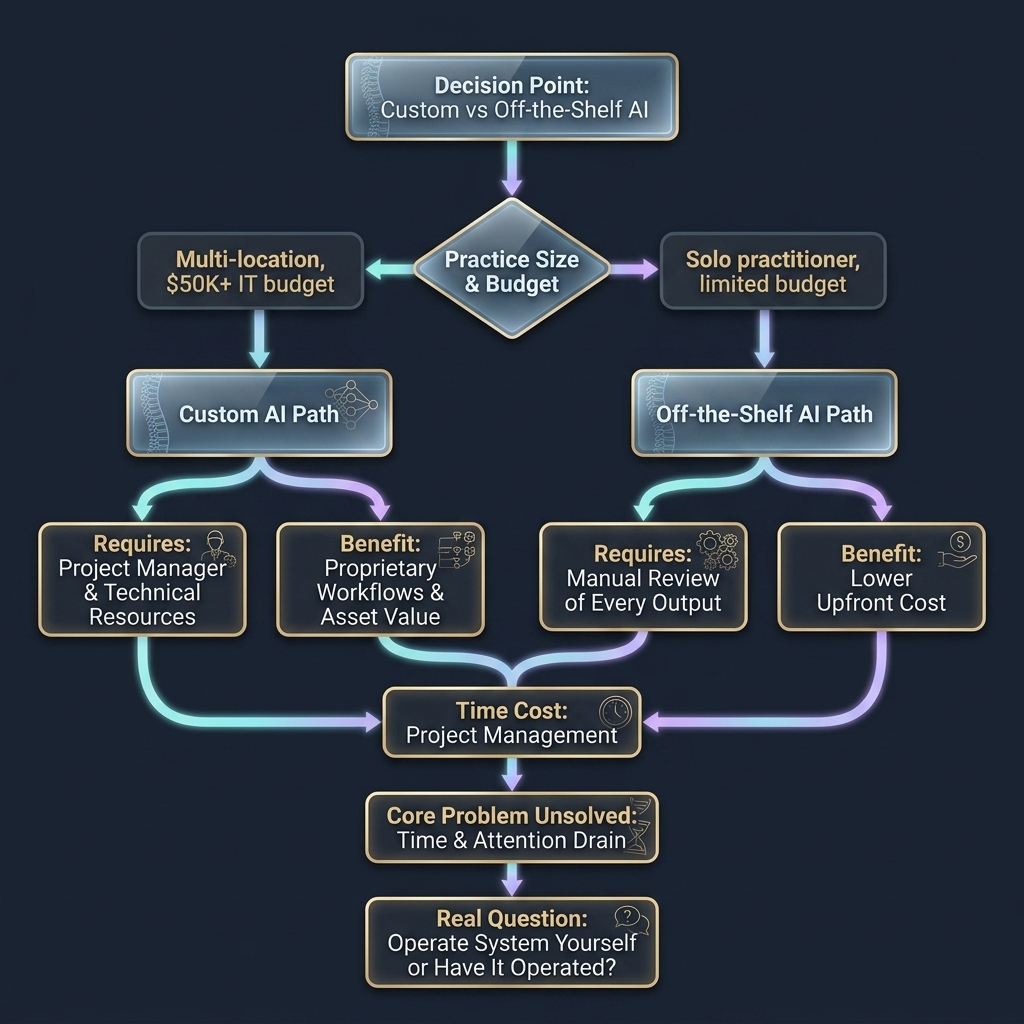
Choose custom AI if you're a multi-location practice with $50,000+ IT budget, proprietary workflows, and technical resources to manage implementation. Select off-the-shelf solutions if you're a solo practitioner willing to manually review every output. However, both require significant time investment; custom demands project management, while off-the-shelf requires constant manual curation and editing.
The Decision Framework: Matching Your Practice to the Right Path
When Custom AI Makes Sense
You run a multi-location practice group with an IT budget exceeding $50,000 annually. You have proprietary clinical workflows that create genuine competitive advantage if digitized. You are building toward a private equity exit and want to increase business valuation with owned software assets.
You also have an internal or contracted technical resource who can act as project manager and ongoing system administrator. You are not personally debugging code or writing user stories.
When Off-the-Shelf AI Makes Sense
You are a solo practitioner looking for a brainstorming tool for internal memos and administrative drafts. You have personal time to manually review and edit every output. You are comfortable with high daily manual effort: copying, pasting, revising, and fact-checking.
You also accept that the output will be generic and require significant human curation to match your brand voice and clinical accuracy standards.
The Problem Both Paths Ignore
Neither path solves the core operational problem: you need consistent, compliant, brand-aligned content and patient communication without becoming a software developer or a full-time editor.
Custom AI demands you manage a software project. Off-the-shelf AI demands you manually curate every output. Both consume the resource you have the least of: your time and attention.
The real question is not custom versus off-the-shelf. The real question is whether you want to operate the system yourself or have it operated for you.
How Can Medical Practices Automate Administrative Tasks Entirely?
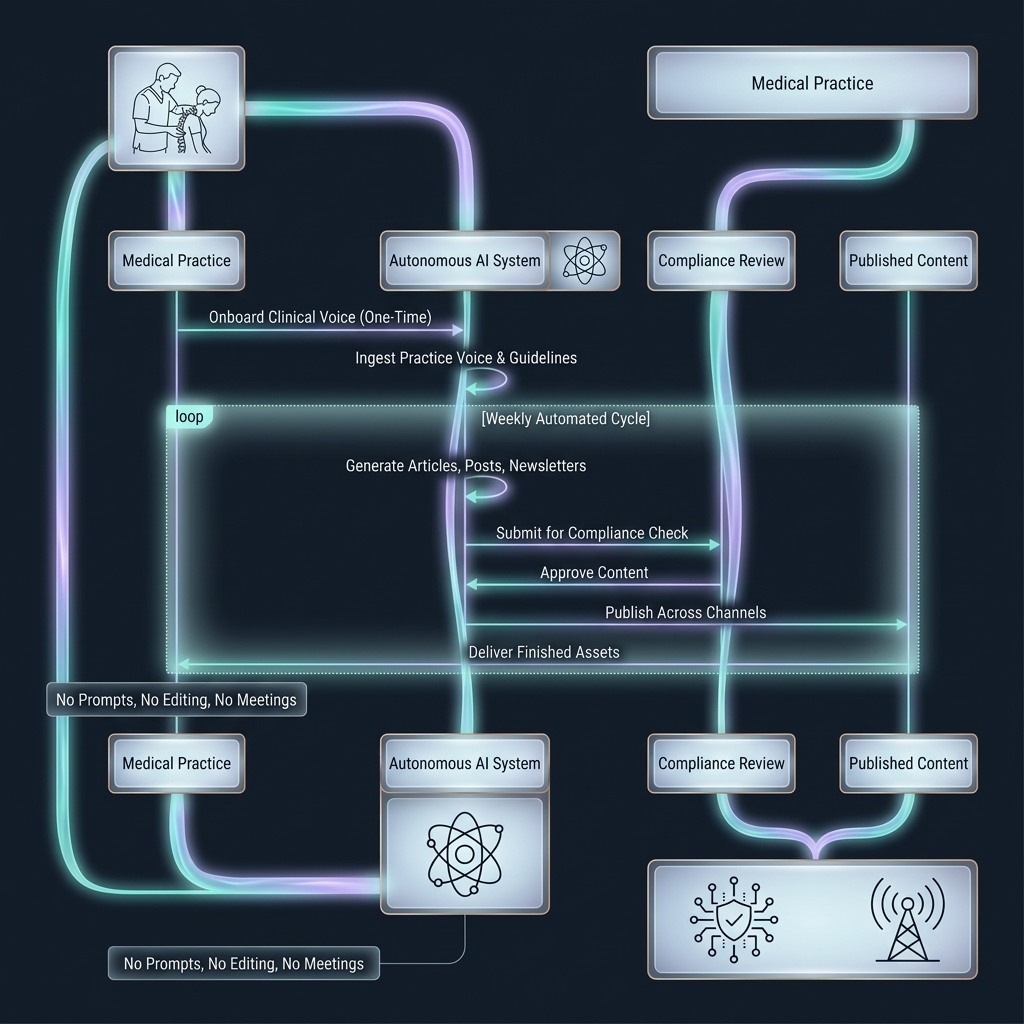
Medical practices can automate administrative tasks entirely by implementing end-to-end systems that handle content creation, communication, and publishing autonomously. These platforms ingest the practice's clinical voice during onboarding, then automatically generate weekly articles, social posts, patient newsletters, and follow-up sequences with built-in compliance review, eliminating manual execution and physician involvement in routine administrative workflows.
The Third Option: Systems That Run Without You
Busy practices need a different model entirely. Not a tool you operate. Not software you manage. A system that runs on its own and delivers finished assets.
According to Medscape's 2024 Physician Burnout Report, 62% of physicians identify excessive administrative tasks as the primary contributor to burnout. The solution is not better administrative tools. The solution is removing administrative tasks from the physician's workload entirely.
Platforms that operate the entire content and communication loop end-to-end, generating weekly articles, social posts, patient newsletters, and automated follow-up sequences from the practice's own voice, with compliance review built in, eliminate the choice between building and prompting. Systems like Omniply handle the production, the review, and the publishing, turning content from a manual project into an automated function.
The model works because it removes the practice owner from the execution layer. No prompts to write. No outputs to edit. No developer meetings. The system ingests the practice's clinical voice during onboarding, then produces finished work on a schedule.
How Do I Choose the Right AI for My Practice?
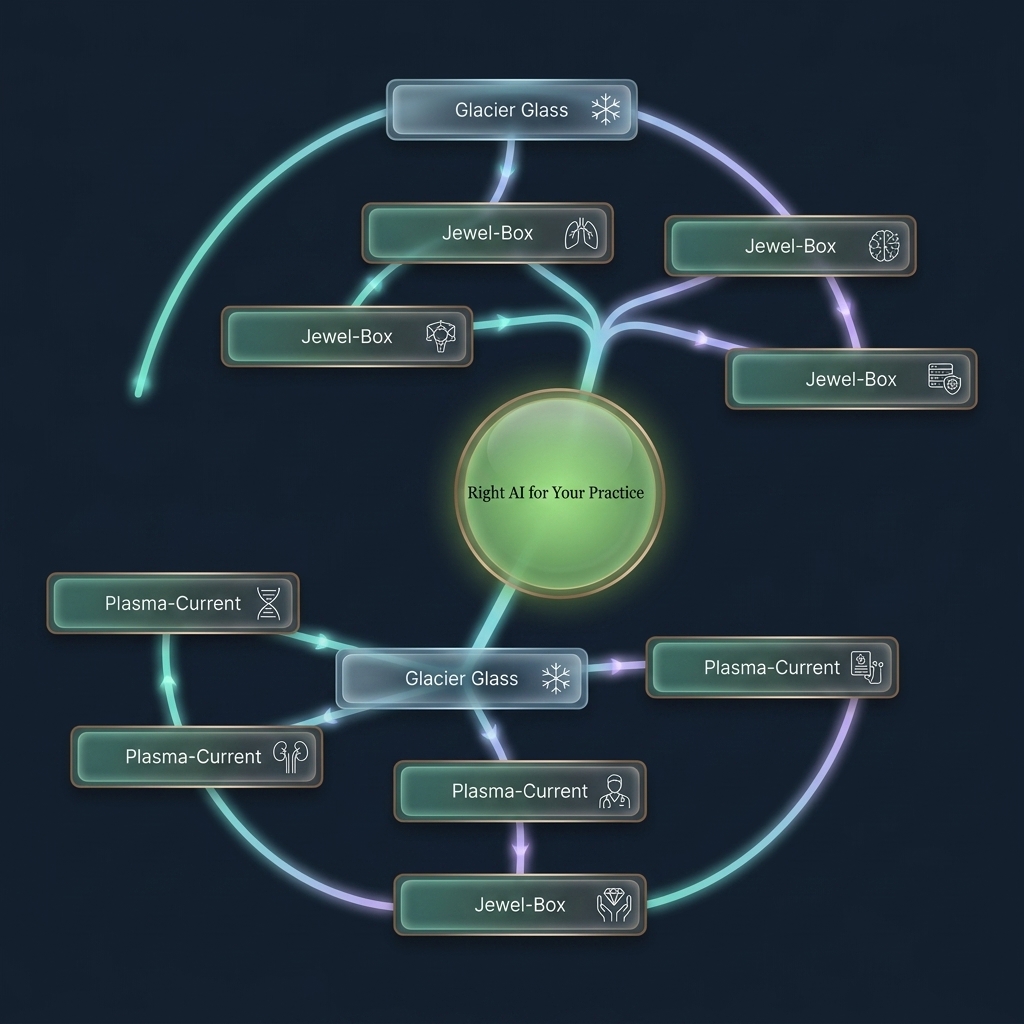
For chiropractic practices with one to three locations, the optimal choice is a managed, healthcare-specific AI system rather than custom or off-the-shelf solutions. Custom AI requires six-figure investments, while generic platforms create compliance risks and demand significant staff time. A specialized managed system eliminates software management responsibilities, allowing practitioners to focus on patient care.
Making the Decision That Fits Your Practice
For a one-to-three location chiropractic practice, custom AI is a capital-intensive distraction. Off-the-shelf AI is a time-consuming compliance risk that dilutes brand and harms search visibility.
The math is clear. Custom AI costs six figures in year one. Off-the-shelf AI costs $14,000 in hidden labor annually and produces generic output that Google actively demotes. Neither path returns the owner's time to clinical work.
The stronger starting point for most practices is a managed, healthcare-specific system that operates the entire communication engine without requiring the owner to act as project manager, prompt engineer, or editor-in-chief.
The goal is not to find better software. The goal is to remove software management from your job description entirely.
Return your focus to what you do best. Deliver exceptional patient care. Let the system handle everything else.
Frequently Asked Questions
Can ChatGPT Write Blog Posts for a Chiropractor?
ChatGPT can generate draft text about chiropractic topics. It cannot ensure the content complies with state advertising regulations, matches your clinical voice, or avoids making claims outside your scope of practice. Every output requires manual review and significant editing to be usable. The tool produces generic content that search engines increasingly filter out of rankings.
Is ChatGPT HIPAA Compliant?
No. ChatGPT's standard terms of service do not include a Business Associate Agreement (BAA), which is required for HIPAA compliance. Input data may be used for model training. Entering any Protected Health Information (PHI) into the platform creates a compliance violation. The platform is not designed for healthcare data handling.
What is the Difference Between Custom and Off-the-shelf AI?
Custom AI means hiring developers to build software specifically for your practice. You own the code, control the features, and pay for ongoing maintenance. Off-the-shelf AI means subscribing to a mass-market tool like ChatGPT. You get instant access but generic output that requires manual curation. Custom costs six figures upfront. Off-the-shelf costs $20 to $200 monthly but demands significant labor to produce usable results.
How Much Does It Cost to Build Custom AI?
Building functional custom AI software for a healthcare practice typically costs $40,000 to $100,000 upfront, plus $2,500 to $5,000 monthly for developer retainers and maintenance. API token fees add $500 to $1,500 monthly depending on usage volume. Total year-one cost often exceeds $100,000 before accounting for internal project management time.
Will My Front Desk Staff Actually Use AI Tools?
Most practices see initial enthusiasm followed by abandonment. Off-the-shelf AI tools require manual prompt writing, output review, and copy-pasting into other systems. During busy clinic hours, this extra labor gets skipped. Without dedicated training and accountability systems, adoption rates drop to near zero within 30 days. The tool adds work instead of removing it.
Should a Clinic Hire an Agency or Use Software?
Agencies produce custom content but cost $2,000 to $5,000 monthly for consistent output. Software costs less but requires your team to operate it, which consumes labor hours. The decision depends on whether you have internal capacity to manage content production. Most small practices lack that capacity, making a managed system that operates autonomously the more realistic path.
When Does a Small Business Need Custom AI?
Small businesses rarely need custom AI. Custom development makes sense for multi-location enterprises with proprietary workflows, annual IT budgets exceeding $50,000, and dedicated technical staff. For practices under five locations, the capital cost and maintenance burden outweigh the benefits. Off-the-shelf tools or managed platforms deliver better return on investment without the technical overhead.