
The majority of local phone calls go to three specific pin drops on a smartphone screen. If your clinic occupies position four, your front desk is essentially invisible.
A patient with acute lower back pain does not research clinical credentials. They tap the first three local options that appear under the map. This is the Local Map Monopoly.
Winning this placement has little to do with traditional advertising or social posts. It comes down to how search algorithms evaluate your location's proximity, review velocity, and profile accuracy. The three-pack at the top of Google's local results controls the primary path to new patient calls.
When you lose those three spots, your cost per prospective patient spikes while your intake calendar thins out.
This article breaks down the exact mechanics behind local map visibility, why standard website updates fail to move your ranking, and how to claim a top-three spot that consistently fills your schedule.
The math dictates the winner.
Key Takeaways
# Key Takeaways: Winning the Google Local Map Pack for Chiropractic Practices- Three-Pack Dominance: The majority of local phone calls go to the three businesses displayed in Google's Local Pack, which captures 40-50% of total clicks for local intent queries, while position four receives zero visibility and functionally no patient calls.
- Profile Authority Mechanism: Google Business Profile signals account for 32% of local ranking weight, far exceeding website domain authority; profiles publishing weekly posts perform twice as well in engagement metrics compared to static profiles untouched for months.
- Review Velocity Over Volume: Review signals represent 16% of ranking weight, but the algorithm prioritizes steady monthly intake (2-5 reviews per month) over total count; a practice with 80 reviews and consistent weekly intake outranks competitors with 340 reviews but no new feedback in 11 weeks.
- NAP Consistency Multiplier: Businesses maintaining identical Name, Address, and Phone data across 40+ authoritative directories experience 4.1x ranking improvement compared to those with inconsistent citations; discrepancies fragment local authority and trigger verification loops.
- Mobile Conversion Behavior: 80% of U.S. consumers search for local businesses at least weekly, with 68% using click-to-call directly from mobile search results; users make decisions in under 10 seconds based on star ratings above 4.5 and proximity within five miles.
- Behavioral Validation Signals: Google tracks post-listing actions (calls, directions, website visits, immediate returns to search) which account for 8% of ranking weight; phone calls from Google Business Profiles convert at significantly higher rates than standard web traffic, reinforcing algorithmic prioritization.
- Spam Filter Triggers: Keyword-stuffed business names ("Smith Chiropractic | Best Back Pain Relief") trigger immediate profile suspension; sudden review spikes (30-50 reviews in days) activate fraud detection causing reviews to be hidden and temporary
What Does the Google Local Pack Actually Control?
The Google Local Pack controls the majority of local search visibility and customer acquisition, capturing 40-50% of total clicks for local intent queries. It displays three businesses above all organic website listings, creating a binary outcome where businesses either occupy one of three positions and receive calls, or rank fourth and operate in functional obscurity with zero visibility.
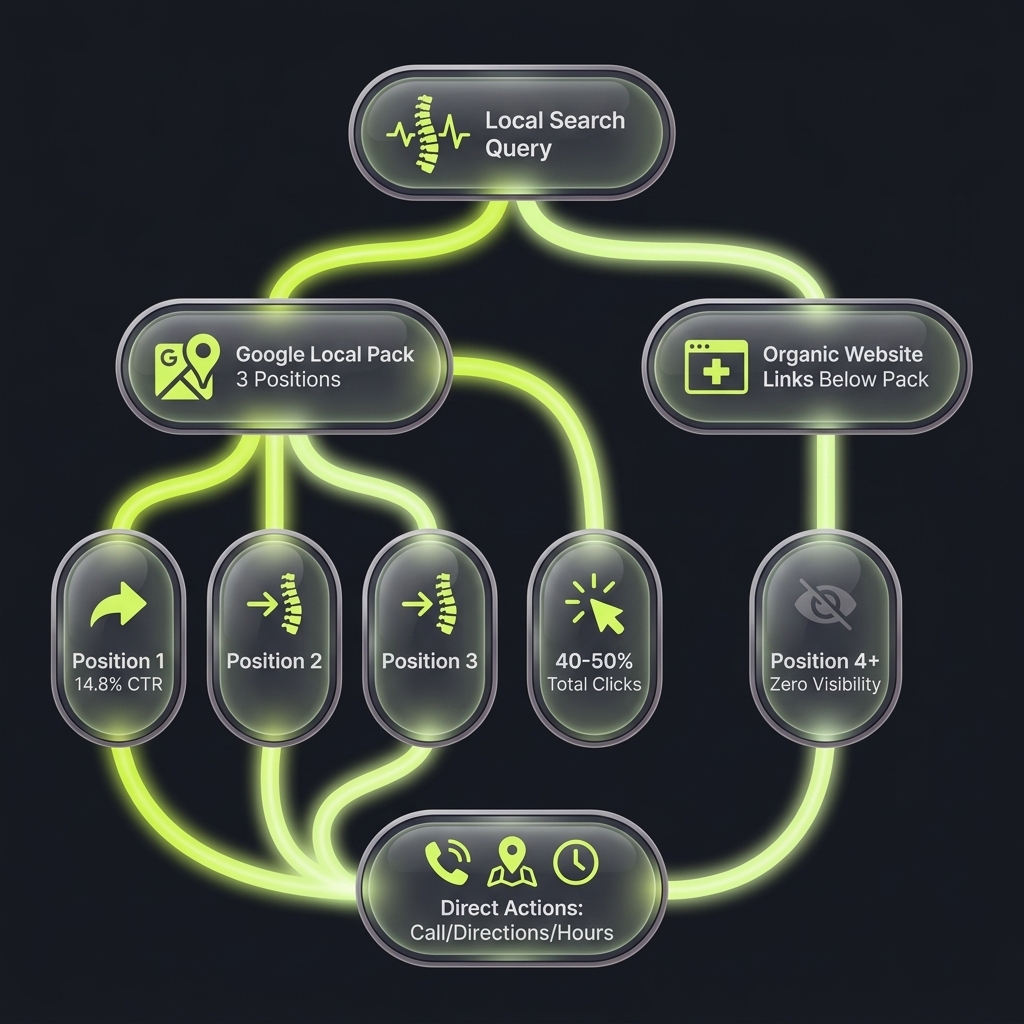
What the Local Pack Really Controls
Sixty-eight percent of U.S. Google searches now end without a click to any website. The searcher found what they needed, a phone number, an address, hours, or reviews, directly on the results page.
The three-pack sits above every traditional website link. It occupies the most valuable real estate on mobile and desktop: the fold. When someone searches "chiropractor near me" or "sciatica relief," they see a map with three pins, three business names, three star ratings, and three tap-to-call buttons before they see a single organic link.
Forty-two percent of all local searches result in clicks directly inside that map interface, not on websites below it. The three-pack receives between 40% and 50% of total clicks for local intent queries.
The top position in that pack captures a 14.8% click-through rate on average. Position four gets nothing.
This creates a binary outcome. You either occupy one of those three slots and receive calls, or you occupy position four and operate in functional obscurity. There is no middle ground.
The Misconceptions That Cost You Calls
Most practice owners believe a modern, high-cost website guarantees visibility. It does not. Your website matters for conversion once someone clicks through, but it contributes almost nothing to whether you appear in the three-pack in the first place. Google Business Profile signals, proximity, categories, profile completeness, review velocity, account for 32% of local ranking weight. Your website's domain authority and on-page content contribute far less.
The second misconception: physical distance determines everything. Distance sets a baseline, 74% of three-pack positions go to businesses within five miles of the searcher, but it does not dictate the order within that radius. A clinic three miles away with steady review velocity and an active profile will outrank a closer competitor with a stale listing and no recent patient feedback.
The third misconception: profile setup is a one-time task. It is not. Google evaluates how active and operationally current your practice appears. A profile untouched for six months signals abandonment. A profile with weekly updates, fresh posts, and continuous review intake signals operational health. The algorithm rewards the latter.
Why Mobile Behavior Changed Everything
Eighty percent of U.S. consumers search for local businesses at least weekly. Thirty-two percent search daily or multiple times per day. The device they use is a phone.
Mobile users do not scroll. They do not open multiple tabs to compare options. They look at the three pins, read the star ratings, and tap the call button on the listing that feels most credible. Sixty-eight percent of users utilize the click-to-call feature directly from mobile search results.
This is not browsing behavior. This is triage behavior. The patient has a problem right now. They want a solution within their insurance network, close to their location, with a rating above 4.5 stars. They make that decision in under ten seconds.
If your listing does not appear in those three slots, you never enter the consideration set.
What Main Factors Determine Google Local Rankings?
Google local rankings are determined by three primary factors: profile authority through continuous activity such as weekly posts and updates, review velocity measuring the frequency and recency of customer feedback rather than total volume, and behavioral validation signals. These mechanisms operate independently but create compounding effects when strategically aligned to demonstrate operational presence and community engagement.
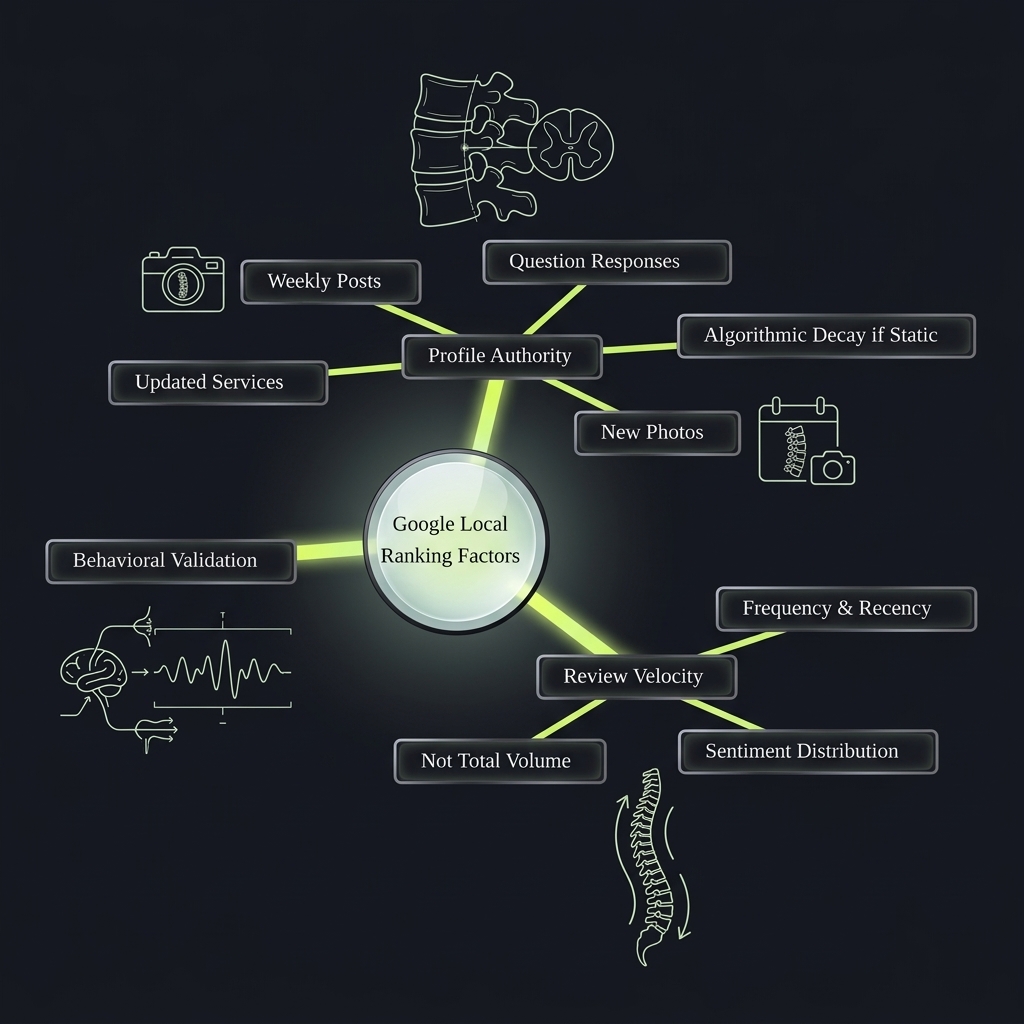
The Three Mechanisms That Determine Rank
Google's local algorithm evaluates three primary signal categories: profile authority, review momentum, and behavioral validation. Each operates independently, but they compound when aligned.
Profile Authority Through Continuous Activity
Google tracks how often your profile changes. Not cosmetic changes—substantive updates that signal operational continuity. Weekly posts about health topics relevant to your local area. Updated service descriptions. New photos. Responses to questions.
A profile that publishes a localized post every week, covering topics like posture correction for desk workers or spinal alignment principles, demonstrates continuous operational presence. Google interprets this as a signal that the business is active, engaged with its community, and likely to answer the phone when a patient calls.
A static profile, untouched for six months, signals the opposite. The algorithm assumes the practice may be closed, unresponsive, or operationally neglected. Even if the practice is thriving, the profile communicates abandonment.
The result: algorithmic decay. Your ranking erodes slowly, week by week, as competitors with active profiles accumulate small advantages that compound into displacement.
One clinic I worked with had a beautiful website and strong word-of-mouth referrals but had not touched their Google profile in eight months. They dropped from position two to position seven over that period. A competitor three blocks away, with a less polished website but weekly profile posts and consistent review intake, moved from position five to position one.
The difference was not clinical skill. It was operational visibility.
Review Velocity and Sentiment Density
Review signals account for 16% of local ranking weight. But the algorithm does not simply count total reviews. It evaluates velocity, recency, and sentiment distribution.
A practice with 200 reviews accumulated over five years and no new feedback in the last six months appears dormant. A practice with 80 reviews and two to five new reviews every month appears operationally healthy and continuously serving patients.
Google's May 2026 filtering update deployed AI models specifically to detect sudden review spikes. If you run a review contest and generate 50 reviews in three days, the algorithm flags it as suspicious. Your new reviews may be hidden, and your profile may enter a temporary review-intake pause while the system audits for fraud.
Steady weekly intake passes every filter. It mimics organic patient behavior. It signals that your practice sees a continuous flow of satisfied patients willing to leave public feedback.
The math: if you see 60 new patients per month and convert 10% of them into reviews, you generate six reviews per month, or roughly 1.5 per week. That rate keeps you competitive in most markets. A competitor generating eight reviews per month will outpace you, even if their total review count is lower.
One clinic I audited had 340 total reviews but had not received a new review in 11 weeks. A competitor with 190 reviews but consistent weekly intake outranked them by two positions. The algorithm prioritized recent momentum over historical volume.
Behavioral Validation and Conversion Friction
Google tracks what users do after they see your listing. Do they click the call button? Do they request directions? Do they visit your website? Do they immediately return to the search results and try a different listing?
These behavioral signals account for 8% of ranking weight, but they validate all your other efforts. A profile with complete information, accurate hours, a working phone number, a clear service list, and high-resolution photos, converts significantly more map views into phone calls compared to an incomplete profile.
Incomplete profiles create friction. A patient taps your listing, cannot find your hours, and returns to the search results to try the next option. Google interprets that as a signal that your listing did not satisfy the user's intent. Your ranking drops incrementally.
The inverse is also true. A profile that consistently converts views into calls signals to Google that users find your listing relevant and trustworthy. Your ranking stabilizes and often improves, even if your review count is lower than competitors.
Phone calls generated directly from Google Business Profiles indicate high-intent behavior and convert at significantly higher rates than standard web traffic—often among the highest conversion rates of any local search action. The algorithm knows this. It prioritizes listings that generate calls because those listings satisfy user intent most effectively.
What Mistakes Ruin My Local Search Visibility?
Local search visibility suffers from NAP inconsistency across directories, where mismatched business names, addresses, and phone numbers fragment authority signals. Keyword-stuffed business names trigger spam filters and profile suspensions. Spiky review patterns, sudden bursts followed by silence, activate fraud detection, causing reviews to be hidden or rankings penalized. Consistent data across directories and steady review acquisition prevent these critical errors.
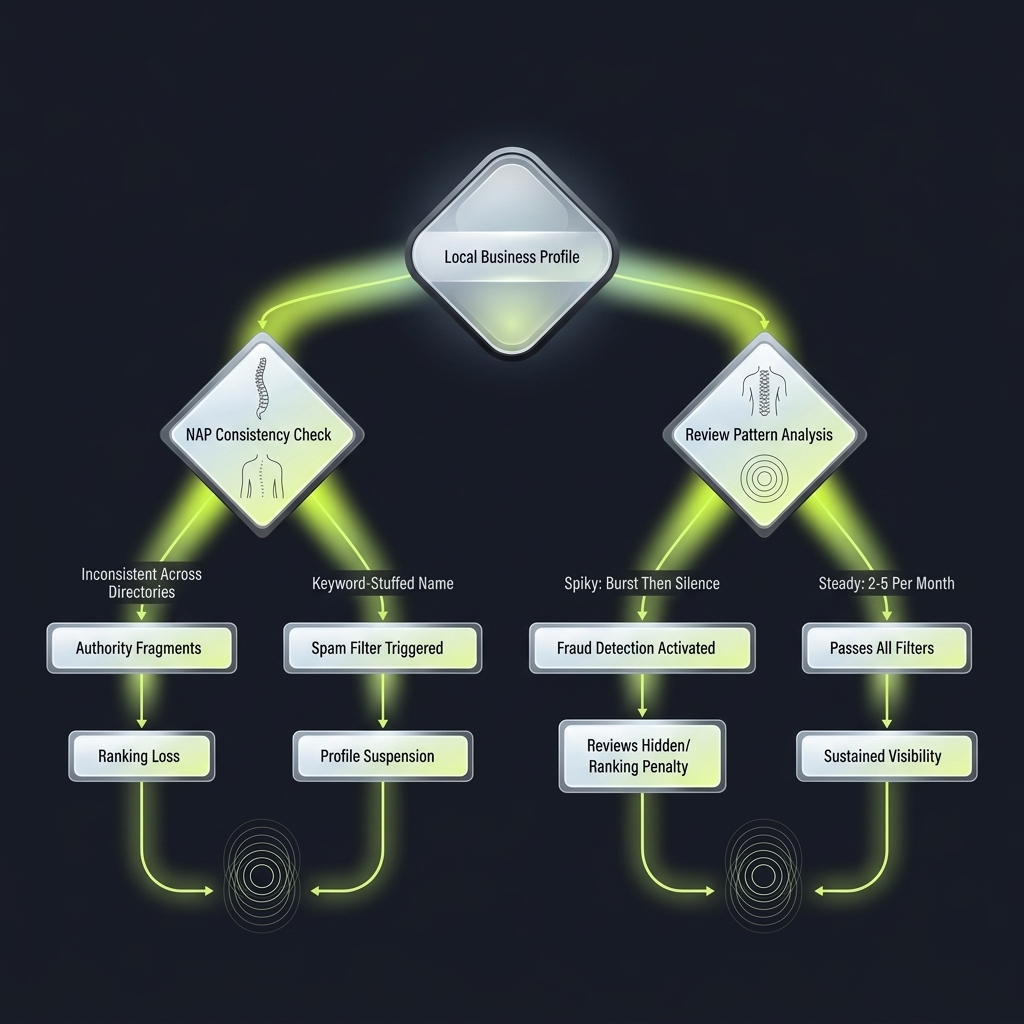
The Mistakes That Destroy Visibility
Most ranking losses do not come from algorithm updates. They come from operational errors that erode trust signals over time.
NAP Inconsistency Across the Web
Your business name, address, and phone number must be identical across every directory, citation, and web property where your practice appears. Google uses this data to verify that you are a legitimate entity.
If your Google profile lists "Smith Chiropractic Clinic" but your Yelp profile lists "Smith Chiropractic" and your website footer lists "Dr. Smith's Chiropractic Clinic," Google sees three potentially different businesses. Your local authority fractures.
The common mistake: a practice owner decides to add keyword-rich text to their business name on Google, "Smith Chiropractic | Best Back Pain Relief in Austin", hoping to game the algorithm. Google's spam filters catch this immediately. The profile gets suspended. The practice disappears from local search entirely until the violation is corrected.
Spiky Review Acquisition Patterns
Running a once-per-year review drive generates a burst of 30 to 50 reviews in a short window, followed by months of silence. This pattern triggers fraud filters.
Google's AI models analyze the timing and network history of reviews. A sudden spike followed by dormancy looks like a purchased review campaign or a coordinated effort, even if every review is legitimate. The system may hide the new reviews, pause your ability to receive reviews, or apply a temporary ranking penalty while it audits your profile.
The solution is not to avoid asking for reviews. It is to build a system that generates reviews continuously, week after week, as a natural byproduct of patient care. Two to five reviews per month, every month, passes every filter.
AI-Generated Content Without Compliance Oversight
Generic AI tools like standard ChatGPT do not understand healthcare advertising regulations. They will generate claims you are not allowed to make: treatment guarantees, outcome promises, or diagnostic language that crosses into practicing medicine without a patient relationship.
Google's Quality Rater Guidelines classify healthcare content strictly under YMYL (Your Money or Your Life). The guidelines explicitly dictate that AI-generated medical content lacking human clinician review, or failing to demonstrate E-E-A-T (Experience, Expertise, Authoritativeness, and Trustworthiness), is treated as a safety issue and must be rated at the lowest quality tier.
A practice that publishes AI-generated blog posts without editing them for compliance and clinical accuracy risks both algorithmic penalties and regulatory action from state boards. The content may also fail to satisfy Google's E-E-A-T criteria, which requires demonstrating first-hand clinical knowledge.
The problem is not that AI cannot assist with content. The problem is that generic tools lack the deterministic guardrails to ensure every sentence complies with health advertising rules. You still need a human with regulatory knowledge to review every output before it goes live.
How Do I Maintain My Local SEO Rankings?
Maintaining local SEO rankings requires consistent operational infrastructure including regular citation audits to ensure NAP consistency across all directories, systematic correction of discrepancies before making Google Business Profile changes, and implementing a front-desk review protocol that requests Google reviews via text within two hours of appointments to generate continuous fresh reviews monthly.
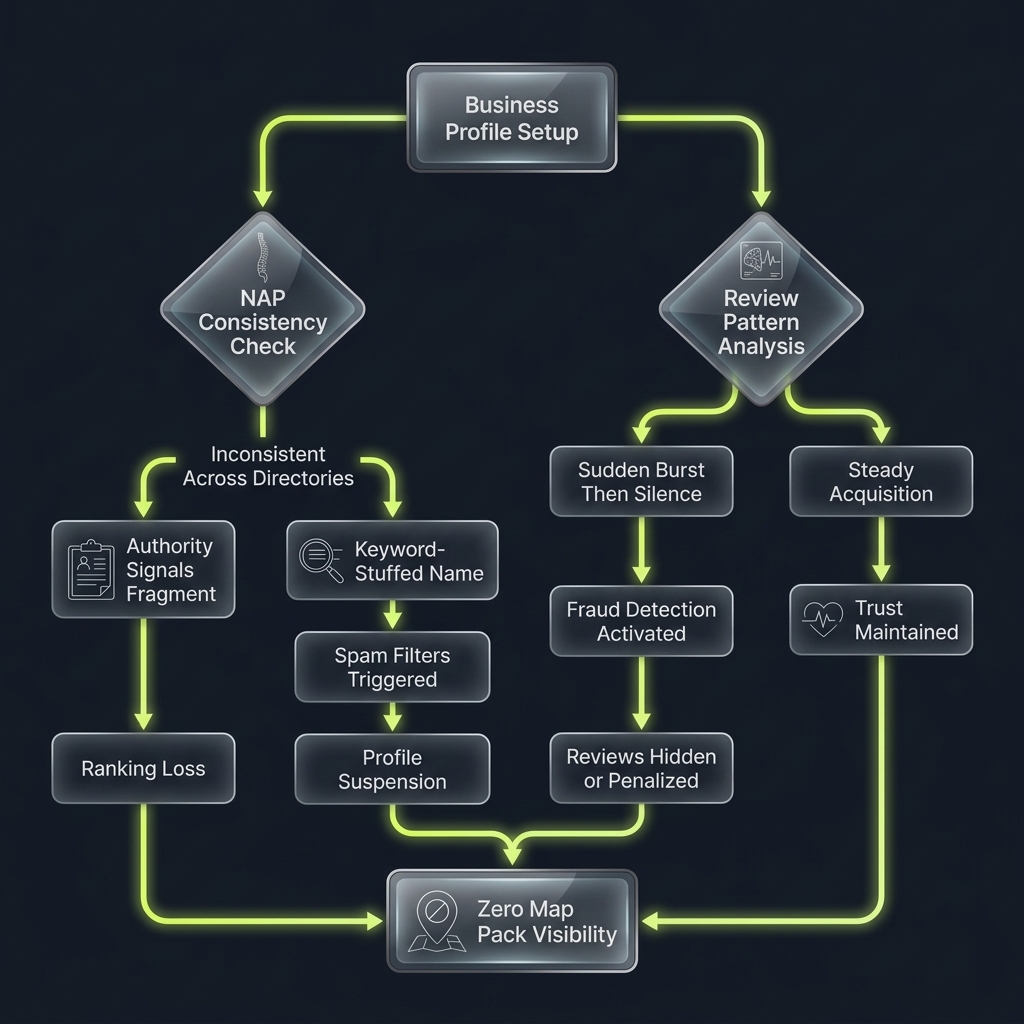
Building a System That Holds Position
Winning the three-pack once is not the goal. Holding it week after week, regardless of competitor movement or algorithm updates, requires operational infrastructure.
Audit Your Entity Footprint
Start with an inventory. List every directory, citation, and web property where your practice name, address, or phone number appears. Check Google, Yelp, Healthgrades, Vitals, your website footer, your social profiles, and any local business directories.
Look for discrepancies. Different phone numbers. Abbreviations in the address. Variations in the business name. Each inconsistency dilutes your local authority.
Correct them systematically. Update every listing to match your Google Business Profile exactly. This process takes time, often weeks if you have dozens of citations, but it rebuilds the foundation of your local ranking.
Do not change your business name or primary category on Google until you have audited and corrected all external citations first. Changing your Google profile while inconsistent data exists elsewhere can trigger verification loops or suspension.
Build a Front-Desk Review Protocol
Reviews do not happen automatically. They happen when you ask, at the right moment, with the right friction level.
The right moment is immediately after a successful adjustment or at the end of a care plan when the patient reports improvement. That is peak satisfaction. Asking three weeks later, via email, yields a 70% lower response rate.
The protocol: train your front desk to send a review request via text message within two hours of the appointment. The message includes a direct link to your Google review page. No multi-step process. No request to log in or create an account. One tap opens the review form.
The math: if you see 60 new patients per month and your front desk sends a review request to every patient at the right moment, with a 10% conversion rate, you generate six reviews per month. That keeps you competitive in most suburban markets.
Do not offer incentives. Google's April 2026 policy update explicitly prohibited the practice of review gating, selectively screening patients and only sending review links to happy ones, as well as the use of on-site review kiosks or iPads stationed at the front desk to collect reviews. Do not filter patients by sentiment before sending the link. Do not offer discounts or gifts in exchange for feedback. Both practices violate platform policies and risk suspension.
Establish Continuous Local Content Output
Your Google Business Profile needs fresh content every week. Not promotional posts. Educational posts that answer the questions your patients ask during consultations.
Topics: posture correction for remote workers. Ergonomic principles for desk setups. Spinal alignment basics. Stretching protocols for lower back tension. Each post should be 150 to 250 words, written in plain language, and focused on a single concept.
This signals operational continuity to Google. It also gives potential patients a preview of your clinical communication style before they call.
The challenge: producing this content manually requires two to four hours per week. Writing, editing, sourcing compliant language, formatting for the platform, and scheduling. Most front-desk teams cannot sustain that workload alongside patient care.
Calculate the True Cost of Manual Execution
Add up the hours required to execute this system manually every single week:
- Profile posts: 2 hours to write, edit, and publish one compliant post per week.
- Review requests: 1 hour to send personalized follow-ups and monitor responses.
- Review responses: 1.5 hours to write thoughtful, compliant replies to every new review.
- NAP audits: 1 hour per month to check citations and correct discrepancies.
- Content planning: 1 hour per week to identify topics and maintain an editorial calendar.
Total: approximately 5.5 hours per week, or 22 hours per month. If your front-desk hourly rate is $20, that is roughly $440 per month in labor cost, assuming the work actually gets done consistently.
In practice, it does not. When patient volume spikes, marketing tasks get deferred. When the front desk calls in sick, content does not get published. The system collapses under clinical workload pressure.
This is why most practices cycle through periods of visibility and invisibility. They execute the system for six weeks, see ranking improvement, get busy with patient care, stop executing, and watch their ranking erode over the next three months.
Evaluate Compliant Automation Infrastructure
The solution is not to work harder. It is to operate the system through infrastructure that does not depend on daily manual effort.
Platforms that operate this whole loop end-to-end, like Omniply, which generates weekly profile posts, review workflows, and compliant content from your practice's own clinical voice, remove execution friction entirely. The system runs whether you are treating 30 patients per week or 90.
The alternative, using generic AI tools and attempting to edit every output for compliance yourself, still consumes your time. You still need to prompt the tool, review the output for regulatory violations, rewrite sections that make impermissible claims, format for the platform, and schedule publication. You have not eliminated the bottleneck. You have simply shifted it.
Generic tools also introduce non-deterministic risk. The same prompt can produce compliant output one week and a regulatory violation the next. Nothing in the tool ensures that every sentence adheres to state board advertising rules or Google's medical content guidelines.
The infrastructure decision comes down to this: do you want to spend 22 hours per month managing a system manually, or do you want the system to operate autonomously while you focus on patient care?
What Questions Do Practice Owners Ask About Local SEO?
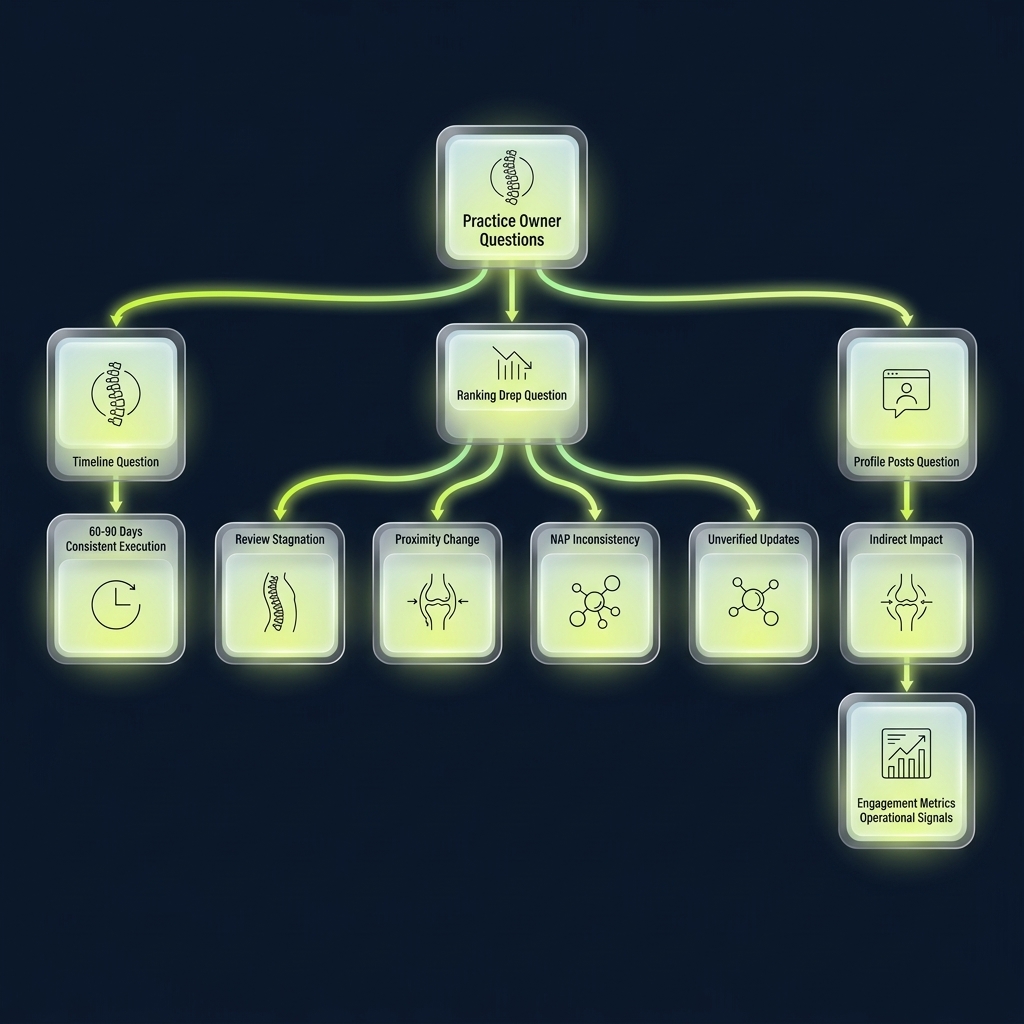
Practice owners commonly ask how long it takes to reach top three map positions (typically 60-90 days with consistent execution), why their practice suddenly dropped from rankings (often due to review stagnation, proximity changes, NAP inconsistencies, or unverified profile updates), and whether Google Business Profile posts actually impact ranking (they do, primarily through engagement metrics and demonstrating operational activity).
Common Questions Practice Owners Ask
How Long Does It Take to Enter the Top Three Map Positions?
Sixty to ninety days of consistent execution. That means weekly profile posts, steady review intake, complete NAP cleanup, and no interruptions in the workflow.
The timeline assumes you are starting from a verified profile with no existing penalties or suspensions. If your profile has been dormant for months, expect the longer end of that range. If you are competing in a dense urban market with established competitors, expect 90 to 120 days.
The algorithm does not reward sudden effort. It rewards sustained operational signals over time. A practice that executes perfectly for six weeks and then goes silent for two months will see minimal movement.
Why Did My Practice Suddenly Drop Out of the Top Three?
Four common causes. First: review stagnation. If you have not received a new review in eight weeks and a competitor is generating two reviews per week, they will displace you.
Second: a competitor opened closer to the geographic center of your search area. Proximity is a baseline factor. If a new practice opens and executes the same system you do, but sits one mile closer to the center of town, they may outrank you on pure distance.
Third: NAP inconsistencies introduced by a directory you do not control. A local citation service updated your listing with an old phone number, creating a discrepancy that fractured your entity authority.
Fourth: unverified profile changes. If you updated your business category or address without re-verifying the profile, Google may have temporarily deprioritized your listing while it confirms the change.
Do Google Business Profile Posts Actually Impact Ranking?
Yes, but indirectly. Posts do not carry heavy direct ranking weight. They improve click-through rates, demonstrate operational activity, and create fresh context for the algorithm to evaluate.
Profiles that publish weekly posts perform twice as well in engagement metrics, calls, direction requests, website clicks, compared to profiles that never post. Google tracks those engagement signals and uses them to validate listing quality.
The compounding effect: better engagement leads to better behavioral signals, which leads to better ranking, which leads to more visibility, which leads to more engagement. The loop reinforces itself.
Can I Use Standard ChatGPT to Handle Local Content?
Not safely. ChatGPT does not know your state's chiropractic advertising rules. It does not know which clinical claims are permissible and which cross into practicing medicine. It does not understand Google's YMYL guidelines or E-E-A-T criteria.
You can use it as a drafting tool, but you still need a human with regulatory knowledge to review every sentence before publication. That review process takes time, often as much time as writing the content from scratch.
The output is also non-deterministic. The same prompt can generate compliant language one day and a regulatory violation the next. You cannot rely on it to produce consistent, safe content without heavy oversight.
How Many Reviews Does a Practice Need Each Month to Stay Competitive?
Two to five, depending on your market density. In a suburban area with three to five competing practices, two reviews per month keeps you stable. In a dense urban market with 15 competitors, you need closer to five.
Velocity matters more than total volume. A practice with 80 reviews and five new reviews per month will outrank a practice with 250 reviews and no new feedback in three months.
The threshold for consumer trust is rising. Thirty-one percent of consumers now require a minimum rating of 4.5 stars to even consider engaging with a local business. That means you need both volume and quality. A handful of one-star reviews can drop your average below the trust threshold, even if you have 200 total reviews.
Are Automated Review Responses Compliant?
Yes, if the automation produces responses that are specific, thoughtful, and do not make clinical claims. Fifty-eight percent of consumers actually prefer an AI-written review response over a human-written one, provided the response is prompt, personalized, and addresses the specific context of their review.
The risk: generic templates that say "Thank you for your feedback" without acknowledging the specific content of the review. Google can detect template responses, and they carry no trust signal.
The better approach: automation that generates a unique response for each review, references specific details the patient mentioned, and adheres to compliance guardrails. That passes both algorithmic and regulatory scrutiny.
Do Top Local Results Actually Increase Phone Calls?
Yes. The top position in the three-pack captures a 14.8% click-through rate. Position two captures approximately 9%. Position three captures approximately 5%.
If your market generates 1,000 local searches per month for chiropractic terms, and you hold position one, you receive approximately 148 profile views. If your profile converts a strong percentage of views into calls, the benchmark for a complete, optimized listing, you receive a substantial volume of calls per month from local search alone.
Position four receives functionally zero visibility. The patient never scrolls past the three-pack.
The math: high call volume per month, with a solid appointment-booking rate, yields consistent new patient appointments. If your average new patient generates meaningful lifetime value, that represents significant attributable revenue from holding position one.
Dropping to position four eliminates that entire revenue stream.
How Do You Consistently Win the Google Three-pack?
Winning the Google three-pack consistently requires operating a continuous system that generates fresh content, maintains steady review velocity, completes all profile data, and validates behavioral signals. Success depends on autonomous infrastructure that executes these operational signals weekly without interruption, not on marketing budgets or manual effort that cannot scale reliably over time.

The System Decides the Winner
The three-pack is not a mystery. It is a system that rewards continuous operational signals: fresh content, steady review velocity, complete profile data, and behavioral validation.
The practices that win are not the ones with the best websites or the largest marketing budgets. They are the ones that operate the system every single week without interruption.
Manual execution fails because it depends on time you do not have. Generic AI tools fail because they still consume your time and introduce compliance risk. The only sustainable path is infrastructure that operates the system autonomously.
Eighty-eight percent of consumers who search locally on their phone visit or call the business within 24 hours. The three-pack is the gatekeeper to that intent. If you do not occupy one of those three positions, you are not competing for new patients. You are waiting for referrals.
The algorithm does not care about your clinical skill. It cares about the signals your profile sends. Build the system that sends those signals continuously, or accept that your competitors will.