
Your EHR contains roughly 1,200 inactive patient files. That is $180,000 in unrealized revenue sitting in digital storage. Every empty slot on your table is a leaked asset.
Most of these people did not leave your practice because they were unhappy. They simply got busy. Yet, your front desk dreads calling them. Nobody wants to send a text that sounds like a desperate ex-partner. Cheap discounts only devalue your clinical expertise.
There is a systematic way to handle win-back communication without losing your dignity. It requires shifting from marketing promotions to a clinical check-in. When done correctly, this process feels like high-end service, not a sales pitch.
This article outlines the exact three-step framework to wake up your dormant charts. We will analyze the math of a quiet campaign. You will get the exact scripts your team can use this week. Finally, we will map the precise timing that turns cold files into active appointments.
Key Takeaways
- Revenue Leak Math: 1,200 inactive patient files represent $180,000 in unrealized revenue, with 15 monthly patient dropouts costing practices $165,600 annually in lost net contribution.
- Acquisition Cost Crisis: Patient acquisition costs climbed 56% from $200 in 2022 to $312 in 2025, making retention five times more cost-effective than new patient marketing.
- Passive Attrition Reality: Nearly 40% of patient attrition occurs passively as individuals drift away without dissatisfaction, with the average patient attending only six sessions before dropping out.
- Compliance Liability Risk: Under FTC's Operation AI Comply, deceptive health claims carry penalties of $53,088 per violation as of January 2025, making generic AI-generated content legally dangerous.
- Segmented Email Performance: Healthcare email open rates reach 46.67% for targeted segments, with properly executed four-touch reactivation sequences generating 3-8% booking rates from lapsed patient lists.
Why Are My Scheduled Patients Not Showing up?
Scheduled patients fail to show up primarily due to scheduling friction, poor communication touchpoints, and life distractions rather than dissatisfaction with care. Nearly 40% of patient attrition occurs passively as individuals simply drift away without formal cancellation. The average patient attends only six sessions before dropping out, often before achieving full clinical recovery, creating significant revenue loss.
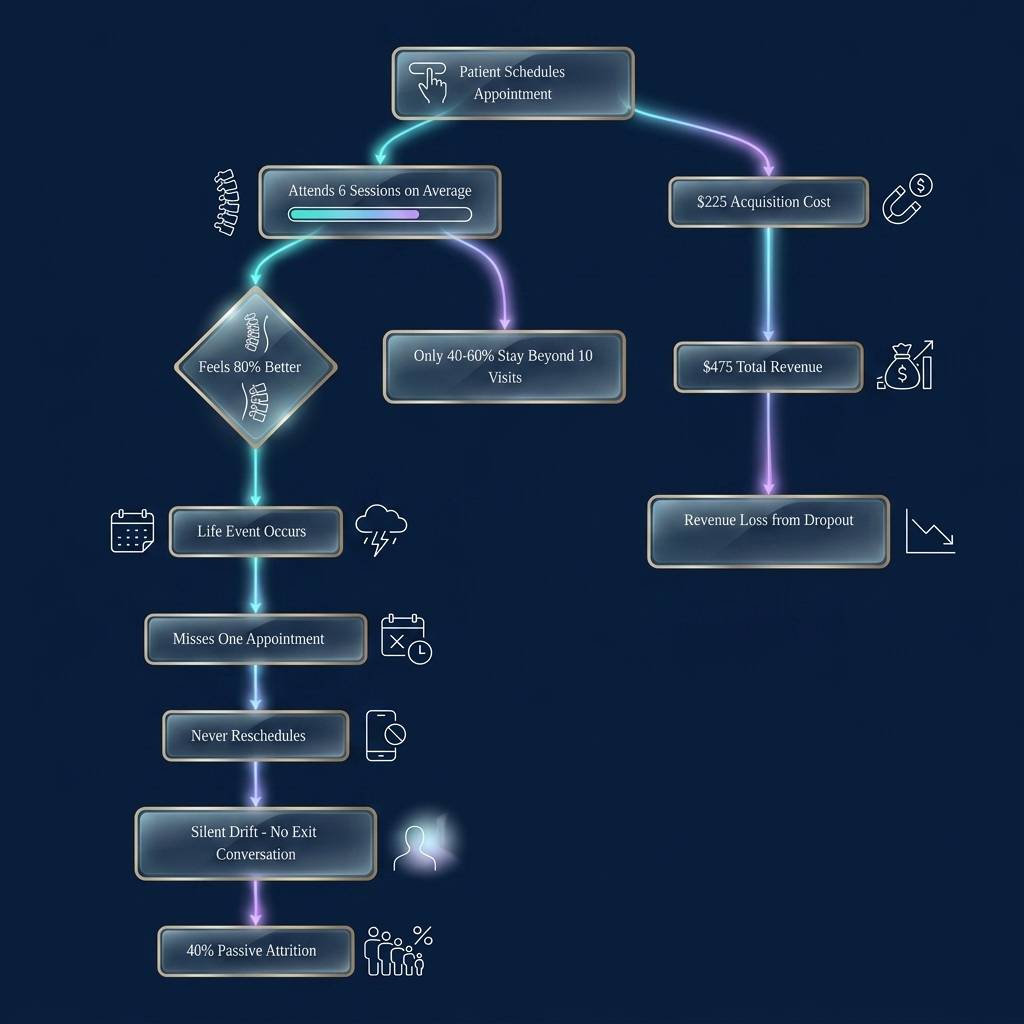
The Monday Morning Ghost Town: the Reality of Patient Drift
You open your electronic health record dashboard Monday morning. The week ahead looks full. Thirty-two appointments scheduled. Yet something nags at you.
You recognize only eighteen of those names.
The rest are new patients, booked through your Google Ads campaign. You spent $287 last week to get them in the door. Meanwhile, somewhere in your system, Sarah Martinez sits in limbo. She came in six times for her lower back. Felt 80% better. Missed her Thursday appointment because her daughter had a soccer tournament. Never rescheduled.
That was eleven weeks ago.
Sarah did not fire you. She did not leave a bad review. She did not switch to the clinic down the street. She simply evaporated from your schedule, joining the hundreds of other files that transitioned silently from "active care" to "lapsed status" without a single exit conversation.
Industry research and chiropractic practice management data confirm that the average patient attends approximately six sessions before dropping out of care, often passively, before achieving full clinical recovery. Most practices retain only 40% to 60% of their patient base beyond ten visits. This is not a clinical failure. Nearly 40% of patients who leave a healthcare practice do so due to scheduling friction, poor communication touchpoints, or simple life distraction, not because they disliked your care.
But the financial damage is identical regardless of the reason.
The Math of the Leaky Bucket
Let's build the model with your actual numbers.
You spend $150 to $300 acquiring each new patient through local advertising. Call it $225 average. That patient comes in for an initial assessment at $85. If they convert to a care plan, they complete an average of six visits at $65 each. Total realized revenue per patient: $475.
Your cost to deliver that care, your time, the room, the assistant's labor, runs roughly $180. Net contribution: $295 per patient who completes six visits.
But here is where the model breaks. A patient who stays on your table for corrective care (twelve visits) and transitions into maintenance care (one visit per month for eighteen months) generates $1,560 in total revenue. After delivery costs, that is $920 in net contribution. That is your true customer lifetime value.
Now count the leak. If fifteen patients drift away every month, patients who completed their initial visits but never returned, you lose $13,800 in net contribution per month. That is $165,600 annually.
You cannot out-advertise that. According to the 2026 Patient Acquisition Cost Report by First Page Sage and healthcare marketing benchmark data, patient acquisition costs in healthcare climbed from roughly $200 in 2022 to $312 in 2025, exactly a 56% increase driven by rising digital ad costs and AI-driven search competition. Acquiring a new patient costs up to five times more than retaining an existing one; this is a fundamental business metric consistently validated across healthcare practice management studies. Every dollar you pour into Google Ads while ignoring the leak is a dollar lighting itself on fire.
The acquisition trap is simple: high churn rate destroys profit margins faster than new patient volume can rebuild them.
Why the Obvious Fixes Burn the List
So you try the standard plays. You send a bulk text blast: "We miss you! $29 adjustment special this week only."
Three things happen immediately. First, your clinical authority evaporates. You just told Sarah that the $65 adjustment you recommended for her spinal health is actually worth $29 when you need to fill a slot. Second, you trained her to wait for the next discount. Third, you positioned yourself as a commodity service competing on price, not a healthcare provider delivering outcomes.
Or you try the guilt-trip phone call. Your front-desk CA dials Sarah: "Hi, this is Jessica from Dr. Carter's office. We noticed you haven't been in for a while. Dr. Carter wanted me to check in and see if you'd like to get back on your care plan."
Sarah feels cornered. She did not plan to avoid you. Life got busy. Now she has to explain herself to a stranger on the phone, creating psychological friction where none existed before. She says she will call back to schedule. She does not.
The generic monthly newsletter is no better. You send recipes, motivational quotes, and broad wellness tips to your entire list. Open rates hover around 12%. Unsubscribes tick up every month. You have created a one-way broadcast channel that patients tune out, and when they finally need care again, your emails are already routed to their spam folder.
These tactics share a common flaw: they prioritize your urgency over the patient's autonomy. They feel like pressure, not service. And pressure destroys the very relationship you are trying to reactivate.
What is the Authority-first Reactivation Paradigm?
The authority-first reactivation paradigm represents a fundamental shift in patient retention strategy, moving from urgency-based scheduling tactics to maintaining continuous clinical authority. Rather than pressuring lapsed patients to return immediately, practices focus on remaining the obvious choice through ongoing educational content and relationship-building, so patients naturally return when physical setbacks occur.
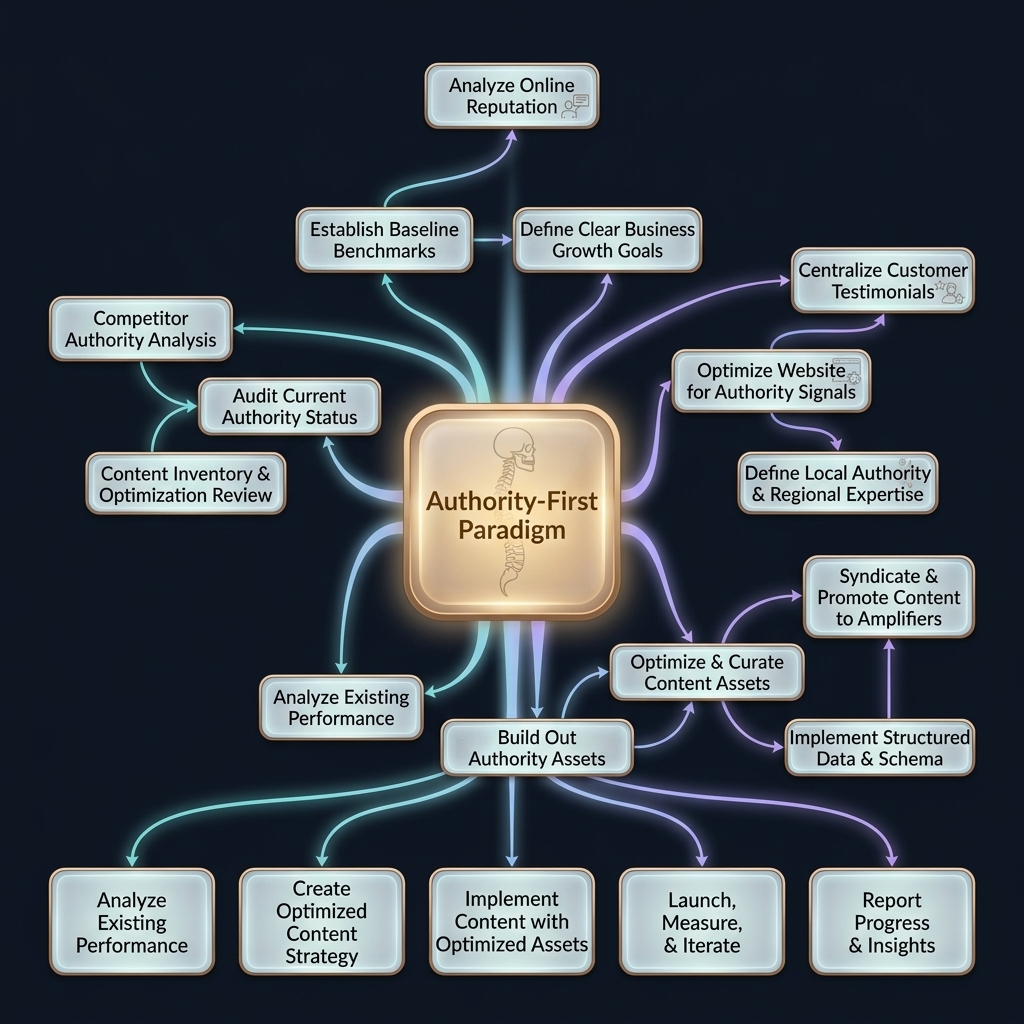
The Authority-First Reactivation Paradigm
The shift starts with a single belief change. Stop asking, "How do we get people back onto our schedule today?" Start asking, "How do we maintain top-of-mind clinical authority so we are the obvious choice when life inevitably triggers their next physical setback?"
This is not semantic wordplay. It is a mechanical difference that changes every downstream decision.
Sarah did not leave because your care failed. She left because her pain dropped below the threshold where scheduling an appointment felt urgent. She intended to come back. Then two months passed. Now she feels awkward about the gap. Reaching out to you requires admitting she fell off the plan, which triggers mild shame.
Your job is to eliminate that friction and keep the pathway warm.
The Four-Layer Retention System
The modern patient recall system operates on four continuous layers, not one-off campaigns.
Layer One: Continuous Content Presence. You publish authoritative clinical insights that address the exact problems your lapsed patients originally walked in with. Not generic wellness content. Specific biomechanical education: how desk posture loads the cervical spine, why lumbar disc pain flares during long drives, what hip flexor tightness does to sacroiliac joint stability.
This content does not ask for anything. It positions you as an active educator in the community. When Sarah sees your article on managing sciatica during air travel, she does not feel sold to. She feels reminded that you understand her body.
Layer Two: Fast Response and Two-Way Communication. When a lapsed patient raises their hand, replies to an email, clicks a link, visits your website, the response must be immediate and human. Not a chatbot holding pattern. Not a voicemail box. A real person or a system that feels like one, removing every possible scheduling barrier in real time.
Practices that implement clear friction-reduction strategies, such as digital booking links combined with transparent availability, report 25% stronger improvement in no-show rates. The mechanism is simple: you make it easier to say yes than to procrastinate.
Layer Three: Review Momentum. A continuous stream of fresh, highly specific patient success stories acts as social proof. When Sarah sees a recent review from another patient describing lower back relief after a car accident, it mirrors her own experience. It reminds her what pain-free life felt like under your care. This is not manipulative. It is evidence.
Layer Four: Steady, Segmented Communication. Not monthly newsletters. Weekly or biweekly emails delivering bite-sized health education directly tied to the patient's original complaint. Segmented by condition, not blasted to the entire list. Recent email marketing benchmark reports list the Medical, Dental, and Healthcare industry as having the highest average email open rate of any sector, sitting at 46.67% for targeted segments. Segmented campaigns outperform generic newsletters by three times or more in both open and click-through rates.
The math is simple: if 33% of your lapsed patients open a well-timed email, and 8% of those click through to your scheduling page, and 15% of those book an appointment, you just reactivated 0.4% of your inactive list with a single touchpoint. Run that weekly across 1,200 inactive files, and you generate five reactivated patients per week. That is $4,600 in net contribution per month from a system that runs in the background.
The Flywheel Effect
Here is where the system compounds. Every reactivated patient who comes back for one visit has a 60% chance of completing a full care plan if the original dropout was due to life friction, not dissatisfaction. That single patient is now worth $920 in lifetime contribution again.
But the second-order effect is more valuable. Lapsed patients who stay engaged with your content become referral sources even during periods when they do not need active care. They forward your articles to friends. They mention you in conversation. They leave reviews. You get credited for expertise without requiring them to sit on your table every week.
A case study published by the Physician Leadership Journal followed a large health system that utilized digital outreach to re-engage nearly one million lapsed patients, generating $4.9 million in operating savings between 2020 and 2024. The mechanism: keeping communication pathways open turned dormant files into active referral engines and prevented the need to replace them with expensive new patient acquisition.
The system works because it respects human psychology. People do not resent helpful information. They resent being sold to. When you lead with value and make reactivation feel like their idea, the urgency disappears.
What Does the Execution Wall Mean for Patient Retention?
The execution wall represents the operational burden of implementing patient retention systems manually. For chiropractic practices, it means dedicating 45+ minutes weekly to database extraction, list scrubbing, and executing multi-touch outreach sequences. This labor-intensive reality often causes practices to abandon systematic retention efforts or resort to discount-based shortcuts that undermine long-term patient value.
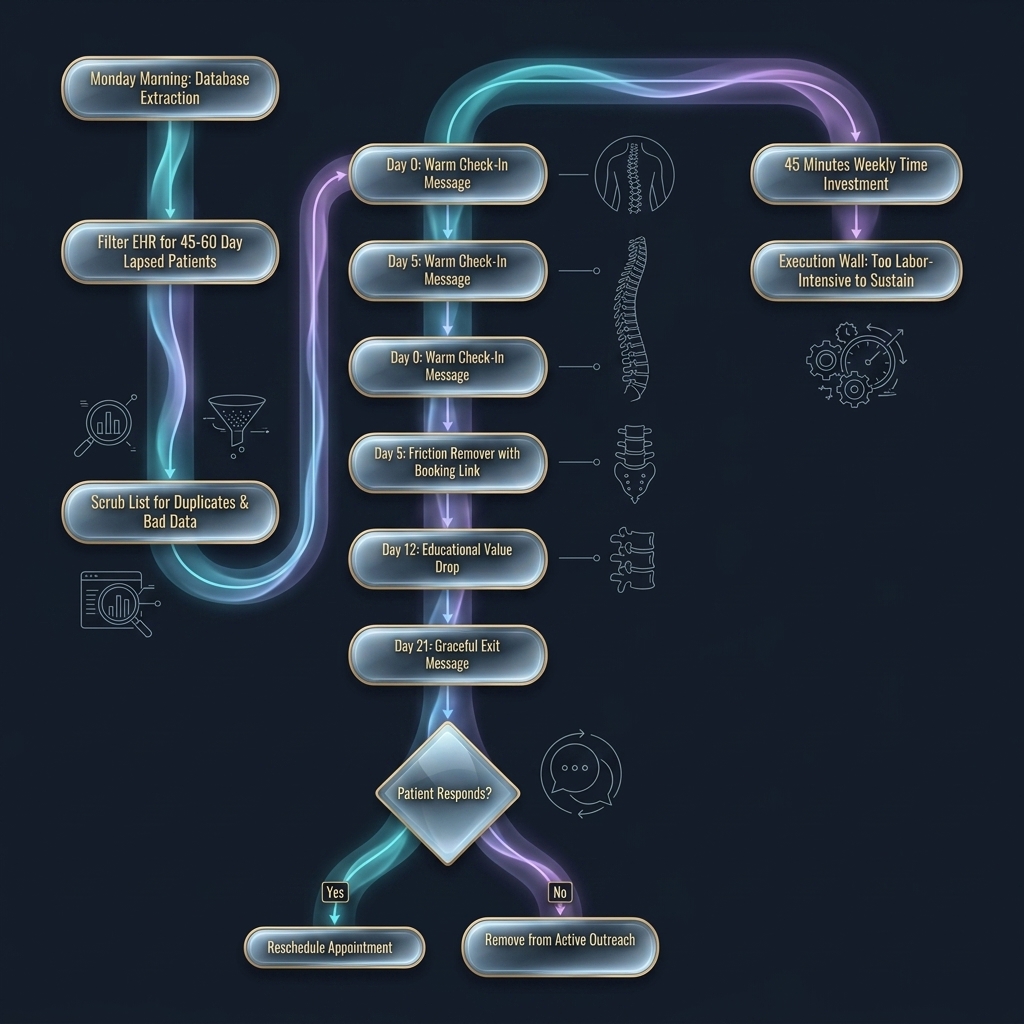
The Execution Wall and the Risk of the Shortcut
So you understand the system. You believe in the model. Now you have to build it.
Here is the honest operational picture.
The Manual Protocol: the 45-Day Lapsed Patient Check-In
Start with a targeted, manual outreach sequence for patients who drifted past 45 days without a scheduled visit. This is a warmth-first, zero-discount approach.
Step One: Database Extraction. Every Monday morning, run a custom report in your EHR. Filter for patients who completed an initial assessment, have no future appointments scheduled, and whose last visit was 45 to 60 days ago. Exclude active maintenance plans. Export to a spreadsheet.
Time cost: 25 minutes per week, assuming your EHR allows custom date-range filtering and your data is clean. If your system has duplicate records, incorrect phone numbers, or patients who moved out of state still marked active, add another 20 minutes to scrub the list.
Step Two: The Four-Touch Sequence. You send four individual messages over 21 days, spaced to avoid feeling pushy.
Day 0 (The Warm Check-In): "Hi Sarah, it's Jessica from Dr. Carter's office. Just wanted to check in; how has your lower back been holding up since we last saw you? I remember you were dealing with some flare-ups after long drives. I'm attaching a quick stretch guide that a few of our patients have found helpful. No need to reply unless you have questions."
No appointment pitch. No urgency. Just clinical warmth.
Day 5 (The Friction Remover): "Hey Sarah, quick follow-up—if you've been thinking about coming back in but haven't had time to call, here's a direct link to our online booking. You can grab a spot that fits your schedule without the phone tag: [link]. We're here whenever you're ready."
Day 12 (The Educational Value Drop): Send a highly relevant article addressing long-term management of her specific condition. "Thought you might find this useful—it's a breakdown of how to manage lumbar disc irritation during travel season. Let me know if you have questions."
Day 21 (The Graceful Exit): "Hi Sarah, I want to respect your inbox, so this will be my last note on this. Just know our door is always open whenever you need us. Take care."
Time cost per patient: 12 minutes total across all four touches—composing individualized messages, copying the correct link, logging the outreach in a tracking spreadsheet, and managing opt-outs.
If you run this sequence for 20 lapsed patients per week, you just added four hours to someone's workload. Every single week. Forever.
The Scale of the Full System
Now expand beyond one sequence. The full retention system requires weekly SEO-optimized clinical articles published to your website, coordinated social media posts, monthly segmented newsletters, and continuous review management.
Writing one 1,200-word clinical article per week: 3 hours. Editing for compliance and tone: 1 hour. Publishing to your site with proper formatting and internal links: 30 minutes. Adapting that article into three social posts: 45 minutes. Designing the accompanying graphics: 1 hour. Drafting and segmenting the monthly newsletter: 2 hours. Monitoring and responding to reviews: 1 hour per week.
Total: 15 hours per week of administrative marketing labor.
A comprehensive study conducted by Google Cloud and The Harris Poll found that clinicians in the U.S. spend an average of 28 hours per week on administrative duties: charting, insurance forms, and EHR management. A landmark time-motion study published in the Annals of Internal Medicine found that for every hour physicians spend in direct, face-to-face clinical time with patients, they spend nearly two additional hours on EHR and desk work. The Google Cloud/Harris Poll report also found that 82% of clinicians attribute feelings and symptoms of burnout to their heavy administrative workloads, and broader industry surveys confirm that 80% of healthcare providers report that paperwork and administrative tasks directly steal time away from patient care.
You cannot personally execute a professional-grade communication system and still run a clinical practice. The math does not work. Something breaks. Usually, it is the marketing. The clinic gets busy. The lead CA goes on vacation. Billing software crashes. The newsletter does not go out for six weeks. The content machine sputters and dies.
Manual systems fail under operational load. Always.
The Dangerous Shortcut: the Generic AI Trap
So you turn to the obvious tool. You open ChatGPT and type: "Write me a reactivation email for a chiropractic patient who hasn't been in for 60 days."
It spits out 200 words in three seconds. The tone is sterile. The phrasing is robotic. Patients recognize AI-generated marketing instantly, and it destroys trust faster than sending nothing at all. But that is not the real problem.
The real problem is compliance.
Generic AI models have no medical or legal guardrails. They will happily draft content claiming that chiropractic adjustments "boost the immune system to prevent viruses," "cure ADHD," or "reverse degenerative disc disease." These are prohibited health claims. Under the FTC's ongoing law enforcement sweep known as "Operation AI Comply," the agency initiated well over a dozen cases into 2025 targeting companies for "AI washing", exaggerating or fabricating AI capabilities, and making deceptive, unsubstantiated claims to consumers and businesses.
Under the FTC's Trade Regulation Rule on the Use of Consumer Reviews and Testimonials, effective October 2024, the maximum civil penalty for deceptive claims was increased to exactly $53,088 per violation as of January 2025. If your AI-generated email makes a false claim and you send it to 500 patients, you just created 500 violations.
You own 100% of the legal liability for every piece of content published under your brand, regardless of whether a human or a machine wrote it. State chiropractic boards, the FDA, and the FTC do not care that you used a chatbot. They care that you made a claim you are not allowed to make.
Because direct-to-consumer health apps (like GoodRx, BetterHelp, Premom, and Hims & Hers) often fall outside of traditional HIPAA enforcement, the FTC has aggressively stepped in. The agency uses the Health Breach Notification Rule (HBNR) and the FTC Act to levy massive fines against platforms that share sensitive patient health data with third-party advertisers (like Meta and Google) without explicit consumer consent. If your AI tool collects patient interaction data and shares it with third parties, you just opened a second compliance risk.
And even if you avoid the legal landmines, you still spent 90 minutes prompting the AI, reviewing its output, correcting factual errors, rewriting the robotic phrasing, and manually pasting it into your email platform. You did not save time. You just added a new layer of review labor.
Generic AI is not a system. It is a time-consuming liability you have to babysit.
How Do I Stop Losing Patients and Grow My Practice?
Stop patient loss by implementing an automated value-first retention system that maintains continuous content presence, enables fast response times, builds review momentum, and delivers segmented patient communication. Since manual execution is operationally impossible for practicing clinicians, practices should deploy end-to-end platforms that preserve clinical voice, ensure compliance, and reactivate dormant patients while providers focus on care delivery.
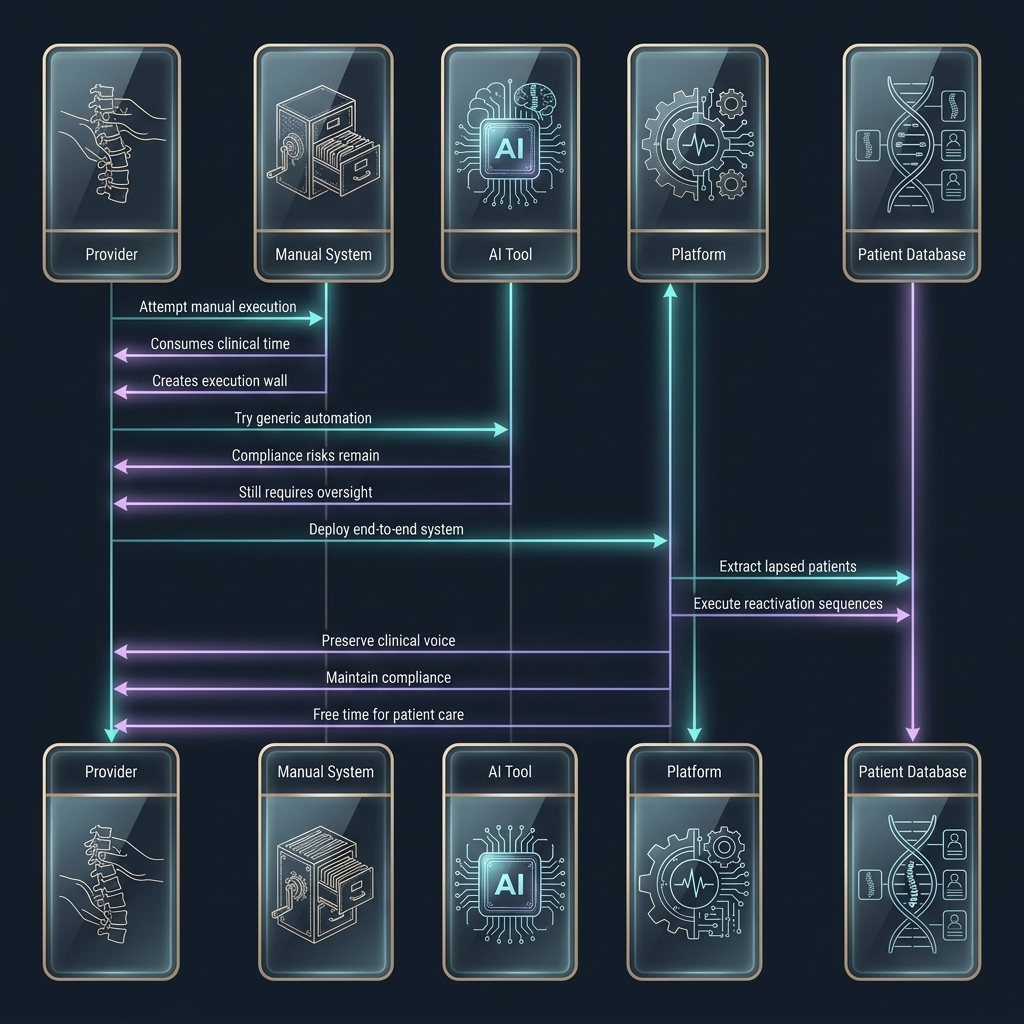
The Path Forward
You now hold three pieces of evidence.
First: the leaky bucket is your most expensive problem. Losing fifteen patients per month to drift costs you $165,600 annually in unrealized net contribution. You cannot out-advertise that.
Second: the value-first retention system works. Continuous content presence, fast response, review momentum, and steady segmented communication generate measurable reactivation rates while preserving clinical authority. The math is sound.
Third: executing that system manually turns you into a part-time marketing administrator. Generic AI tools do not solve the problem; they create new compliance risks and still consume your time.
The paradox is clear. The system is right. You need it running. But you cannot build it, write it, and operate it by hand without abandoning patient care.
The answer is not to do it yourself. The answer is to have it operated for you by a system that preserves your clinical voice, ensures absolute regulatory compliance, and runs silently in the background while you focus on the patient on your table. Platforms that operate this whole loop end-to-end, generating weekly content, managing patient communication sequences, and maintaining compliance guardrails, exist precisely because the manual path is operationally impossible. (Omniply is one example, building everything from the practice's own voice and reviewing it before publication.)
Your clinic's largest asset is already sitting in your inactive files. It simply needs a system to wake it up.
The choice is not whether to run a recall system. The choice is whether to let a machine do the work you do not have time to do yourself.
Frequently Asked Questions
How Do I Text Past Patients Without Sounding Desperate?
Lead with clinical warmth, not urgency. Ask how their original complaint has been holding up. Offer a helpful resource with no strings attached. Never open with a discount or an appointment request. The first message should feel like a check-in from a provider who remembers their case, not a sales pitch from a business that needs to fill slots.
Can ChatGPT Write Win-back Texts for Patients?
Generic AI tools can generate text, but they cannot ensure compliance with health advertising regulations. They will write prohibited medical claims without hesitation. You own the legal liability for every message sent under your brand. Additionally, AI-generated content is immediately recognizable to patients and destroys trust. If you use AI, you need a system with built-in compliance review, not a raw chatbot.
Is It Legal to Text Past Patients?
Yes, if they provided consent to receive text messages during their intake process and you include an opt-out mechanism in every message. HIPAA does not prohibit appointment reminders or general health information sent via text, but you must have documented consent and honor opt-out requests immediately. Consult your state regulations and legal counsel to ensure compliance.
What is a Good Win-back Response Rate?
A well-executed, segmented recall sequence targeting patients who left due to life friction (not dissatisfaction) typically generates reactivation rates between 3% and 8%. If you send a warm, four-touch sequence to 100 lapsed patients, expect three to eight to book an appointment. Higher rates indicate strong original relationships; lower rates suggest poor segmentation or overly aggressive messaging.
How Much Time Does a Win-back Campaign Take?
A manual four-touch sequence for 20 patients per week requires approximately four hours of labor: database extraction, message personalization, tracking, and opt-out management. Scaling to a full retention system, weekly content, social posts, newsletters, and review management, consumes 15+ hours per week. Automated systems reduce this to near zero, but generic tools still require significant review time.
What Are the Best Win-back Text Message Templates?
Effective templates follow a three-part structure: personalized greeting using the patient's name and referencing their original complaint, a no-pressure value offer (stretch guide, article, or educational resource), and a friction-free next step (direct booking link or simple reply option). Avoid discounts, urgency language, and guilt-inducing phrasing. The message should feel like high-end service, not a promotional blast.
Do I Need an Agency for Win-back Campaigns?
You need a system, not necessarily an agency. Agencies typically charge $2,000 to $5,000 per month and still require your time for approvals and content direction. The decision comes down to whether you want to own the execution (manual labor), rent the execution (agency retainer), or deploy a platform that operates the system autonomously with compliance built in. Most practices cannot sustain manual execution long-term.