
Your front desk handles forty calls a day, but your active patient count is drifting downward.
You do not have a clinical problem.
You have a leaky bucket.
It costs hundreds of dollars to acquire a single new patient file. When a prospect hangs up without booking, that money vanishes.
Most owners try to fix this by buying more ads. They dump more water into a sieve. It is an expensive way to run a business.
Before you spend another dollar on marketing, you need a Leak Detection Test. This three-minute business audit checklist will show you exactly where your revenue is slipping through the floorboards.
We will run the math on two diagnostic numbers: your booking capture rate and your drop-off point. You do not need complex spreadsheets or marketing jargon. You need raw operational math that reveals the truth about your front desk.
Let's look at the numbers.
Key Takeaways
- Revenue Leak Quantified: Chiropractic practices can lose up to $39,000 monthly ($468,000 annually) across four measurable axes: content presence ($10,500), response speed ($12,000), review generation ($7,500), and patient drop-off ($9,000).
- Speed-to-Lead Conversion: Responding to inquiries within five minutes makes you 100 times more likely to make contact and 21 times more likely to qualify the lead compared to waiting 30 minutes; 78% of buyers purchase from the first responder.
- Acquisition Cost Reality: Healthcare Customer Acquisition Cost (CAC) ranges from $350 to $700, with paid channels averaging $653 per patient; acquiring new patients costs 5 to 25 times more than retaining existing ones.
- Compliance Risk Exposure: In 2024, the Office for Civil Rights collected $9.9 million in HIPAA penalties across 22 actions; maximum annual penalties for single violation categories reach $2,134,831; recent enforcement has focused on website tracking technologies that expose patient data.
- Manual Execution Burden: Operating a complete marketing system manually requires 10 to 15 hours weekly; 39% of small business owners already work over 60 hours per week with 68.1% consumed by administrative tasks.
Why is My Clinic Losing Money Despite Being Busy?
Busy clinics lose money through structural operational leaks, not clinical performance issues. Revenue disappears across four axes: inactive digital content presence that fails to convert online searchers, slow response times to inquiries that allow competitors to capture leads first, and unmeasured conversion gaps. These leaks can cost practices up to $39,000 monthly despite high patient volume.
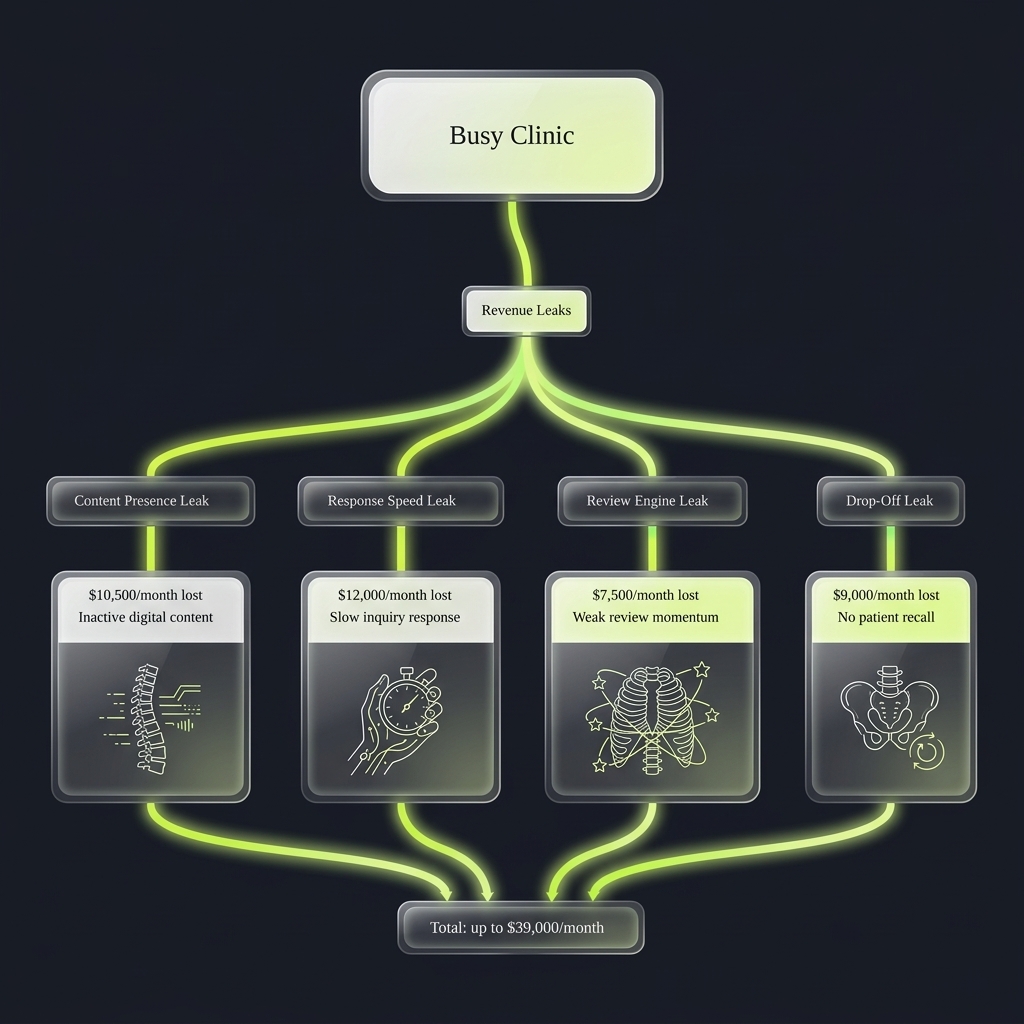
The Four-Axis Leak: Where Your Revenue Disappears
You delivered 120 adjustments this week. Tables stayed full. The phone rang. But the bank balance does not match the clinical output.
The problem is structural, not clinical. Revenue leaks across four specific operational axes, and most owners never measure them. Each axis has a dollar value attached. We will calculate yours.
Axis One: the Content Presence Leak
A prospective patient searches your name at 9 PM on a Tuesday. They find a blog last updated in 2021 and a Facebook page with three posts from last year. Your competitor down the street published an article on sciatica yesterday and has an active Instagram feed showing real patient outcomes.
Who gets the call?
Here is the math. If 100 high-intent local searchers land on your digital footprint monthly, an active content presence converts at roughly 8%. An inactive one converts at 1%.
That is a seven-patient difference. At a conservative case value of $1,500, you leak $10,500 per month.
The mechanism is simple: people judge clinical authority by visible expertise. An empty blog signals an empty waiting room, whether that is true or not.
Axis Two: the Response Speed Leak
A lead submits a contact form at 2:30 PM on a Saturday. Your front desk checks email Monday morning at 9 AM. The lead booked with someone else Sunday afternoon.
Speed-to-lead data is brutal. Responding within five minutes makes you 100 times more likely to make contact and 21 times more likely to qualify the lead compared to waiting 30 minutes. Wait three hours and the odds collapse entirely.
Run your own numbers. If you receive 20 online inquiries per month and convert only 2 instead of 10 due to slow response time, you lose 8 patients.
Monthly leak: $12,000.
The average Customer Acquisition Cost (CAC) in healthcare now sits between $350 and $700. Paid channels push that number to $653 per patient. Every lead you fail to capture fast represents money already spent and wasted.
Axis Three: the Review Engine Leak
A patient walks out pain-free and promises to write a review. They forget by the time they reach the parking lot. Your competitor has 300 reviews. You have 38.
The Google Map Pack captures 42% of all local search clicks. The top position inside that pack pulls a 14.8% click-through rate. Position seven gets almost nothing.
Reviews determine rank. Rank determines visibility. Visibility determines new patient flow.
If lacking a systematic review-generation process keeps you outside the top three spots, you lose an estimated 5 high-intent new patients per month.
Monthly leak: $7,500.
Seventy-five percent of consumers always or regularly read online reviews when researching local businesses. The math is clear: no reviews means no trust, and no trust means no booking.
Axis Four: the Drop-Off Leak
A patient completes their initial acute care plan: six visits over three weeks. They feel better. They stop booking.
You never called. You never sent a reminder. They forgot you exist.
Acquiring a new patient costs 5 to 25 times more than retaining an existing one. Yet most practices have no systematic process to keep past patients active.
If 15 patients drop off prematurely each month, missing out on an additional 10 wellness visits at $60 per visit, the practice leaks $9,000 monthly.
A 5% improvement in retention can drive profit increases between 25% and 95%. The inverse is equally true: a 5% decline in retention can quietly hollow out your bottom line.
The Cumulative Math
Add the four axes together.
Content presence leak: $10,500.
Response speed leak: $12,000.
Review engine leak: $7,500.
Drop-off leak: $9,000.
Total monthly leak: $39,000.
That is $468,000 per year in unrealized clinical revenue, sitting in your existing operation, invisible until you measure it.
Most owners never run this calculation. They feel the margin pressure but cannot name the source.
Why Isn't Pouring More Money Into Ads Working?
Increasing ad spend fails because it drives more traffic through an unconverted system; it is a "leaky bucket" problem. Healthcare ad costs rose 15-30% between 2024-2026, raising Customer Acquisition Cost while booking rates remained flat. Ads generate expensive attention that's lost to slow response times, weak social proof, and absent follow-up infrastructure, making additional spending ineffective without addressing conversion fundamentals.
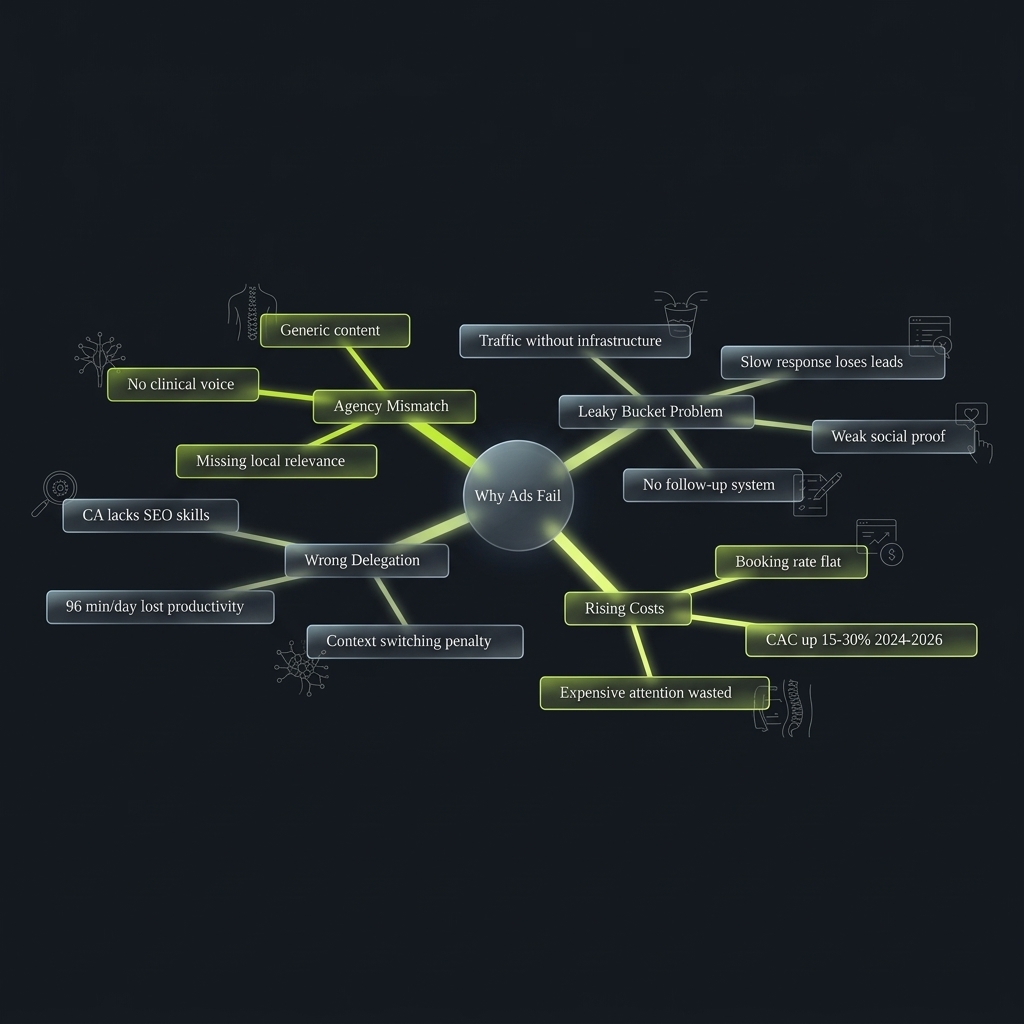
Why the Obvious Fixes Fail
You have already tried the obvious solutions. They did not work. Here is why.
The High-Ad-Spend Mirage
Pouring more money into Facebook Ads or Google PPC does not fix a leaky bucket. It forces more water through the same holes.
Healthcare ad costs climbed 15% to 30% between 2024 and 2026 for unchanged campaigns. Your Customer Acquisition Cost (CAC) rises while your booking rate stays flat. You spend more to acquire leads you still fail to convert.
The mechanism: ads generate traffic, but traffic without infrastructure converts poorly. You are buying expensive attention and then losing it to slow response times, weak social proof, and zero follow-up.
The Delegated-to-the-CA Trap
You asked your front-desk assistant to "post on Instagram" or "write a blog article." They tried for two weeks, then stopped.
This is not a motivation problem. It is a skillset mismatch.
Your CA was hired to handle patient check-ins, insurance verification, and scheduling. Writing Search Engine Optimization (SEO) content and managing a local SEO strategy are entirely separate jobs requiring entirely separate expertise.
A 2024 Slack survey of 2,000 U.S. small business owners found that they lose an average of 96 minutes of productivity daily. While context switching accounts for 17% of that lost time and waiting on siloed tools adds another 28%, the total includes non-work distractions (57%) and procrastination (47%). Asking one person to do three unrelated jobs guarantees all three get done poorly.
The Agency Disconnect
You hired a local SEO agency. They delivered dry, generic content that sounds like it was written by someone who has never adjusted a patient.
Because it was.
Generic agencies do not understand your specific techniques, your clinical philosophy, or your patient demographic. They produce technically correct content that fails to convert because it lacks clinical voice and local relevance.
Worse, they often do not understand healthcare advertising regulations. State chiropractic boards and HIPAA rules strictly govern what claims you can make online. A generic copywriter will happily write that you can "cure" migraines or "prevent" chronic disease, leaving you liable for regulatory fines and board investigations.
The risk is real, and generic agencies do not carry it.
What is the Leak-repair System in Marketing?
The leak-repair system in marketing is a structural approach that integrates four interconnected components: clinical authority through optimized content, instant automated responses to capture high-intent prospects, systematic review requests for social proof, and continuous nurturing communications. These elements operate as a self-reinforcing loop where each axis amplifies the others, creating compounding returns rather than relying on isolated tactics.
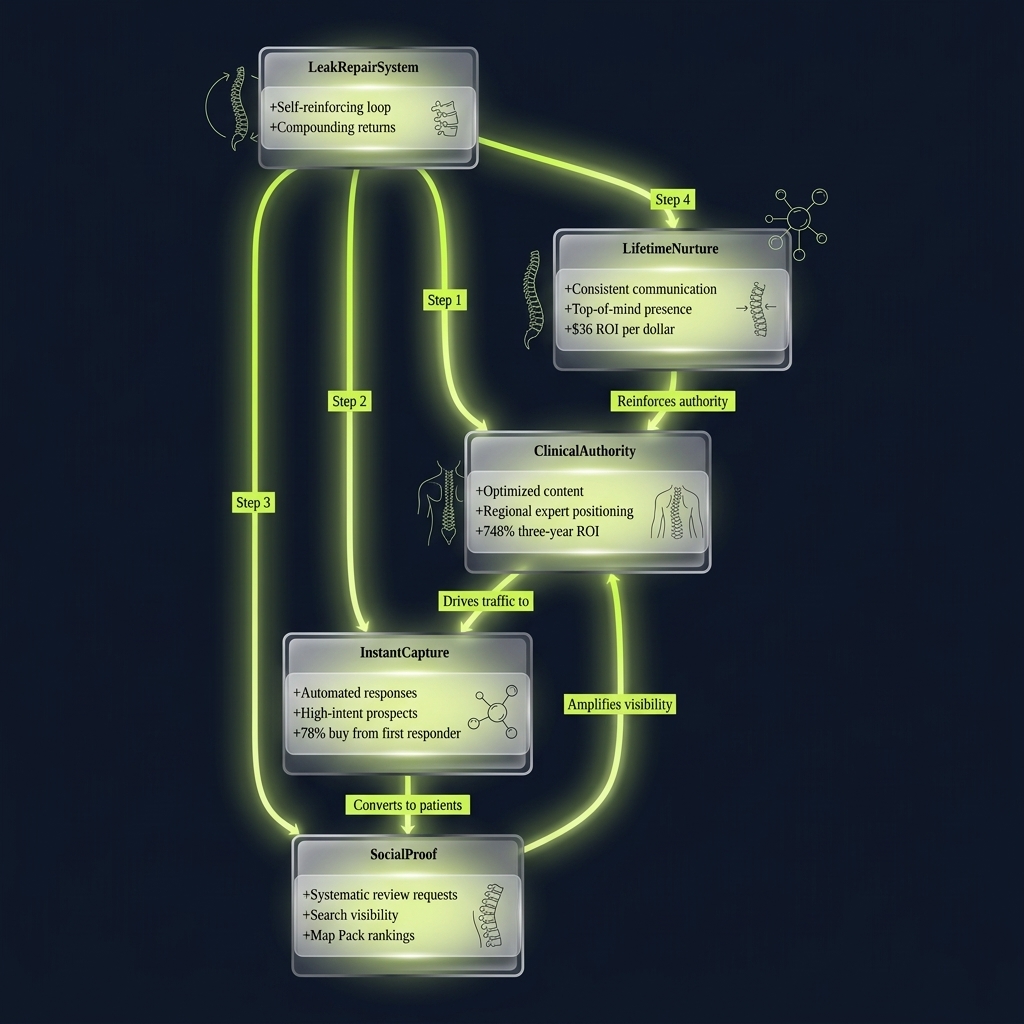
The Leak-Repair System
The solution is not more tactics. It is a system.
Marketing is not a slot machine where you insert coins and pray for a return. It is infrastructure. Repairing the four-axis leak is a structural fix that yields compounding returns.
The Integrated Loop
Isolated tactics do nothing. A standalone newsletter or an occasional social post generates no momentum.
What works is an ecosystem where search presence, immediate response, review momentum, and continuous nurturing operate as a single, self-reinforcing loop.
Here is the mechanism:
Step One: Clinical Authority. High-quality, locally optimized content establishes you as the regional expert. Prospective patients searching for sciatica relief or headache treatment find your articles, not your competitor's.
Organic marketing channels like SEO deliver a 748% three-year ROI, dramatically outperforming paid advertising. The content you publish today continues working for years.
Step Two: Instant Capture. Automated, immediate responses capture high-intent prospects the second they decide they need help. Seventy-eight percent of buyers purchase from the vendor who responds first.
Five minutes versus 30 minutes is the difference between booking and losing the patient.
Step Three: Social Proof. Frictionless, systematic review requests turn happy clinical outcomes into search-engine visibility. The top three local SEO priorities marketers track are Google Map Pack rankings, new leads, and organic rankings, all driven by review volume and recency.
Step Four: Lifetime Nurture. Consistent, valuable communication keeps your practice top-of-mind. Email marketing yields an average ROI of $36 for every $1 spent. Healthcare providers using segmented, triggered content see double-digit percentage increases in open rates year over year.
Each axis amplifies the others. Content drives traffic. Speed captures it. Reviews convert it. Nurture retains it.
The kinetic energy of a system that runs uninterrupted: lower acquisition costs, higher case values, and organic referral growth.
Why is Manual System Execution so Hard to Maintain?
Manual system execution demands 10 to 15 hours weekly for writing, publishing, tracking reviews, formatting emails, and monitoring responses. Since small business owners already work over 60 hours per week with 68.1% consumed by administrative tasks, every marketing hour diverts time from patient care, staff training, and personal life, making consistent execution unsustainable.
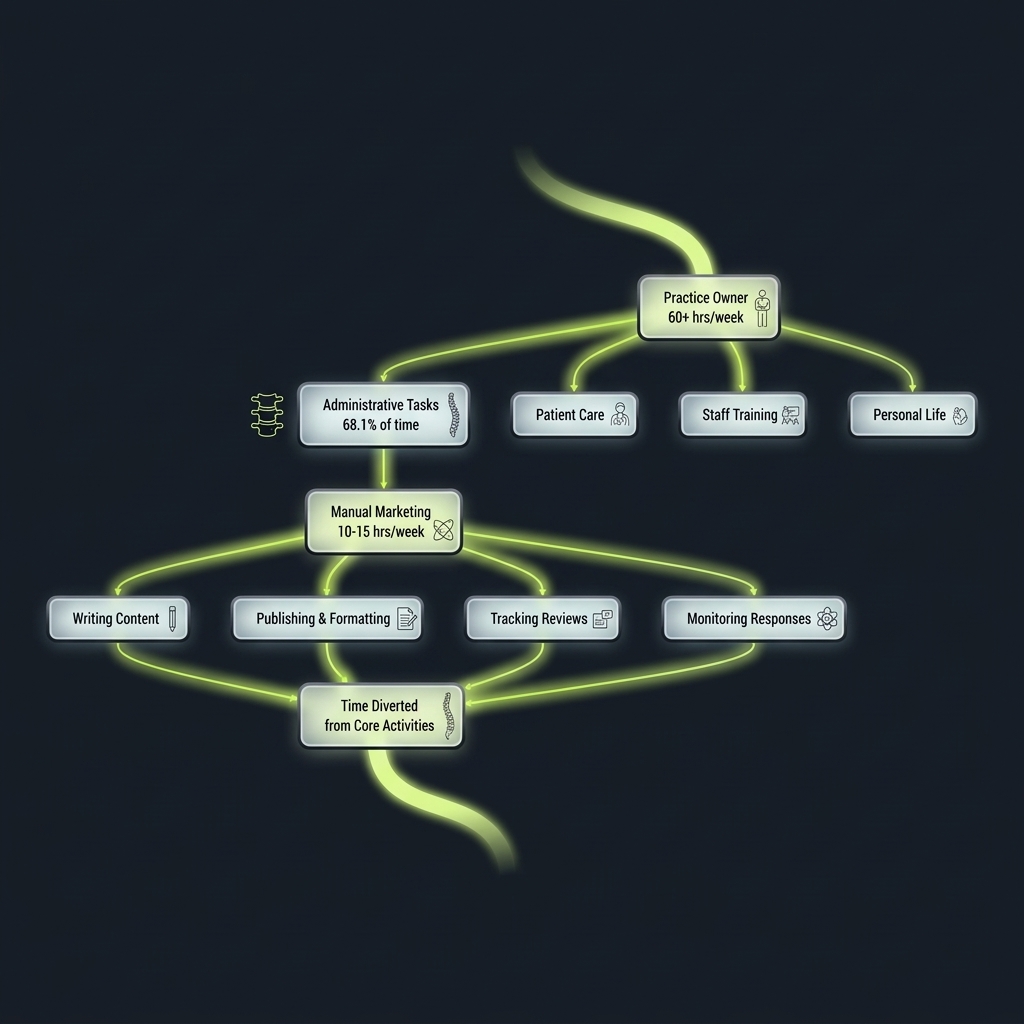
The Execution Wall
The system is correct. The math proves it. But building and maintaining this system manually is a second full-time job.
The Three-Minute Self-Audit
Before you fix anything, measure the leak.
Step One: Open Google Incognito. Search "[Your City] chiropractor." Note your Google Map Pack ranking and review count relative to the top three competitors.
Step Two: Check your website blog and social media pages. Write down the exact date of the last published piece of content.
Step Three: Submit a test inquiry through your website contact form on a Saturday afternoon. Note the exact time and date you receive a response.
Step Four: Pull your patient ledger for the last 90 days. Divide inactive patients by total active patients to calculate your true retention rate.
You now know your numbers. The value of this knowledge is immediate.
The cost of acting on it manually is 10 to 15 hours every single week: writing, publishing, tracking, prompting, chasing reviews, formatting emails, and monitoring responses.
Thirty-nine percent of small business owners already exceed 60 hours of work per week. Administrative and operational tasks consume 68.1% of their time. Every hour spent acting as a marketer is an hour lost adjusting patients, training staff, or spending time with family.
Why Generic AI Will Not Save You
The obvious shortcut is ChatGPT. Prompt it to write your blog posts and patient newsletters. Free, fast, done.
Except it is not.
Generic AI tools produce inconsistent, non-deterministic output. Every prompt requires editing, formatting, fact-checking, and publishing oversight. You trade writing time for supervision time, and the output still lacks your clinical voice.
Worse, nothing in ChatGPT ensures compliance with health-advertising regulations. It will confidently write that you can "cure" asthma, "prevent" ear infections, or "guarantee" pain relief - claims that violate state chiropractic board advertising rules and FTC requirements.
GPT-4 fabricates 18% of bibliographic citations in medical contexts. A 2026 global clinician survey found that 91.8% of clinicians had encountered medical AI hallucinations, and 84.7% believed they could directly cause patient harm if published without verification.
The risk is not theoretical. It is financial and regulatory.
You cannot outsource compliance to a tool that does not understand the rules.
How Do I Automate My Chiropractic Practice's Marketing?
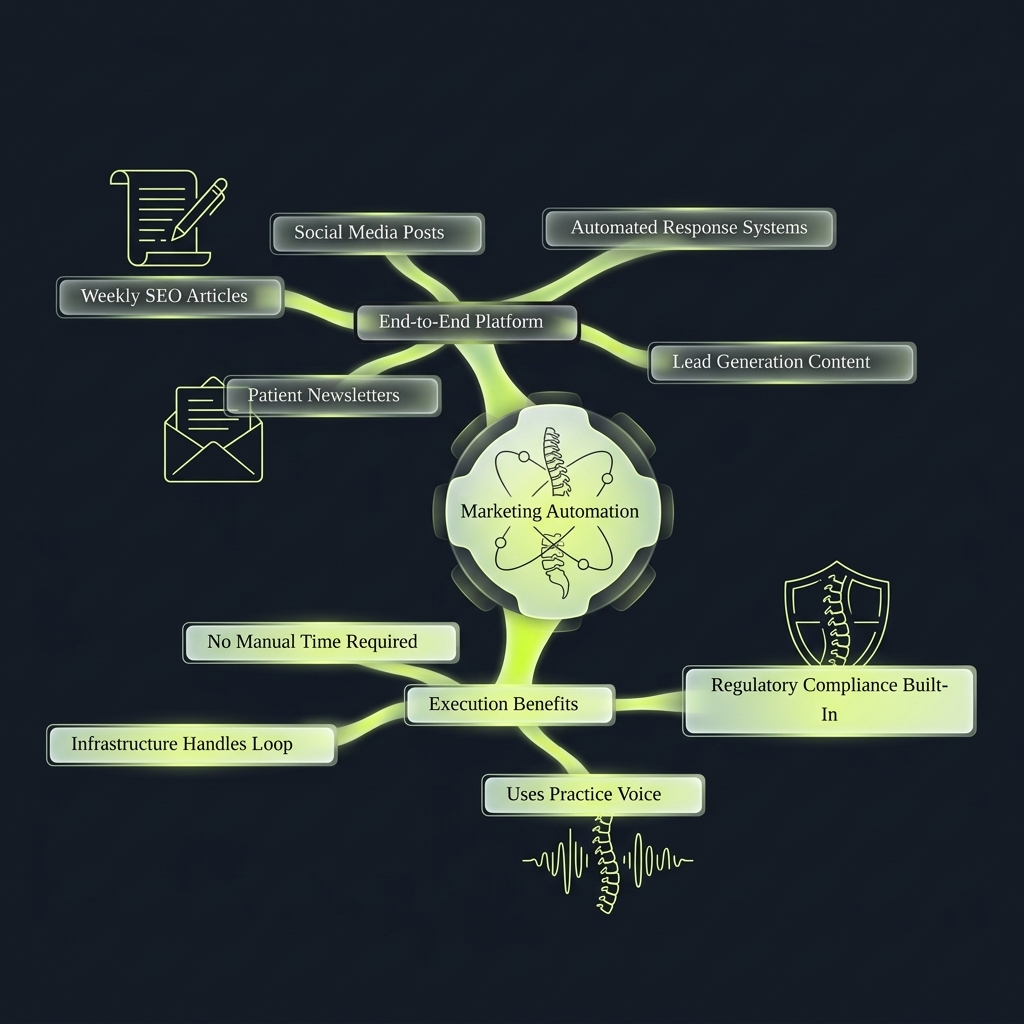
Chiropractic practices can automate marketing through end-to-end platforms that generate weekly SEO articles, social media posts, patient newsletters, and lead-generation content while maintaining regulatory compliance. These systems operate autonomously using the practice's voice, eliminating manual execution time. Purpose-built platforms like Omniply handle the complete marketing loop without requiring practitioners to become marketers themselves.
The Path Forward
The four-axis leak is real. The system to repair it is proven. But executing that system manually consumes time you do not have, and generic AI tools introduce compliance risk you cannot afford.
The alternative is a platform that operates the entire loop end-to-end: weekly SEO articles published to your site, social posts, patient newsletters, lead-generation content, and automated response systems, all generated from your practice's own voice and reviewed for regulatory compliance. Platforms like Omniply exist specifically to solve this execution problem for chiropractic practices, running the system that works without requiring the owner to become a marketer.
The math does not lie. The leak can cost you up to $39,000 per month. The system fixes it. The only question is whether you build it yourself or let infrastructure handle it.
A clinician's time is worth more than prompting ChatGPT at 11 PM on a Sunday.
Frequently Asked Questions
Can ChatGPT Write Patient Recall Emails?
It can generate text, but the output requires significant editing for tone, compliance, and personalization. Generic AI tools do not understand healthcare advertising regulations and will produce claims you are not legally allowed to make. Every email still requires manual review and formatting before sending.
What is a Good PVA for Chiropractors?
Patient Visit Average (PVA) varies by practice model and case mix. A wellness-focused practice might target 20 to 30 visits per patient annually, while an acute-care model might see 8 to 12. The key metric is trend: if your PVA is declining month-over-month, you have a retention problem.
How Many New Patients Should a Chiropractor Get?
Depends on practice size and capacity. A solo practitioner running at full clinical capacity might need 10 to 15 new patients per month to replace natural attrition. A multi-provider clinic scaling up might target 30 to 50. The real question is not volume but cost: if your CAC exceeds $700 per patient, your acquisition model is broken.
How to Improve Chiropractic Front Desk Booking Rates
Measure response time first. If your front desk cannot respond to online inquiries within five minutes, you lose 80% of potential bookings. Automate immediate acknowledgment, then train staff to follow up within the hour. Track booking rate by inquiry source to identify which channels convert best.
How to Track Chiropractic Patient PVA Manually
Pull your patient ledger for the last 90 days. Count total visits. Count unique active patients. Divide total visits by unique patients. That is your current PVA. Repeat monthly to identify trends. If PVA drops, audit your recall process and post-care communication.
Is Texting Patients HIPAA Compliant?
Yes, with the right safeguards. Routine messages like appointment reminders are standard practice, and texting is permitted when the patient has been informed of the risks and consents; use a HIPAA-compliant texting platform with encryption for anything more. Keep clinical details out of plain text messages unless your platform meets all HIPAA technical safeguards and a Business Associate Agreement is in place.